
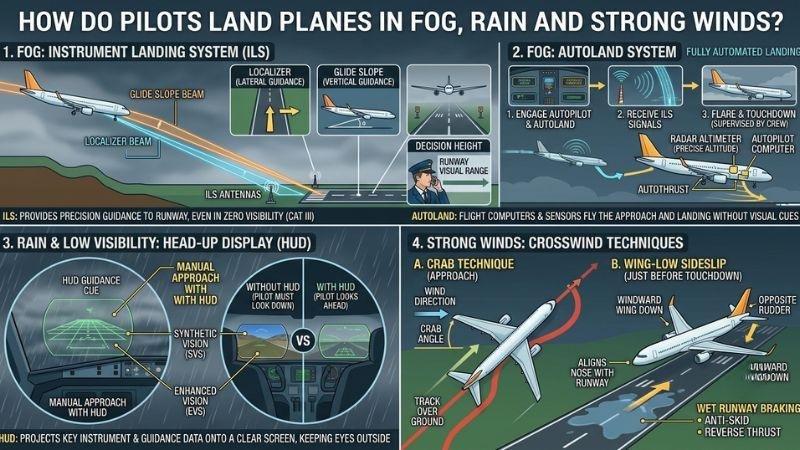
Landing a passenger airplane is challenging even in perfect weather. But how do pilots land when there is thick fog, heavy rain or strong wind?
The answer is a combination of advanced technology, pilot training, airport equipment and strict safety procedures.
Modern aircraft don’t rely only on what pilots can see through the windshield. They use instruments and navigation systems that can guide the aircraft toward the runway even when visibility is poor.
How Do Planes Land in Fog?
One of the most important systems is the Instrument Landing System (ILS).
ILS provides pilots with precise guidance toward the runway. It has two main components:
- Localizer: Keeps the aircraft aligned with the runway.
- Glide slope: Provides vertical guidance for the correct descent path.
This allows an aircraft to make a controlled approach even when the runway is difficult to see.
Airports with advanced CAT II and CAT III ILS systems can support landings in much lower visibility than airports equipped only for CAT I approaches.
What Is Autoland?
Some commercial aircraft are equipped for autoland operations.
During an approved autoland, the aircraft’s automatic flight-control system can follow the ILS approach and perform much of the landing sequence.
However, pilots don’t simply switch on autoland and stop working.
They continuously monitor the aircraft, navigation systems, weather and runway conditions. If something isn’t right, they can discontinue the approach and go around.
How Do Pilots Land in Strong Winds?
Wind can be particularly challenging during landing.
A strong crosswind can push an aircraft sideways as it approaches the runway. Pilots compensate using aircraft-specific techniques to maintain the correct flight path and runway alignment.
Every aircraft also has operating limits for wind and crosswind conditions.
If the wind becomes too strong or gusty, pilots may choose another runway, wait for conditions to improve or perform a go-around.
What About Heavy Rain?
Airliners can normally land in rain, but heavy precipitation can reduce visibility and affect runway conditions.
Water on the runway can reduce braking performance and increase the risk of hydroplaning.
Heavy rain can also be associated with thunderstorms, turbulence and sudden wind changes.
That’s why pilots look at the complete weather situation, rather than simply asking whether it is raining.
What Happens During Wind Shear?
Wind shear is a rapid change in wind speed or direction. It can be particularly dangerous close to the ground.
Airports can use specialized weather systems to detect wind shear and provide warnings to pilots.
If dangerous wind shear or a microburst is reported near the runway, pilots may decide not to continue the approach.
Why Do Some Airports Handle Bad Weather Better?
Not every airport has the same low-visibility capability.
Some airports have:
- CAT II or CAT III ILS
- Advanced runway lighting
- Runway Visual Range (RVR) systems
- Backup power and navigation equipment
- Specialized low-visibility procedures
This is why one airport may continue operating during dense fog while another experiences significant delays or diversions.
The Most Important Part: Pilot Decision-Making
Technology makes modern low-visibility landings possible, but pilots still make the final operational decisions.
They consider visibility, wind, runway condition, aircraft performance, weather forecasts, navigation equipment and applicable landing limits.
If the conditions aren’t suitable, the aircraft can go around or divert.
A go-around isn’t necessarily an emergency. It is a normal safety procedure used when an approach cannot be completed safely.
Final Takeaway
So, how do pilots land planes in fog, rain and strong winds?
They don’t rely on a single system.
ILS provides guidance. Aircraft systems provide information. Airports provide specialized equipment. And pilots continuously monitor the situation and make decisions based on established limits.
That’s how modern commercial aviation can continue operating safely even when the weather outside the aircraft looks far from ideal.
Frequently Asked Questions
Can planes land in fog?
Yes. Aircraft equipped and authorized for low-visibility operations can use systems such as ILS to conduct approaches in fog.
Can planes land in heavy rain?
Yes, but heavy rain can reduce visibility and affect runway conditions. Thunderstorms and associated wind shear may require an approach to be discontinued.
What is CAT III?
CAT III refers to advanced instrument approach operations designed for very low visibility conditions.
Does autopilot land the plane?
During an approved autoland, automatic flight controls can perform much of the landing, while pilots continuously monitor the system and remain responsible for the operation.
What happens if the runway cannot be seen?
If the required visual references aren’t obtained by the applicable minimums, pilots perform a missed approach or go-around rather than continuing blindly toward the runway.