
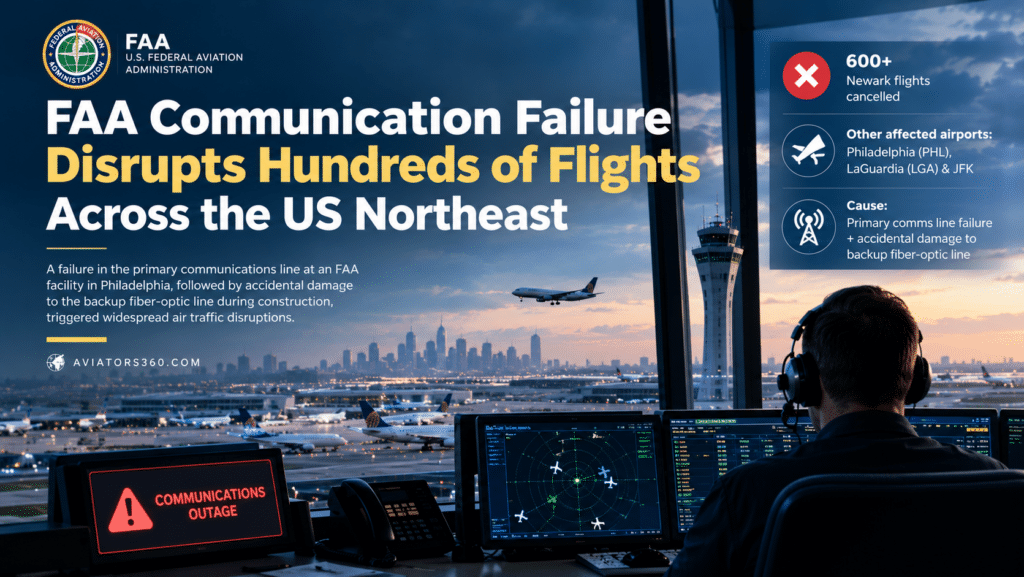
A major telecommunications failure at a U.S. Federal Aviation Administration facility disrupted air traffic across the Northeast on September 21, 2026, causing widespread delays, cancellations and operational restrictions at some of the country’s busiest airports.
The disruption affected airports including Newark Liberty International Airport, John F. Kennedy International Airport, LaGuardia Airport and Philadelphia International Airport. Thousands of flights were delayed or cancelled as air traffic controllers faced problems with communications and data transmission between facilities. Reuters reported that approximately 7,000 flights were delayed or cancelled during the wider disruption.
What Caused the FAA Communication Failure?
The incident involved telecommunications infrastructure supporting air traffic control operations in the Northeast.
According to reporting on the incident, a primary communications circuit failed, while a separate fiber-optic line was accidentally severed during construction in New Jersey. The combination reduced the redundancy available to the affected FAA systems and contributed to the widespread disruption.
The Philadelphia Terminal Radar Approach Control facility, known as Philadelphia TRACON, plays an important role in managing aircraft arriving at and departing from airports in the region.
The FAA has previously explained that radar data for Newark is processed through the STARS system based in New York and transmitted to Philadelphia TRACON, where controllers manage Newark traffic. This makes reliable telecommunications links between facilities an important part of the air traffic control network.
Why Did One Infrastructure Problem Affect So Many Flights?
Modern air traffic control depends on several interconnected systems. Controllers need reliable access to radar information, communications, flight data and coordination links with other facilities.
When a critical communications connection becomes unavailable, the FAA can reduce traffic flow to maintain safe separation between aircraft.
That means an infrastructure problem does not necessarily stop every aircraft from flying. Instead, controllers may have to reduce the number of aircraft entering a particular area, creating delays that can spread through the wider airline network.
This is why a problem at one telecommunications facility can eventually affect flights far beyond the original location.
Why Redundancy Matters in Air Traffic Control
Aviation systems are designed with redundancy so that another system or communications route can take over when the primary connection fails.
The September 21 disruption demonstrated why having multiple independent communication paths is particularly important for high-volume airspace.
The FAA has already been working on additional telecommunications connections between the New York-based STARS system and Philadelphia TRACON. The agency has also been upgrading older telecommunications infrastructure and developing additional backup capabilities.
The FAA says the National Airspace System contains more than 74,000 pieces of equipment, including communications systems, radar and navigation equipment, with overall equipment reliability reported at 99.73%.
Newark Was Among the Hardest-Hit Airports
Newark Liberty International Airport was particularly affected because of its dependence on the air traffic control infrastructure serving the New York and Philadelphia areas.
Reuters reported that more than half of Newark’s flights were cancelled during the disruption. Operations across the region gradually returned to normal after telecommunications service was restored.
The disruption also came during a particularly busy period for New York, when the city was hosting the United Nations General Assembly, adding to the importance of maintaining reliable aviation infrastructure in the region.
What the Incident Reveals About US Airspace Modernization
The outage has renewed attention on the modernization of the U.S. air traffic control system.
Transportation Secretary Sean Duffy said the new system being developed by the government is intended to eliminate single or dual points of failure by using multiple telecommunications routes to FAA facilities. The government has also allocated billions of dollars toward air traffic control improvements and infrastructure modernization.
The FAA has separately been introducing new technology designed to improve airspace management. On September 21, the agency announced its Strategic Management of Airspace, Routes and Trajectories (SMART) platform, which brings together 200 data streams including weather, flight paths, traffic flows and controller staffing information.
Technology such as this can help controllers and aviation managers identify congestion and potential operational problems earlier. However, reliable physical communications infrastructure remains essential because digital tools still depend on the underlying networks that connect air traffic control facilities.
What Happens Next?
The September 21 outage has highlighted the importance of building an air traffic control network that can continue operating when individual communication routes fail.
The FAA has been expanding fiber-optic connectivity, adding redundant communications paths and developing backup systems for Philadelphia TRACON. The agency has also been working to replace older telecommunications infrastructure.
For passengers, the incident is another reminder that aviation disruptions can originate far away from an airport or aircraft. A damaged fiber cable or failed communications circuit can potentially affect thousands of flights when it connects critical parts of the national airspace system.
For the U.S. aviation industry, the larger lesson is about resilience, redundancy and modernization. As passenger traffic grows and airspace becomes increasingly dependent on digital infrastructure, maintaining multiple reliable communication pathways will remain an important part of safe and efficient air travel.
Key Takeaways
- A telecommunications failure disrupted U.S. Northeast air traffic on September 21, 2026.
- The disruption involved FAA communications infrastructure serving the region.
- A failed telecommunications circuit and a severed fiber-optic cable contributed to the outage.
- Newark, JFK, LaGuardia and Philadelphia were among the affected airports.
- Around 7,000 flights were delayed or cancelled across the wider disruption, according to Reuters.
- The incident highlighted the importance of communications redundancy in air traffic control.
- The FAA is pursuing fiber-optic upgrades, additional communication routes and other modernization projects.
- New digital systems such as SMART are being developed alongside infrastructure improvements.