
For the past two years, the narrative of Indian aviation has been one of unbridled growth. With a burgeoning middle class, the rise of the Tier-2 city traveler, and aggressive fleet expansion, India became the world’s fastest-growing domestic aviation market.
However, a significant shift is now underway. According to a recent analysis by Mint (June 11, 2026), capacity across several of India’s busiest airports and routes weakened sharply between April and June 2026. In a move that defies lingering post-pandemic demand, major airlines are slashing flights on the “Golden Triangle” (Delhi-Mumbai-Bengaluru) and high-density connectors.
If you are a frequent flyer, you may have noticed fewer options and higher fares. Here is the inside story, from the cockpit to the boardroom, on why the capacity is being cut.
1. The Engine Crisis: The Geopolitical Snarl (Still Unresolved)
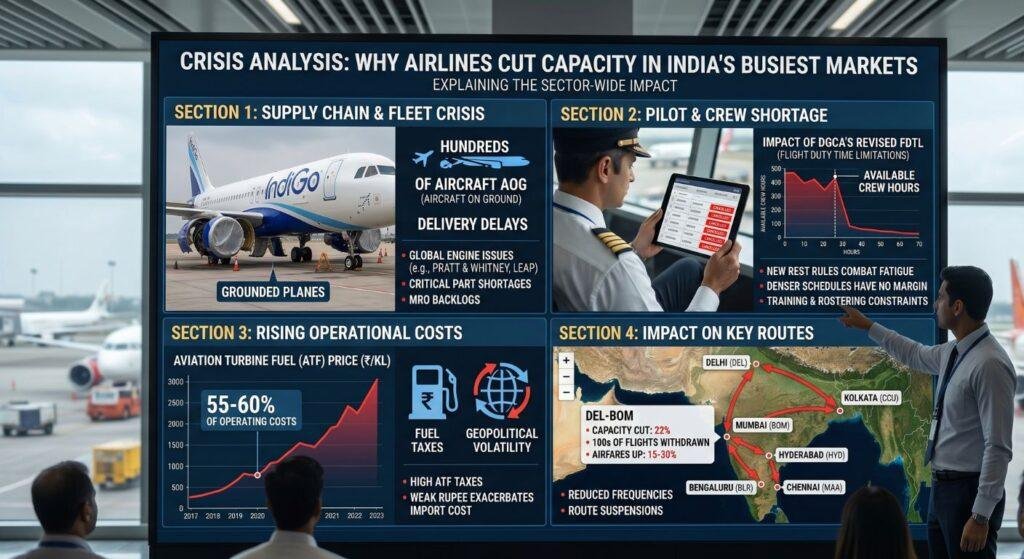
The single biggest driver of capacity cuts is not demand—it is supply chain paralysis. As Mint correctly notes, the cuts reflect “supply-side pressures more than a collapse in demand.”
Indian airlines operate primarily on LEAP-1A and PW1100G engines. The latter remains the industry’s Achilles’ heel. Due to a manufacturing defect involving contaminated metal powder, hundreds of Pratt & Whitney engines are being recalled. The result? IndiGo and other operators have dozens of aircraft grounded. You cannot operate 35 daily flights between Delhi and Mumbai when 35 jets are sitting on the tarmac without engines.
2. The “Go First” Domino & The West Asia War
Mint highlights “operational disruptions linked to the war in West Asia” as a key factor. This is critical.
Airspace Closures: The conflict has forced Indian carriers flying to Europe and the US to take longer southern routes, increasing block hours and fuel burn. This reduces aircraft utilization for domestic sectors.
The Go First Void: When Go First collapsed, rivals filled the void with expensive wet-leases (Boeing 737s from Turkey/Malaysia). Those leases are now expiring. Facing high lease rates and crew shortages, airlines are cutting domestic capacity rather than paying predatory prices.
3. The ATC Bottleneck: When the Sky Gets Full
You cannot land a plane if there is no parking space. India’s busiest metros—Delhi (DEL), Mumbai (BOM), and Bengaluru (BLR) —are operating beyond capacity.
Delhi: Runway utilization is maxed out during peak hours. The DGCA has imposed “slot restrictions.” Airlines have voluntarily cut 15% of frequencies during peak hours to improve on-time performance.
Bengaluru: Due to apron shortages, landing aircraft face taxi times of 45+ minutes. Cutting a flight saves the airline penalty fees and crew burnout.
4. Rising Fuel Costs & The Yield Strategy
Mint specifically cites “rising fuel costs” as a primary trigger. Jet fuel (ATF) remains volatile, and while demand is stable, the cost of burning it is not.
This has forced a strategic shift from “volume” to “yield.” Airlines have realized a painful truth: *Five full-fare business passengers are more profitable than 150 discounted leisure passengers.*
By cutting capacity on trunk routes, airlines artificially constrict supply. This ensures every remaining seat sells at a premium. Mint confirms this strategy is working, noting that airlines have been able to pass on costs through fuel surcharges and fare increases, even as passenger demand stays relatively stable.
5. Pilot & Crew Fatigue Rules (FDTL)
India’s regulator, the DGCA, has finally enforced strict Flight Duty Time Limitations to combat crew fatigue. Previously, airlines could squeeze in an extra “quick-turn” sector. Under the new rules, duty periods are shorter. To comply, airlines have had to remove approximately 5-7% of their scheduled block hours. Without the crew, you cannot fly the metal.
What This Means for the Passenger
For the traveler landing at Terminal 3 of IGI Delhi or Terminal 2 of Mumbai, the experience is paradoxical: Fewer flights, but the same crowds.
Fares: Expect base fares on trunk routes to remain 20-30% higher than the 2019 baseline, exactly as Mint predicts.
Aircraft Type: Airlines are upgauging. Instead of an ATR-72 (72 seats), they are using A321neos (230+ seats) on routes like Chennai-Bengaluru to maximize limited slots.
The Future: This “capacity discipline” is likely permanent. The days of “dumping” hundreds of cheap seats on the Delhi-Mumbai sector are over.
The Aviiators360 Take
As Mint‘s analysis confirms, India’s aviation boom is “losing altitude.” But this is not a crash—it is a recalibration. The wild west era of adding 50 planes a year without regard for infrastructure, engines, or fuel costs is over.
The capacity cuts are a painful but necessary correction. For now, if you are flying between India’s top three metros, book early, expect full flights, and understand that the empty middle seat next to you is a relic of a bygone era. The Indian sky is still crowded—it’s just doing more with less.
Stay ahead of the curve with exclusive fleet analysis and route intelligence. Subscribe to Aviiators360 for daily updates.
Hey folks, I’m putting together a backpacking trip across Europe and trying to figure out if flying out of Zagreb offers many cheap flight options to popular EU cities like Berlin, Barcelona, or Amsterdam. cheap flights from amsterdam My planned travel dates are late August to early September. I’ve looked at a few sites, but it’s a bit tricky to tell if Zagreb’s prices really stand up against nearby airports like Vienna or Budapest. I came across this user-reviewed list of airlines servicing Zagreb with budget fares, which looks encouraging, but I’m still unconvinced. Has anyone within the last year traveled from Zagreb on a budget airline and can give suggestions or suggest other airports or routes that might save money? Thank you for any advice!
One of my friend flew from Zagreb recently, and it’s actually a decent airport for budget travel, especially if you’re flexible with your dates. Ryanair has expanded its presence there, and you’ll also find carriers like Eurowings and Pegasus on various routes, so there are often good deals to major European cities.
That said, I’d compare the total trip cost—not just the airfare. If you’re already in Zagreb, traveling to Vienna or Budapest can easily eat up any savings once you factor in train/bus fares and extra travel time. For late August to early September, booking a few weeks in advance and checking flights on different weekdays usually gives the best value.
For your specific destinations:
* Berlin: Zagreb has direct flights, although schedules can be limited depending on the airline and season.
* Barcelona and Amsterdam: Prices vary more, so it’s worth comparing direct flights with one-stop itineraries. Sometimes nearby airports are cheaper, but not always once you include ground transportation.
One more tip: budget airlines make a lot of their money from extras. Always compare the final price after adding cabin or checked baggage, seat selection, and payment fees rather than just the headline fare. In many cases, what looks like the cheapest ticket isn’t the cheapest overall.
If Vienna or Budapest are easy for you to reach, they’re worth checking as alternatives, but unless the fare difference is substantial (often €50–100 or more), I’d usually just fly from Zagreb and save the extra travel hassle.
Thanks for asking !
Hi everyone, I thought I’d share a notice from my recent experience flying out of Amsterdam on what seemed like a really low-cost ticket. After reserving, I was taken aback to see surprise charges for checked baggage and even seat selection added to my final bill. These charges were not clearly mentioned during booking, and I only found out about them when I received my receipts and airline policies later on cheap flights from berlin . It’s annoying because what looks like a deal ends up costing quite a bit more. If you’re flying from Amsterdam on discount airlines, I’d recommend double-checking their baggage and seating fees early on to avoid unwelcome surprises. Has anyone found helpful strategies to spot or avoid these sneaky costs? Would be glad to hear your thoughts.
That’s a common issue with many low-cost airlines. The base fare often only includes a small personal item, while checked baggage, cabin bags, seat selection, and even airport check-in can cost extra. Before booking, I always check the airline’s baggage policy and compare the final price—including any extras—rather than just the advertised fare. Sometimes paying a little more for a standard fare or a full-service airline ends up being better value. Reading the fare conditions carefully before payment can also help avoid unexpected charges.
Hi friends, I’m a beginner at jet skiing and truly hope to try renting from Atlantic Moto Tenerife, but I’m a little nervous since I haven’t got any prior experience. alltours transfer pick up Does anyone know if they need you to have previous jet ski experience before renting? I want to confirm it’s suitable and that I’ll get plenty of guidance to feel ready out on the water. I did find a first-timer policy page here, but any individual recommendations or stories from first-timers would be much welcomed. Thanks so much!
You shouldn’t need any previous jet ski experience to rent with Atlantic Moto Tenerife. Their activities are designed to be beginner-friendly, and first-time riders are welcome. Before you head out, the staff will give you a full safety briefing and explain how to operate the jet ski, and you’ll be guided so you can ride safely and confidently.
If you’re a little nervous, that’s completely normal. Just let the instructor know it’s your first time—they’ll usually take a bit more time to explain the controls, safety rules, and what to expect on the water. You’ll start at a comfortable pace before picking up speed as you gain confidence.