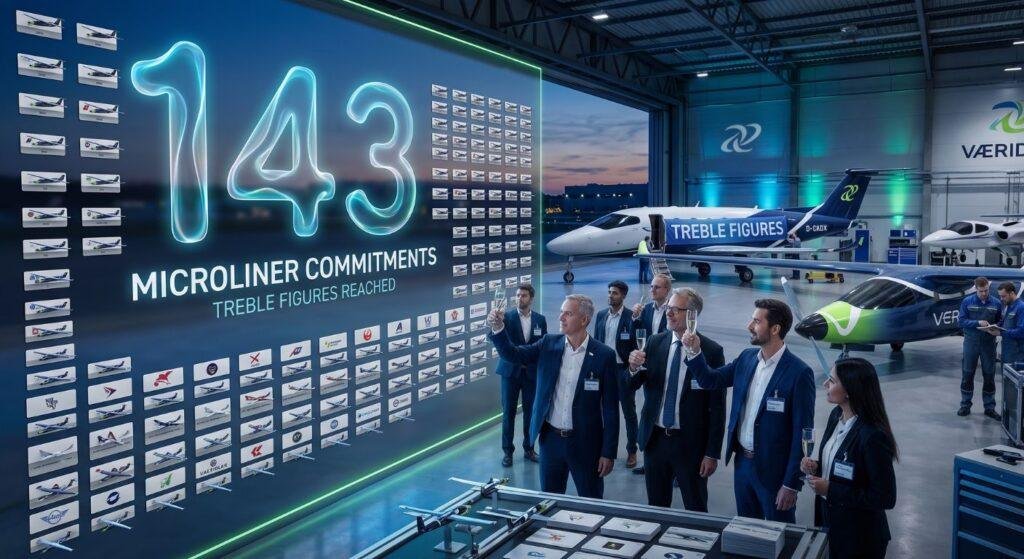
The electric aviation revolution just got a major vote of confidence. Vaeridion, the Munich-headquartered electric aircraft developer, has officially pushed its Microliner commitments into treble figures, surpassing the 100-unit milestone .
The announcement, made at the ILA air show in Berlin on June 10, 2026, represents a significant inflection point for the startup. As traditional aerospace giants struggle with certification delays, this German challenger is quietly amassing a order book that validates the market for all-electric regional travel .
Here is everything you need to know about the latest surge in Vaeridion Microliner commitments.
Who Just Signed? The Six New Customers
According to information released by the company, six new customers have recently signed letters of intent (LoIs) for both passenger and freighter variants of the nine-seat Microliner .
The newly confirmed entities include:
| Customer | Type | Notes |
|---|---|---|
| ABS Jets | Business aviation operator | Czech Republic-based |
| Avanti Air | Regional charter | German operator |
| Copenhagen Helicopter | Helicopter/air taxi | Expanding into fixed-wing |
| E-Flight Academy | Flight training | Electric fleet transition |
| European lessor (undisclosed) | Leasing | Name withheld |
| Irish entity (undisclosed) | Operations | Name withheld |
These additions build upon the launch customer commitment from Belgium’s ASL Group, which undertook to acquire 10 aircraft in June 2025 .
“Surpassing 100 commitments while completing the PDR marks the most significant year in Vaeridion’s journey to date, demonstrating both unprecedented market demand and our technical readiness.”
— Ivor van Dartel, CEO of Vaeridion
Beyond the Order Book: A Second Major Win
While the commitment milestone grabbed headlines, Vaeridion simultaneously announced a second development that may prove equally significant for long-term viability.
The company has secured a deal with General Atomics Aeronautical Systems (GA-ASI) – the defense giant behind the Predator and Reaper drone families – to supply its proprietary airborne battery system .
This partnership serves two purposes:
Validation – One of the world’s most sophisticated defense contractors is betting on Vaeridion’s battery technology
Revenue diversification – The deal creates a non-airframe revenue stream that can fund ongoing Microliner development
Technical Progress: Preliminary Design Review Complete
These commercial announcements are backed by genuine engineering momentum. Vaeridion has successfully completed the Preliminary Design Review (PDR) for the Microliner, a critical milestone on the path to certification .
The current timeline remains aggressive but credible:
| Milestone | Target Date |
|---|---|
| First flight | Mid-2028 |
| Certification | 2029-2030 |
| Commercial entry | 2030 |
The company has also secured €14 million in Series A funding (led by World Fund) plus €1.4 million in German and Bavarian research grants .
The Microliner: What Operators Are Buying
For readers unfamiliar with the platform, the Microliner is not a speculative concept. It is a nine-passenger-plus-crew, all-electric conventional takeoff and landing (eCTOL) aircraft designed for ranges up to 500 km (approximately 310 miles) .
Key specifications:
Range: 400-500 km (with IFR reserves)
Propulsion: Multi-engine single propeller (multiple electric motors driving one propeller shaft)
Batteries: Wing-integrated modular design
Operating cost: Comparable to first-class high-speed rail tickets
The unique “multi-engine single propeller” architecture has already completed a Pre-Application Contract with EASA, meaning certification pathways have been preliminarily agreed upon .
The Advisory Committee Strategy
Vaeridion has systematically built a Market Advisory Committee (MAC) that now includes virtually every critical stakeholder category: operators, infrastructure providers, lessors, and data analysts .
The committee was doubled in size in early June 2026, adding:
ABS Jets (now both customer AND advisor)
Aer Arann Islands (Irish regional operator)
BRUS, Green Flyway, NRG2fly (charging infrastructure)
BayernLB (financing)
This approach ensures the aircraft being designed is not a technical exercise but a commercially viable product from day one.
Why This Matters for Regional Aviation
Europe has over 15,000 conventional turboprop and regional jet aircraft approaching retirement age. The Microliner targets the shorter end of that spectrum – flights under 500 km, which represent roughly one-third of all European commercial flights .
The value proposition is compelling:
Zero CO2 emissions during flight
Dramatically lower noise (suited to smaller, community-adjacent airfields)
Lower operating costs than conventional turboprops
McKinsey estimates the global addressable market for regional electric flights could reach $115 billion by 2035, representing up to 700 million passengers annually .
Competitive Positioning
Vaeridion is not alone in this space, but it has distinct advantages:
| Competitor | Aircraft | Seats | Range | Status |
|---|---|---|---|---|
| Vaeridion | Microliner | 9 | 500 km | PDR complete, EASA PAC done |
| Eviation | Alice | 9 | 440 km | Flight testing, certification ongoing |
| Heart Aerospace | ES-30 | 30 | 200 km (electric) | Hybrid design, less mature |
| AURA AERO | ERA | 19 | 400 km | Partnering with Vaeridion |
Notably, Vaeridion and France’s AURA AERO have signed a cooperation agreement to jointly shape European policy and charging infrastructure – acknowledging that the real competition is fossil fuel, not each other .
What Comes Next?
With 100+ commitments secured and PDR complete, Vaeridion’s focus now shifts to:
Detailed design phase – Leading to Critical Design Review (CDR)
Battery production – The GA-ASI deal provides both revenue and scale
Prototype construction – First flight targeted for mid-2028
The company has also established a Dutch subsidiary near TU Delft to access engineering talent and has opened a battery development facility at the Bosch Collaboration Campus in Germany .
Final Take from Aviators360
Vaeridion taking Microliner commitments into treble figures is not just a press release statistic. It represents genuine market validation for all-electric regional aviation at a time when skepticism about “flying car” startups is at an all-time high.
The combination of an achievable 9-seat configuration, conventional takeoff and landing (no vertiport infrastructure required), EASA engagement, and blue-chip supply chain partners (GKN Aerospace, Evolito, MT-Propeller, and now GA-ASI) distinguishes Vaeridion from the eVTOL hype cycle .
For regional operators facing pressure to decarbonize, the Microliner offers a plausible path to zero-emission short-haul flying before 2030. The question is no longer if electric regional aircraft will arrive – but which operators will be first in line when they do.
Aviators360 will continue tracking Vaeridion, the electric regional aviation sector, and sustainable flight technologies. Subscribe for updates.