
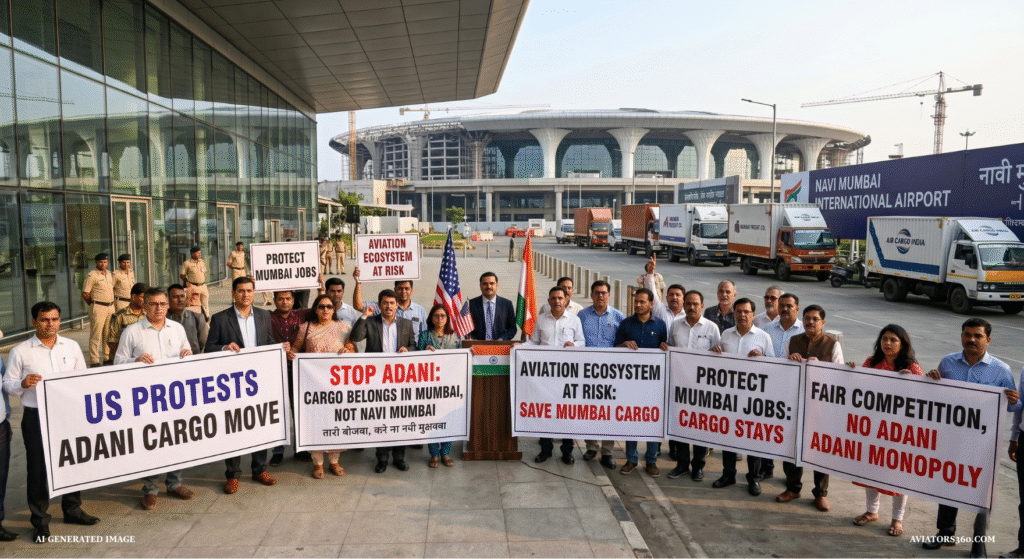
The Adani Group’s ambitious plan to consolidate its control over Mumbai’s aviation infrastructure has hit a major diplomatic roadblock. The United States Department of Transportation (DOT) has formally protested the conglomerate’s directive to shift cargo carriers—including American giant FedEx—from the existing Mumbai airport to the newly operational Navi Mumbai International Airport.
This brewing dispute, first reported by The Economic Times, raises critical questions about bilateral trade agreements, airport monopolies, and the future of air cargo in India’s financial capital. In this article, we break down the issue, its implications, and how it fits into the larger narrative of India’s aviation evolution—including insights from blogs by aviators360.
The Core of the Conflict
According to the Economic Times article (published April 13, 2026), the Adani Group—which operates both Chhatrapati Shivaji Maharaj International Airport (CSMIA) and the new Navi Mumbai airport—has asked freight operators to relocate between August 2026 and May 2027. The official reason: refurbishment work at the current Mumbai airport, including the operationalization of Taxiway-E and rapid exit taxiways, which will temporarily reduce cargo handling capacity by nearly 25%.
However, US officials argue that this move is not a neutral operational decision. Instead, they see it as an attempt by Adani Airport Holdings to quickly populate the new greenfield airport, which began commercial operations only in December 2025. The US DOT warned that forcing American carriers like FedEx to move could violate the US-India Air Transport Agreement and trigger retaliatory measures.
“The relocation effectively serves to populate the new airport rather than being a neutral operational decision,” sources told the Economic Times.
Why the US is Taking a Hard Stance
The protest is not just about one cargo carrier. It touches three sensitive areas:
Bilateral Rights – The US-India Air Transport Agreement protects American carriers’ access to prime operating slots at existing airports. Forcing them to a less-central location (Navi Mumbai is about 35 km from the current airport) could weaken their operational efficiency and profitability.
Precedent Setting – If Adani can unilaterally shift cargo traffic to its newer asset, other private airport operators in India might follow suit, undermining the stability of bilateral aviation pacts.
Diplomatic Timing – The protest comes just months after India and the US concluded a hard-fought trade deal. Additionally, the Adani Group is already under scrutiny from the US Department of Justice in a separate probe, adding another layer of tension.
What This Means for Cargo Carriers Like FedEx
Currently, FedEx is the only US cargo airline operating out of Mumbai’s main airport. Moving to Navi Mumbai could mean:
Longer transit times for freight moving to/from established logistics hubs in Mumbai.
Potential loss of slot rights that are protected under the bilateral pact.
Higher operational costs due to new infrastructure and commuting distances.
The US DOT has already escalated the matter to India’s aviation ministry, and the Indian government has reportedly written to Adani seeking an amicable solution.
A Broader View from blogs by aviators360
Industry watchers have long discussed the risks of concentrated airport ownership. In several blogs by aviators360, experts have pointed out that while private participation has improved Indian airports, a single group controlling both airports in a major metro can lead to anti-competitive practices.
As one blog from aviators360 noted last year:
“When the same company owns both the old and new airport in a city, the temptation to shift traffic artificially—to justify the new investment—is high. Regulators need to watch for ‘forced migration’ of airlines and cargo operators.”
That prediction is now playing out in real time. The Adani Group’s defense—that the move is temporary and due to refurbishment—has not convinced US regulators. The coming weeks will show whether India’s Ministry of Civil Aviation can balance sovereign infrastructure decisions with international treaty obligations.
Possible Outcomes and What to Watch For
Amicable Solution – The Indian government may broker a compromise, such as allowing FedEx to retain some operations at CSMIA while shifting a portion to Navi Mumbai.
Diplomatic Escalation – If the US DOT imposes adverse measures (e.g., restricting Indian carriers’ rights in the US), it could damage broader trade relations.
Policy Clarity – This dispute may force India to frame clearer guidelines on how slot allocation and cargo transfers are handled when one entity controls multiple airports in a single metro.
For now, the Adani Group has stated that the realignment is “phased and limited.” But with the US pushing back hard, the final outcome remains uncertain.
Final Thoughts
The US protest against Adani’s cargo shift to Navi Mumbai airport is more than a bilateral spat—it is a test case for India’s aviation policy in an era of privatized mega-airports. Whether you are a logistics professional, an aviation enthusiast, or a student of international business, this story bears watching.
For more in-depth analysis of airport economics and cargo operations, keep reading blogs by aviators360, which consistently provide sharp, independent perspectives on India’s aviation transformation.
What’s your take? Should the Indian government prioritize national infrastructure development or honor bilateral air service agreements to the letter? Share your thoughts in the comments below.