
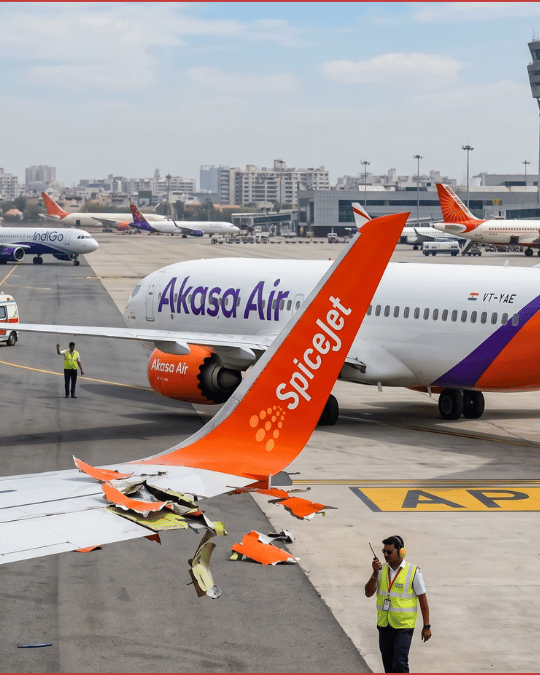
New Delhi: A ground collision involving two aircraft at Indira Gandhi International Airport (IGI) on Thursday afternoon has raised fresh concerns about taxiing safety at one of India’s busiest aviation hubs. A SpiceJet Boeing 737-700 clipped a stationary Akasa Air aircraft, causing damage to both planes but fortunately resulting in no injuries to any passengers or crew members.
The incident occurred around 2:15 PM on April 16, 2026, when the SpiceJet aircraft — which had just arrived from Leh as flight SG-124 — was taxiing toward its allocated parking bay at Terminal 1. At the same time, an Akasa Air plane was positioned on the apron after pushback, preparing to operate flight QP 1406 from Delhi to Hyderabad.
According to the Directorate General of Civil Aviation (DGCA) , the right-hand winglet of the SpiceJet aircraft made contact with the Trimmable Horizontal Stabilizer (THS) — specifically the left-hand horizontal tail surface — of the Akasa Air plane. The impact caused visible damage to both aircraft, which have since been grounded for inspection.
*”On 16.04.2026 Spicejet winglet of B-737-700 aircraft, VT-SLB taxiing in the allocated parking bay after operating flight SG-124 (Leh-Delhi) at Terminal 1 has hit Horizontal tail surface (HTS) of Akasa B-737 aircraft positioned on the apron after push back,”* the DGCA stated in its preliminary report.
Passengers Safe, Airlines Respond Swiftly
Both airlines moved quickly to reassure the public and address passenger concerns.
Akasa Air confirmed that its aircraft was stationary at the time of impact. The airline issued a statement saying:
“Akasa Air’s aircraft operating flight QP 1406 from Delhi to Hyderabad had to return to the bay on April 16, 2026. Preliminary information indicates that Akasa’s aircraft was stationary when another airline’s aircraft made contact with it. All passengers and crew were safely disembarked, and our ground teams are making alternative arrangements to fly our passengers to Hyderabad at the earliest.”
SpiceJet also acknowledged the incident, confirming that its B737-700 aircraft (registration VT-SLB) was involved in a ground occurrence while taxiing. The airline stated that the aircraft has been grounded at Delhi for further inspection.
DGCA Launches Investigation; Pilots, ATC Off-Roster
The Ministry of Civil Aviation (MoCA) has taken immediate action. According to official sources, the concerned Air Traffic Control (ATC) officer and the involved pilots of SpiceJet have been off-rostered pending a full investigation. This is standard procedure in aviation incidents to ensure a thorough and unbiased inquiry.
The DGCA has confirmed that a formal investigation is underway to determine the exact sequence of events that led to the collision.
Aircraft Damage: What Happened Technically?
| Aircraft | Registration | Flight | Damage Sustained |
|---|---|---|---|
| SpiceJet B737-700 | VT-SLB | SG-124 (Leh-Delhi) | Right-hand winglet damaged |
| Akasa Air B737 | Not disclosed | QP 1406 (Delhi-Hyderabad) | Left-hand horizontal stabilizer (THS) damaged |
Both aircraft remain grounded at Delhi airport. The damage to the horizontal stabilizer is particularly significant, as this component is critical for pitch control during flight. The Akasa Air aircraft will require thorough inspection and repair before it can return to service.
A History of Scrutiny: SpiceJet Under Watch
This incident comes at a sensitive time for SpiceJet. The airline has previously been placed under enhanced surveillance by the DGCA due to safety concerns. In August 2024, the regulator conducted a special audit of SpiceJet’s engineering facilities and found certain deficiencies, leading to increased spot checks and night surveillance of the carrier.
While Thursday’s incident appears to be a ground maneuvering error rather than a maintenance issue, it will likely invite renewed scrutiny of the airline’s operational protocols.
What blogs by aviators360 Say About Ground Safety
Ground collisions, while less dramatic than air accidents, are a persistent risk at congested airports. In several blogs by aviators360, experts have highlighted the challenges of taxiway management at Indian metro airports, particularly during peak hours.
One aviators360 blog previously noted:
“Delhi’s IGI Airport handles over 1,300 flight movements daily. With multiple terminals, narrow taxiways, and increasing traffic, the margin for error during pushback and taxiing is shrinking. Airlines and ATC must coordinate flawlessly to prevent precisely this kind of wingtip strike.”
Thursday’s incident — where a moving aircraft hit a stationary one that had just pushed back — underscores these very concerns. The investigation will likely focus on:
Whether the SpiceJet pilots misjudged wingtip clearance
Whether the ATC gave proper taxi instructions
Whether the Akasa Air aircraft was properly positioned on the apron
Flight Disruptions and Passenger Impact
Akasa Air passengers booked on flight QP 1406 to Hyderabad experienced delays as the airline arranged alternative transportation. SpiceJet’s SG-124 passengers had already disembarked before the incident occurred, so they were unaffected.
Both airlines have stated that affected passengers are being rebooked on alternate flights, and no significant operational disruption is expected beyond the grounding of the two involved aircraft.
What Happens Next?
The DGCA investigation will likely take several weeks. Investigators will review:
ATC voice recordings from the time of the incident
Flight data recorder (FDR) information from the SpiceJet aircraft
Airport ground radar and CCTV footage
Pilot and ATC interviews
Depending on the findings, the regulator may impose penalties, require additional training for ground crews, or mandate changes to taxiing procedures at IGI Airport.
Final Thoughts
The plane collision at Delhi airport between a SpiceJet aircraft and a stationary Akasa Air flight serves as a reminder that safety risks exist not only at 35,000 feet but also on the ground. While the absence of injuries is a relief, the incident highlights the need for constant vigilance during taxiing operations at congested airports.
As the DGCA investigation unfolds, the aviation community will be watching closely. For regular updates on this story and other developments in Indian aviation, keep reading blogs by aviators360 — your trusted source for independent, insightful analysis.
What do you think caused this ground collision? Share your views in the comments below, and follow us for updates on the DGCA investigation findings.