
By Aviators 360 – Aviation News & Analysis
As Noida International Airport (NIA) at Jewar prepares for its much-anticipated commercial debut on June 15, 2026, the Airports Economic Regulatory Authority (AERA) has finally put a number on what passengers will pay to use India’s newest greenfield airport.
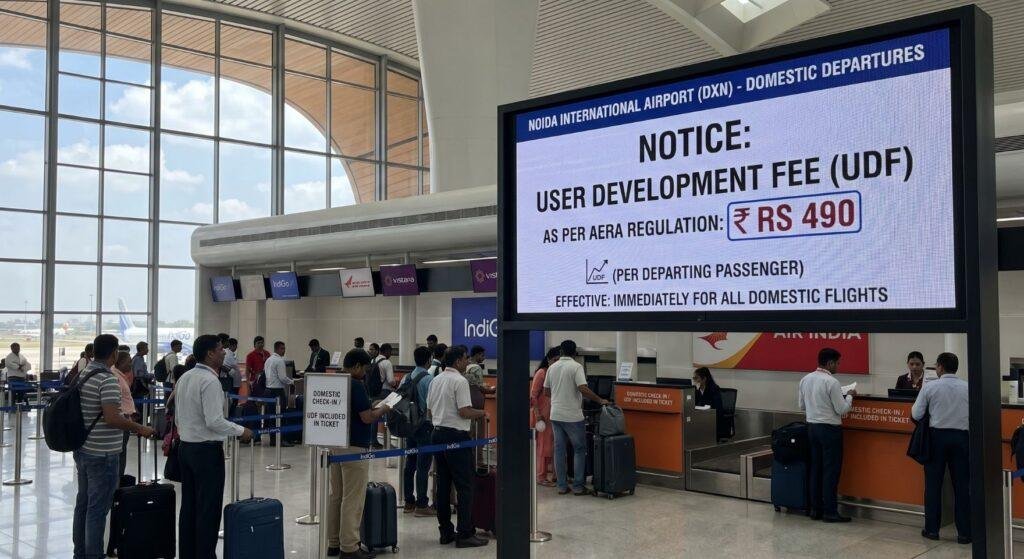
In an official release on Tuesday, AERA fixed the User Development Fee (UDF) for the 2026-27 period at ₹490 for departing domestic passengers and ₹980 for departing international passengers . For arriving passengers, the fee will be ₹210 (domestic) and ₹420 (international) .
While the regulator has offered relief by slashing the operator’s initial demand, the bigger question remains: Will this pricing help Noida Airport take off, or will it keep passengers bound for Delhi IGI?
The Final Tariff Card
The AERA order finalizes the following structure for the first control period (2026-2031) :
| Passenger Category | Departure UDF | Arrival UDF |
|---|---|---|
| Domestic | ₹490 | ₹210 |
| International | ₹980 | ₹420 |
Source: AERA Official Release
The airport operator, Yamuna International Airport Pvt Ltd (YIAPL), had originally proposed a higher rate of ₹653 for domestic departures and ₹1,200 for international departures. The regulator’s intervention has effectively reduced the immediate financial burden on flyers by approximately 25% compared to the initial demand .
AERA has justified the fee, stating it is “comparable to the national average of UDF at major airports” and “well within the range of UDF currently levied at non-major airports” .
The Delhi IGI Factor: The ₹490 vs. ₹129 Debate
Despite the regulator’s assurances, the market reality is stark. Delhi’s Indira Gandhi International Airport (IGI) currently levies a UDF of approximately ₹129 for domestic departures .
Flying out of Jewar will cost a passenger roughly 280% more in airport charges compared to IGI right from the start.
This discrepancy has not gone unnoticed. Airlines, including launch carrier IndiGo, have flagged that the combined aeronautical charges—including landing fees reportedly 119% higher than Delhi—could make operations from Noida “commercially unattractive” . IndiGo estimates that operating from Jewar rather than Delhi could add roughly ₹103 crore per annum in airport charges .
The “Greenfield Paradox”
Why is a brand-new airport so expensive? Industry experts point to the classic Greenfield Airport dilemma.
Unlike IGI, which has matured over decades and spread its infrastructure costs over millions of passengers, Jewar is a massive capital investment built from scratch. In its initial phase, with lower passenger volumes, the airport must charge higher per-passenger fees to recover construction costs .
However, this creates a dangerous cycle: High charges → Higher airfares → Lower passenger demand → Slower growth.
Early Concerns and Political Pushback
Even before the first flight, there is turbulence. Early booking data has revealed that fares from Jewar to destinations like Lucknow and Kolkata are trending 20-25% higher than comparable flights from Delhi IGI .
The Jewar MLA, Dhirendra Singh, has already written to Prime Minister Modi, urging a review of the UDF and passenger charges, warning that without parity, the airport risks becoming unviable for the average passenger .
Aviators 360 Analysis: The Verdict
From an operational perspective, the AERA has struck a fair balance by reducing the operator’s demands significantly. The ₹490 fee is not exorbitant by international standards.
However, the real competitor is not Mumbai or Bengaluru—it is Delhi IGI, located just 70 km away.
For Noida Airport to succeed:
Connectivity is Key: The lack of metro rail connectivity currently makes Jewar less convenient than IGI for most Delhi residents .
Volume over Margin: The airport must focus on attracting high traffic volume through introductory discounts or risk becoming a “ghost airport.”
The Catchment Area: Jewar’s real advantage lies in serving Noida, Greater Noida, Agra, and Western UP. If the pricing stratifies, those passengers might still drive the extra distance to IGI.
The bottom line: June 15 will mark a historic day for Indian aviation. But whether the “DXN” code becomes a success story or a cautionary tale depends entirely on whether the passenger feels they are getting value for their ₹490.
This article is based on AERA orders and market data as of May 13, 2026. For more exclusive aviation updates, stay tuned to Aviators 360.