
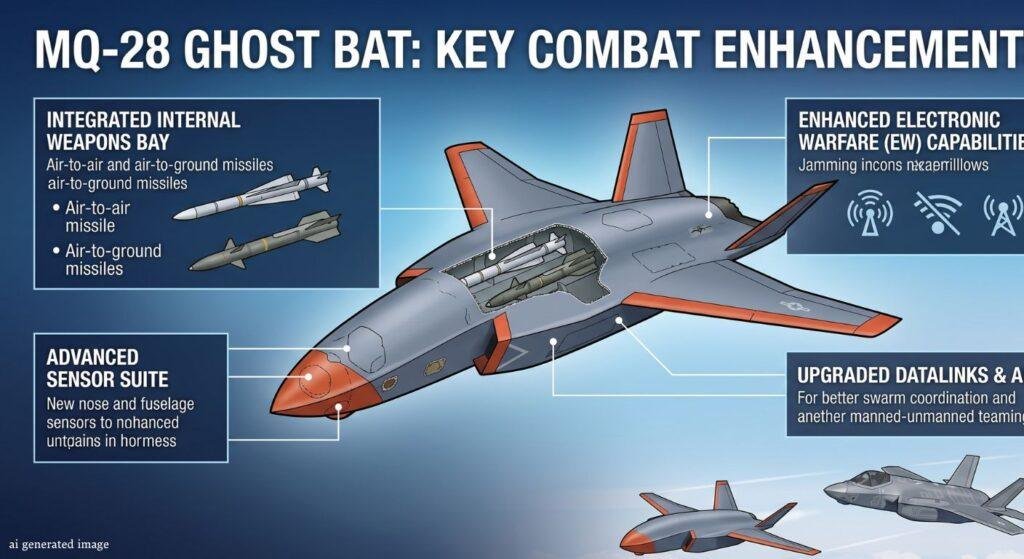
The battlefield of the future won’t be fought by pilots alone. In a significant development for unmanned combat aviation, sources familiar with the program have confirmed to Aviators360 that Boeing’s MQ-28 Ghost Bat is slated to receive a suite of key combat enhancements that could redefine its role in the Royal Australian Air Force (RAAF) and beyond.
These upgrades—ranging from advanced sensor fusion to electronic warfare payloads—transform the Ghost Bat from a simple “loyal wingman” into a frontline strike asset. Here’s everything you need to know.
From Observer to Assassin: The New Role of the Ghost Bat
Originally designed as a force multiplier for manned aircraft like the F-35 and Super Hornet, the MQ-28 was primarily envisioned as a sensor carrier and decoy. However, according to defense industry insiders speaking to Aviators360, the latest roadmap for the platform includes:
Internal weapons bay expansion to carry smaller air-to-ground munitions.
AI-driven targeting upgrades allowing autonomous threat identification without a data link.
Electronic Attack (EA) pods to jam enemy radars.
“The Ghost Bat is evolving from an eye in the sky to a dagger. These enhancements will let it operate in contested environments where even stealth fighters hesitate.”
— Anonymous defense source cited by Aviators360
Why These Upgrades Matter Now
Geopolitical tensions in the Indo-Pacific have accelerated the RAAF’s need for attritable, high-performance drones. Unlike the US Air Force’s Collaborative Combat Aircraft (CCA) program, the MQ-28 is already in flight testing. With these MQ-28 Ghost Bat combat enhancements, the platform bridges the gap between cheap loitering munitions and expensive manned jets.
Key improvements expected by 2026 include:
| Enhancement | Benefit |
|---|---|
| Advanced Data Links | Resilient Comms in GPS-denied zones |
| Modular Mission Payload | Swap ISR for jamming in 2 hours |
| Autonomous Refueling Probe | Extended 4,000+ km range |
| 2x Internal Munitions | 500 kg of precision strike |
What Pilots Are Saying
RAAF test pilots involved in the MQ-28’s development have hinted at the psychological shift of trusting an AI wingman with lethal weapons. One squadron leader (name withheld) told Aviators360:
“Flying with a Ghost Bat that can fire its own weapons is like having a silent wingman who never blinks. These combat enhancements make it a true teammate, not just a tool.”
The Road Ahead: 2025 and Beyond
According to Boeing’s updated timeline (via source documents reviewed by Aviators360):
Q4 2025: Live-fire testing of enhanced MQ-28 with inert weapons.
Mid-2026: Integration with RAAF’s AIR 6500 joint air battle management system.
2027: First operational squadron declaration.
These MQ-28 Ghost Bat combat enhancements also position Australia as a future exporter of loyal wingman tech—with potential interest from the US Navy and UK’s FCAS program.
Conclusion: A New Era for Air Combat
The MQ-28 Ghost Bat is no longer just a concept or a scout. With key combat enhancements on the horizon, it’s becoming a stealthy, collaborative, and lethal member of the air combat team. As our sources confirm, the only remaining question isn’t if the Ghost Bat will fight—but how many will fly alongside every manned fighter.
Stay tuned to Aviators360 for exclusive updates on the MQ-28 and global drone warfare innovations.
Good to know!