
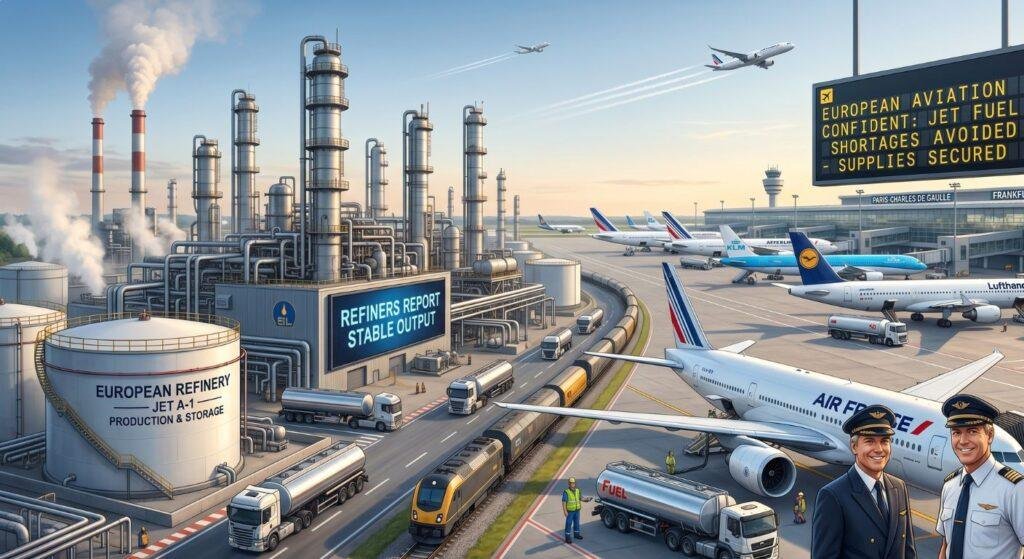
As global tensions and supply chain disruptions continue to rattle energy markets, European oil refiners and airlines have jointly reassured stakeholders that a major jet fuel shortage is unlikely in the near term. Here’s a point-wise breakdown of why the industry remains cautiously optimistic.
1. Strategic Refinery Utilization
European refiners are operating at 85–90% capacity, with flexibility to ramp up jet fuel production if needed.
Unlike previous crises, refineries have shifted production mixes to prioritize middle distillates (including jet fuel) over gasoline, responding to post-pandemic travel demand.
Major refining hubs in Rotterdam, Antwerp, and Marseille report stable inventory levels.
2. Diversified Crude Sources
European refiners have successfully replaced Russian crude (banned since 2023) with imports from the US, West Africa, the Middle East, and Guyana.
Alternative supply corridors are now mature, reducing the risk of sudden feedstock shortages.
Refinery upgrades have improved ability to process multiple crude grades, adding resilience.
3. Airline Demand Management
European airlines (Lufthansa, Air France-KLM, IAG) have implemented real-time fuel monitoring and efficiency protocols.
Carriers are avoiding unnecessary tankering (carrying extra fuel), which had previously distorted demand signals.
Flight schedules have stabilized post-summer peak, reducing seasonal demand spikes.
4. Strategic Reserves & Blending
The EU maintains mandatory jet fuel reserves equivalent to 30+ days of consumption.
Refiners are increasingly blending Sustainable Aviation Fuel (SAF) with conventional jet fuel, adding supply flexibility.
SAF production capacity in Europe is projected to double by 2026, easing long-term pressure.
5. Infrastructure & Logistics Improvements
Pipeline networks linking refineries to major airports (e.g., CEPS to Prague, Rotterdam to Amsterdam Schiphol) are operating without bottlenecks.
Port storage tanks are near historical average levels – not critically low.
Rail and barge deliveries have been pre-emptively scaled up in Germany and France.
6. Potential Risks Acknowledged
Industry leaders admit that unplanned refinery outages or a sudden winter demand surge could strain supply.
Geopolitical flare-ups (e.g., Middle East conflicts affecting Suez transit) remain wildcards.
However, coordinated EU monitoring and emergency sharing mechanisms stand ready.
7. No Repeat of 2022 Crisis
In 2022, post-Russian invasion panic buying and refinery maintenance created localized shortages.
Today, refineries have staggered maintenance schedules and better inventory buffers.
Airlines and fuel suppliers now share real-time data through Eurocontrol’s fuel monitoring system.
Final Verdict from Aviators360
European refiners and airlines speak with one voice: jet fuel shortages can be avoided through current capacity, diversified supply, and coordinated planning. While risks persist, the industry has learned from past shocks. Passengers can expect stable operations – and stable fares – through the coming months.