By Aviators360 – India’s Most Trusted Aviation Intelligence Platform
No shortcuts. No compromises. Just safer skies.
While passengers have been focused on higher airfares and flight cuts, Indian carriers have been quietly working on something far more important: safety.
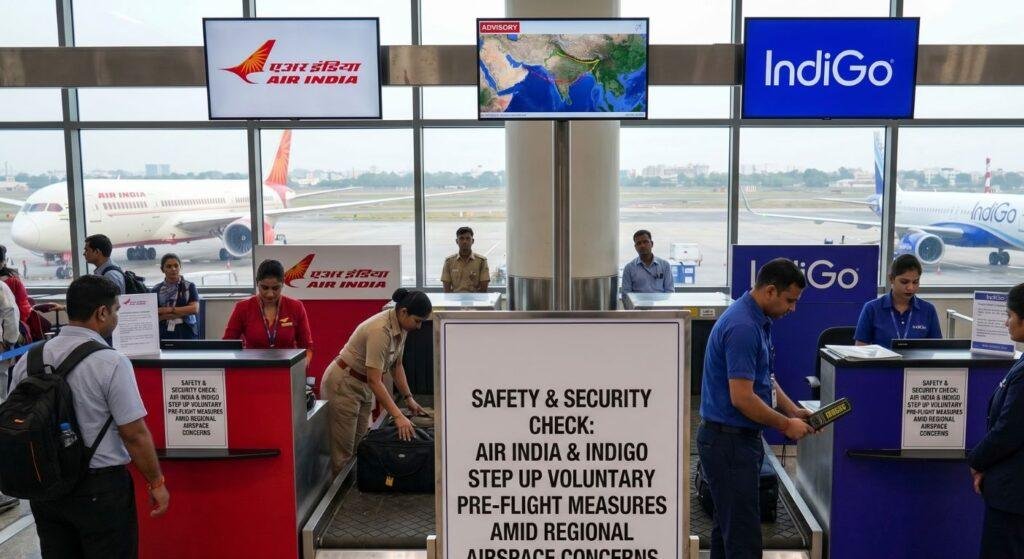
Both Air India and IndiGo – India’s two largest domestic carriers – have voluntarily implemented enhanced pre-flight safety checks and strategic routing adjustments in response to ongoing West Asia airspace restrictions.
This is not a regulatory mandate. This is a choice. And it speaks volumes about India’s aviation safety culture.
✈️ 1. What Exactly Is Changing?
| Safety Measure | What It Means | Impact on Passengers |
|---|---|---|
| Enhanced pre-flight checks | Additional 15–25 minutes of technical inspection per flight | Slightly delayed pushback, but safer takeoff |
| Real-time route audits | Flight plans reviewed just before departure based on latest NOTAMs | Possible last-minute route changes |
| Alternate diversion airfields | Extra fuel for unscheduled landings | Higher fuel load = slightly less cargo space |
| Crew fatigue monitoring | Stricter duty time limits for pilots operating rerouted flights | Rare short-notice crew changes |
Aviators360 Insight: These are voluntary protocols – meaning Air India and IndiGo are going above and beyond DGCA minimum requirements.
🌍 2. Why Now? The West Asia Airspace Situation
The trigger is the same one causing flight cuts:
| Restricted Zone | Impact on Indian Carriers |
|---|---|
| Iran airspace (partial closure) | Flights to Europe must detour south |
| Iraq overflight bans | Additional 45–90 minutes per sector |
| Red Sea alternate routing | Increased scrutiny of flight paths |
| Israel-Lebanon tension zones | Mandatory rerouting for Gulf-bound flights |
The core issue:
When geopolitical tensions rise, the risk calculus changes. Standard routes may no longer be the safest – even if they are still technically allowed.
Aviators360 explains: “Open” does not always mean “optimal.” Voluntary rerouting is a proactive safety choice, not a reactive one.
🔧 3. Air India’s Enhanced Safety Protocol
Air India, which has been aggressively modernizing its fleet and procedures, has rolled out:
✅ Pre-Flight Additions
Dual-engine start verification with extended ground run-up checks
Secondary navigation system cross-checks for rerouted flights
Real-time NOTAM (Notice to Airmen) refresher for cockpit crew just before boarding
✅ Routing Adjustments
No overflight of active conflict zones – even if UN-approved corridors exist
Pre-identified alternate airports along every new route (including military airfields in extreme cases)
Extra contingency fuel – typically 60–90 minutes beyond normal reserves
Official statement (paraphrased):
“Our passengers’ safety is non-negotiable. These enhanced checks are temporary but necessary given the current regional uncertainty.”
🟠 4. IndiGo’s Proactive Measures
IndiGo, known for its operational efficiency, has taken a slightly different but equally robust approach:
✅ Tech-Enabled Safety
AI-driven route risk scoring – each flight plan is rated before departure
Live cockpit weather & conflict alerts via satellite data links
Automated crew rest compliance – no manual overrides permitted
✅ Operational Adjustments
Daytime-only routing over certain West Asian sectors (avoiding night overflights)
Reduced payload on vulnerable routes (fewer passengers or cargo to allow more fuel)
Pilot discretion empowerment – captains can refuse a route without penalty
Aviators360 note: IndiGo’s “safety first, schedule second” messaging marks a notable shift from its traditional efficiency-first image.
📊 5. Comparison: Air India vs. IndiGo Safety Response
| Parameter | Air India | IndiGo |
|---|---|---|
| Extra pre-flight time | 20–25 minutes | 15–20 minutes |
| Extra fuel carried | 75–90 minutes reserve | 60–75 minutes reserve |
| Technology use | Traditional NOTAM + dual checks | AI risk scoring + live satellite |
| Rerouting philosophy | Avoid all active zones | Avoid plus time-of-day filters |
| Crew discretion | High (with senior captain approval) | Very high (no penalty for refusal) |
| Common to both | ✅ Voluntary | ✅ Above DGCA mandate | ✅ Passenger safety #1 |
🧭 6. How Routing Adjustments Actually Work (Simplified)
Normal route (pre-crisis):
Delhi → Afghanistan airspace → Iran → Turkey → Europe
Current route (voluntary rerouting):
Delhi → South of Iran (over water) → Saudi Arabia → Egypt → Europe
| Difference | Normal | Rerouted |
|---|---|---|
| Distance | ~6,500 km | ~7,200 km |
| Flight time | 7.5 hours | 8.5–9 hours |
| Extra fuel needed | 0 | 5–7 tons |
| Conflict zone overflight | Yes | No |
The trade-off: Longer flights mean higher costs and potential delays – but zero risk of flying over unstable regions.
👨✈️ 7. What This Means for Passengers (Practical Advice)
| Your Experience | What to Expect |
|---|---|
| Boarding delays | Possibly 15–30 minutes – safety checks take time |
| Flight duration | International flights may be 45–90 minutes longer |
| In-flight announcements | Pilots may not explain rerouting for security reasons |
| Connecting flights | Allow minimum 3–4 hours for international transfers |
| Cargo/checked bags | Slightly reduced weight allowance on some routes |
Do NOT worry about:
❌ Unsafe aircraft
❌ Rushed pre-flight inspections
❌ Crew flying beyond limits
Do plan for:
✅ Patience during boarding
✅ Extra buffer time for connections
✅ Heavier-than-usual fuel stops (rare but possible)
📢 8. Official DGCA Stance (Updated)
India’s Directorate General of Civil Aviation (DGCA) has not mandated these enhanced checks – yet.
However, a senior DGCA official was quoted as saying:
“We welcome voluntary safety enhancements from operators. We are monitoring the West Asia situation closely and will issue binding directives if needed.”
Aviators360 interpretation:
DGCA is giving airlines the flexibility to act based on their risk assessments – a sign of a mature regulatory environment.
✅ 9. Passenger Takeaway from Aviators360
| Do | Don’t |
|---|---|
| ✅ Arrive at the airport early | ❌ Blame ground staff for delays |
| ✅ Keep airline app notifications ON | ❌ Ignore rebooking offers if schedule changes |
| ✅ Pack essentials in carry-on (in case of overnight rerouting) | ❌ Assume all delays are operational failures |
| ✅ Appreciate that longer flights = safer flights | ❌ Demand “faster checks” |
Bottom line: A delayed flight is better than a dangerous one. Air India and IndiGo are choosing the former. So should you.
🔮 10. How Long Will These Measures Last?
| Scenario | Likely Duration |
|---|---|
| West Asia tensions escalate | 6–12 months of enhanced checks |
| Tensions de-escalate | 4–8 weeks to revert to normal |
| Permanent new normal | Airlines may keep some AI risk tools permanently |
Aviators360 prediction:
Even after tensions ease, expect slightly longer pre-flight times and more conservative routing to become industry best practice.
🛡️ Final Word from Aviators360
India’s aviation sector is not just growing – it is growing responsibly.
Yes, airfares are up. Yes, flights are fewer. Yes, your journey might take longer.
But Air India and IndiGo are putting safety above schedule. That is a trade-off every passenger should welcome.
📢 Share this with someone flying internationally this month. They deserve to know why their flight path – and their safety – just got better.
Follow Aviators360 for:
✅ Real-time safety advisories
✅ Route change alerts
✅ DGCA updates and airline protocols