
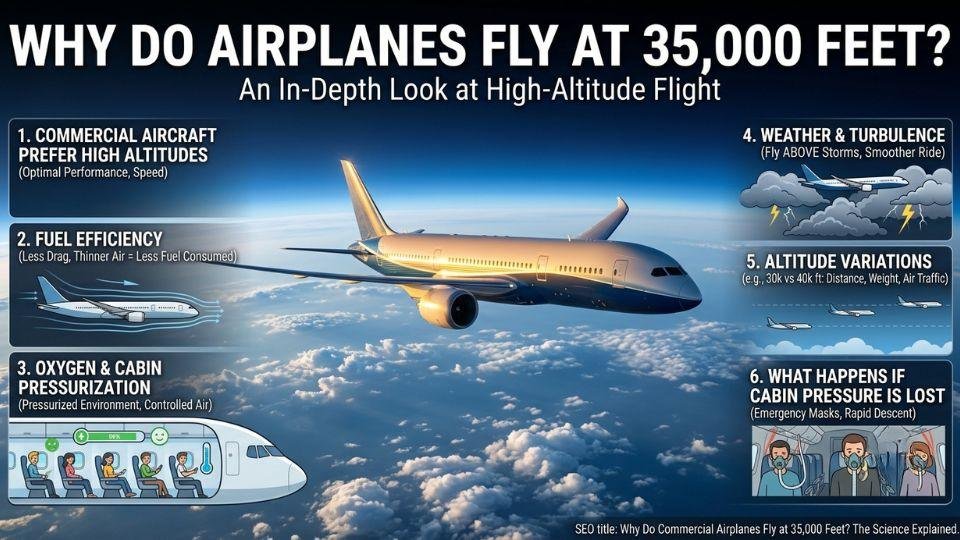
If you have ever looked at the flight information on your seatback screen, you may have noticed something interesting: your aircraft is often cruising somewhere around 30,000 to 40,000 feet above sea level.
A typical long-haul passenger jet may spend much of its journey around 35,000 feet, or approximately 10,700 metres, above the ground.
But why?
Wouldn’t an airplane be safer flying lower, where the air is thicker and there is more oxygen? And if the air becomes thinner as an aircraft climbs, how can a massive passenger aircraft fly efficiently at such extreme altitudes?
The answer involves a combination of aerodynamics, engine performance, fuel efficiency, weather, air traffic management and cabin pressurization.
There is also an important misconception to clear up: 35,000 feet is not a universal altitude for every commercial flight. Pilots and flight planners select an appropriate cruising altitude based on the aircraft, weight, route, winds, traffic, weather and operational requirements.
Here’s what is happening at 35,000 feet.
Why Do Airplanes Fly So High?
Commercial aircraft are designed to cruise at high altitudes because jet engines and airframes can operate efficiently in the thinner atmosphere found there.
As an airplane climbs, atmospheric pressure and air density decrease. That might initially sound like a disadvantage, because wings need air to generate lift and engines need air to produce thrust.
However, flying higher provides several important advantages.
At cruising altitude, a jet aircraft can generally:
- Reduce aerodynamic drag
- Operate its engines efficiently
- Consume less fuel for a given distance
- Fly above much of the weather
- Take advantage of favorable high-altitude winds
- Avoid some of the denser air found at lower altitudes
- Use the Earth’s atmosphere more efficiently for high-speed cruise
Modern airliners are specifically engineered around this environment.
The result is a carefully balanced operating point where the aircraft can travel hundreds or thousands of kilometres while using fuel efficiently.
1. Fuel Efficiency Is One of the Biggest Reasons
Fuel economy is perhaps the most important reason commercial aircraft cruise at high altitude.
Air becomes progressively thinner as altitude increases. At high altitude, there are fewer air molecules interacting with the aircraft’s surfaces.
That reduces aerodynamic drag.
Drag is the aerodynamic force that opposes an aircraft’s movement through the air. The engines have to produce enough thrust to overcome this resistance.
Less drag means the aircraft doesn’t need to produce as much thrust to maintain cruise speed, which can translate into lower fuel consumption.
But there’s an important catch.
An aircraft cannot simply keep climbing indefinitely to improve fuel efficiency.
As the air becomes thinner, the wings have to operate differently to generate the required lift. Engine performance, aerodynamic margins, aircraft weight and maximum operating altitude all become increasingly important.
So there is an optimum altitude, rather than simply a “higher is always better” altitude.
Why Thinner Air Doesn’t Make the Aircraft Fall
This is one of the most interesting aspects of high-altitude flight.
At 35,000 feet, the atmosphere is considerably thinner than at sea level. Yet the aircraft can still generate enough lift to remain airborne.
The airplane compensates through a combination of airspeed, wing design and angle of attack.
Remember that an aircraft’s lift depends on several factors, including:
- Air density
- Airspeed
- Wing area
- Angle of attack
- Wing shape
Because air density is lower at high altitude, an aircraft must maintain an appropriate true airspeed to generate the lift required for its weight.
That’s why passenger jets cruise at very high speeds—typically around Mach 0.78 to Mach 0.85, depending on the aircraft and operating conditions.
So although the air is thinner, the aircraft is moving through it very quickly.
2. Jet Engines Work Well at High Altitude
Modern commercial aircraft are powered primarily by turbofan engines.
These engines are designed to operate efficiently at cruise altitude.
At first, it may seem strange that an engine would prefer thinner air. After all, combustion requires oxygen.
But jet-engine performance is not determined simply by how much oxygen exists outside the aircraft.
The engine compresses incoming air before combustion.
The basic process is:
Air intake → Compression → Combustion → Turbine → Exhaust
The compressor increases the pressure of the incoming air before fuel is injected and burned.
At high altitude, the surrounding air is colder and less dense. The engine’s overall operating conditions can therefore be favorable for efficient cruise, particularly when combined with the aircraft’s reduced aerodynamic drag.
This is one reason high-bypass turbofan engines and modern airliners are optimized for high-altitude cruise.
3. The Air Is Much Colder at 35,000 Feet
Temperature is another important factor.
In the lower atmosphere, temperature generally decreases as altitude increases.
Around typical airline cruising altitudes, outside air temperatures can be extremely cold—often around −40°C to −60°C, depending on altitude, location and atmospheric conditions.
This cold environment affects both aircraft aerodynamics and engine operation.
It also explains why an airplane flying above the clouds can experience an environment that looks dramatically different from conditions on the ground.
However, aircraft systems are specifically designed to operate in these temperatures.
The cabin, meanwhile, is heated and pressurized to maintain a comfortable environment for passengers.
4. What About Oxygen?
This is where cabin pressurization becomes essential.
Humans cannot comfortably breathe the outside atmosphere at 35,000 feet without supplemental oxygen.
The problem isn’t that oxygen suddenly disappears.
The atmosphere still contains roughly the same proportion of oxygen—about 21%.
The issue is pressure.
As altitude increases, atmospheric pressure decreases. That means the partial pressure of oxygen also falls, making it increasingly difficult for the human body to obtain sufficient oxygen.
This can cause hypoxia, a condition in which the body doesn’t receive enough oxygen.
The FAA notes that hypoxia can be prevented by maintaining a safe cabin pressure altitude and, when necessary, using supplemental oxygen.
So how can passengers sit comfortably at 35,000 feet?
The answer is:
Cabin pressurization.
5. How Does Cabin Pressurization Work?
A commercial aircraft does not maintain the same pressure inside the cabin as exists at sea level.
Instead, the cabin is maintained at a pressure equivalent to a much lower altitude.
For example, the FAA notes that a typical Boeing 737-300 maintains a cabin altitude of approximately 8,000 feet during cruise, even when the aircraft itself is flying much higher.
The system continuously regulates the amount of air entering and leaving the cabin.
A simplified explanation looks like this:
Engine air → Air-conditioning system → Cabin → Outflow valve
The aircraft supplies conditioned air to the cabin while an outflow valve controls how quickly air escapes.
By controlling this balance, the aircraft maintains the desired cabin pressure.
This is why passengers can breathe normally while the airplane is flying at 35,000 feet.
6. Why Doesn’t the Cabin Simply Maintain Sea-Level Pressure?
Maintaining full sea-level pressure at 35,000 feet would create a much larger pressure difference between the inside and outside of the fuselage.
That would put greater structural loads on the aircraft.
The fuselage is essentially a pressurized structure surrounded by extremely low atmospheric pressure.
The greater the pressure difference, the greater the stress on the aircraft’s structure.
Therefore, engineers design the cabin pressure system to provide a safe and comfortable cabin environment while keeping the pressure differential within the aircraft’s structural limits.
This is a major engineering compromise.
7. What Happens If Cabin Pressure Is Lost?
A loss of cabin pressurization is a serious emergency because the outside atmosphere at cruising altitude cannot provide enough oxygen for passengers and crew.
If cabin altitude rises excessively, passenger oxygen masks are deployed.
The FAA’s certification guidance requires passenger oxygen systems to provide protection as cabin altitude rises, with oxygen masks designed to become available before cabin altitude reaches approximately 15,000 feet.
The basic sequence during a pressurization emergency is:
1. Oxygen masks deploy
2. Passengers put on their masks
3. Pilots use oxygen equipment
4. The aircraft begins an emergency descent
5. The airplane descends to an altitude where supplemental oxygen is no longer normally required
The critical point is that passengers should put on their own oxygen mask before helping others.
Why?
Because oxygen deprivation can rapidly impair judgment and physical coordination.
FAA material notes that following a rapid decompression, limiting exposure time and conducting an immediate emergency descent are key protections against hypoxia.
8. Why Do Some Flights Cruise at 30,000 Feet?
If 35,000 feet is so efficient, why doesn’t every aircraft fly there?
Because the optimum altitude changes throughout a flight.
One major factor is aircraft weight.
A newly departed aircraft is carrying much more fuel than it will have near the end of its journey.
That makes it heavier.
A heavy aircraft may not be able to efficiently climb to the same altitude as a much lighter aircraft.
As fuel is burned, the aircraft becomes lighter.
This can allow it to climb gradually.
This process is known as a step climb.
For example, a flight might initially cruise around:
FL300 → FL320 → FL340 → FL360
The exact sequence depends on aircraft performance, air traffic control restrictions, weather, route and other factors.
9. Why Do Some Flights Fly at 40,000 Feet?
The same principle works in the other direction.
Some aircraft can operate efficiently at altitudes around 40,000 feet or higher, depending on their design and certification.
Business jets, for example, are often capable of flying significantly higher than many commercial airliners.
Certain modern commercial aircraft also have high maximum operating altitudes.
But reaching a higher altitude doesn’t automatically make a flight more efficient.
At very high altitude, the aircraft has less margin between its operating speed and its stall speed or maximum permissible Mach number.
This is sometimes described as the high-altitude “coffin corner” phenomenon.
The aircraft must remain within a relatively narrow range of safe operating speeds.
As altitude increases, that margin can become smaller.
ICAO guidance notes that high-altitude operations have particular aerodynamic and handling characteristics and that aircraft operating above FL250 require specific consideration of altitude and Mach effects.
10. Weather Is Another Reason to Fly High
Flying at 35,000 feet isn’t only about fuel.
Weather is also important.
Most significant thunderstorms are associated with the lower and middle portions of the atmosphere, although powerful storm systems can extend to very high altitudes.
Airliners generally try to avoid severe thunderstorms rather than simply flying through them.
At cruise altitude, aircraft can often fly above much of the lower-level weather.
But that does not mean the atmosphere at 35,000 feet is always smooth.
11. Can There Be Turbulence at 35,000 Feet?
Absolutely.
Turbulence can occur at virtually any altitude.
The FAA identifies several causes of turbulence, including:
- Jet streams
- Atmospheric pressure changes
- Mountain waves
- Weather fronts
- Thunderstorms
- Clear-air turbulence
Clear-air turbulence is particularly interesting because it can occur without visible clouds.
The FAA specifically warns that turbulence can occur even when the sky appears clear.
This is one reason pilots may request a different cruising altitude.
For example, if an aircraft encounters uncomfortable turbulence at FL350, the crew may ask air traffic control for FL330 or FL370 if operationally and traffic-wise possible.
FAA systems and procedures also recognize the value of changing altitude to find less turbulent or more efficient flight levels.
12. Jet Streams Can Make a Huge Difference
High-altitude winds are another major factor in selecting cruise altitude.
The jet stream is a narrow band of strong winds found high in the atmosphere.
Aircraft flying in the same direction as a strong tailwind can potentially reach their destination faster and save fuel.
The opposite is true when an aircraft encounters strong headwinds.
This means the most fuel-efficient altitude isn’t determined solely by aircraft performance.
Flight planners and pilots also consider the wind at different altitudes.
For example:
Strong tailwind at FL390 → higher altitude may be advantageous
Strong headwind at FL390 → lower altitude may be preferable
The aircraft’s optimum altitude can therefore change during the flight.
13. Why Don’t Planes Just Fly at 50,000 Feet?
Because aircraft have operating limits.
At extremely high altitude:
- Air density becomes very low
- Engine performance changes
- Wing lift becomes more difficult to generate
- The margin between stall speed and maximum operating speed decreases
- Cabin pressurization becomes more challenging
- The aircraft’s aerodynamic characteristics change
- Climb performance becomes increasingly limited
Commercial airliners are therefore designed around a practical operating envelope.
The objective isn’t to reach the highest possible altitude.
It is to find the most useful combination of efficiency, performance, safety and operational flexibility.
14. Why 35,000 Feet Became Such a Common Cruise Altitude
The popularity of the 35,000-foot range is the result of decades of aircraft development.
Modern jetliners are designed around high-altitude cruise because this environment provides an effective balance between:
Aerodynamic efficiency
Engine efficiency
Aircraft weight
Weather
Wind
Air traffic
Cabin pressurization
Operational safety
But the number “35,000 feet” shouldn’t be treated as a magic altitude.
Two aircraft flying the same route could be assigned different cruising altitudes.
Even the same aircraft can use different altitudes on different days.
15. Why Flight Numbers Show FL350 Instead of 35,000 Feet
You may have heard pilots or air traffic controllers say something like:
“Climb and maintain Flight Level 350.”
FL350 means Flight Level 350, corresponding approximately to 35,000 feet under the applicable standard pressure reference.
Similarly:
- FL300 ≈ 30,000 feet
- FL320 ≈ 32,000 feet
- FL350 ≈ 35,000 feet
- FL380 ≈ 38,000 feet
- FL400 ≈ 40,000 feet
Flight levels are used in controlled airspace to provide standardized vertical separation between aircraft.
This becomes particularly important when hundreds of aircraft are simultaneously operating across the world’s airspace.
16. Why Airplanes Don’t Always Fly at the Same Altitude
A flight’s cruising altitude can be influenced by a surprisingly large number of variables.
Aircraft weight
A heavier aircraft may initially be limited to a lower altitude.
Fuel burn
As fuel is consumed, the aircraft becomes lighter and may climb.
Wind
Strong tailwinds or headwinds can make one altitude more advantageous than another.
Weather
Pilots may request a different altitude to avoid turbulence or unfavorable weather.
Air traffic
Another aircraft may already occupy the preferred flight level.
Route restrictions
Certain airspace or traffic-management procedures can affect available altitudes.
Aircraft performance
Different aircraft types have different maximum operating altitudes and performance characteristics.
So when you see an aircraft cruising at 31,000 feet while another is at 39,000 feet, there may be perfectly good operational reasons.
17. The Aircraft Is Constantly Balancing Several Forces
An airplane in cruise is effectively maintaining a carefully controlled balance.
Four major forces act on the aircraft:
Lift — upward aerodynamic force
Weight — gravitational force pulling downward
Thrust — engine force pushing the aircraft forward
Drag — aerodynamic resistance acting backward
In steady cruise:
Lift ≈ Weight
and
Thrust ≈ Drag
The aircraft’s flight-management and control systems continuously help maintain the desired flight path, speed and altitude.
At 35,000 feet, this balance is achieved in a much thinner atmosphere than at sea level.
That is a remarkable demonstration of modern aerodynamic and propulsion engineering.
18. What Happens During the Climb to 35,000 Feet?
The aircraft doesn’t instantly jump to its cruising altitude.
After takeoff, it climbs progressively through different altitudes.
During the climb:
- The aircraft accelerates
- The air becomes progressively thinner
- Atmospheric pressure decreases
- Temperature generally falls
- Engine operating conditions change
- The aircraft transitions from climb speeds to cruise speeds
- Air traffic control manages the aircraft’s vertical separation
Eventually, the aircraft reaches its assigned cruise altitude.
Depending on the flight, this could be somewhere around 30,000–40,000 feet.
19. Why Does the Plane Sometimes Climb Again Later?
If you’ve ever noticed the aircraft altitude increasing during a flight, you may have witnessed a step climb.
Imagine an aircraft departing with a large fuel load.
At the beginning:
Heavy aircraft → lower optimum altitude
After several hours:
Fuel burned → lighter aircraft → higher optimum altitude
The aircraft may then request a higher flight level.
This allows it to remain closer to its efficient operating point throughout the journey.
Modern flight-management systems help calculate and manage these changes.
20. Is Flying Higher Always More Fuel Efficient?
No.
This is one of the biggest misconceptions about cruising altitude.
There is a point where climbing higher stops producing meaningful efficiency gains and can introduce other disadvantages.
The aircraft must balance:
Lower drag
against
Lower air density
and
Engine and aerodynamic limitations
against
Traffic, wind and weather
The best altitude is therefore an optimization problem.
For an airline, even small improvements in fuel efficiency matter because commercial aircraft can burn thousands of kilograms of fuel during a long flight.
A small percentage improvement multiplied across thousands of flights can become a significant operational difference.
The Simple Answer: Why 35,000 Feet?
So, why do commercial airplanes fly at 35,000 feet?
Because high-altitude cruise provides an efficient operating environment for modern jet aircraft.
At around this altitude, aircraft can take advantage of reduced aerodynamic drag while their engines remain capable of producing the required thrust. The atmosphere is thin enough to improve cruise efficiency but not so thin that the aircraft cannot operate effectively within its certified performance envelope.
Meanwhile, cabin pressurization creates a breathable environment for passengers and crew.
But 35,000 feet isn’t a fixed rule.
Depending on the aircraft, weight, route, winds, weather and air-traffic conditions, a flight might cruise at 30,000, 32,000, 35,000, 37,000, 39,000 or around 40,000 feet.
The altitude you see on your flight information screen is the result of a continuous optimization between physics and practicality.
What Happens If You Look Out the Window at 35,000 Feet?
At 35,000 feet, the view from a passenger window can look almost unreal.
The sky appears much darker than it does from the ground.
The horizon can appear distinctly curved depending on viewing conditions and altitude.
Large cloud systems may appear far below the aircraft, while the airplane cruises through extremely cold, thin air.
Inside the cabin, however, passengers may be comfortably eating a meal, watching a movie or sleeping.
That contrast is possible because of one of aviation’s most important achievements:
The aircraft creates a controlled environment inside a machine flying through an environment that humans could not comfortably survive in for long without protection.
Final Takeaway
The next time your flight display shows 35,000 feet, remember that the number isn’t arbitrary.
It represents a carefully selected point in an aircraft’s operating envelope.
Flying high allows modern airliners to reduce drag, operate efficiently, take advantage of high-altitude winds and avoid much of the lower atmosphere’s weather. At the same time, sophisticated pressurization systems allow passengers to breathe comfortably despite the extremely low pressure outside.
And as the aircraft burns fuel, encounters different winds or approaches different weather systems, the optimum altitude can change.
35,000 feet isn’t simply where airplanes fly. It’s where aerodynamics, engine technology, weather, economics and human physiology meet.
Frequently Asked Questions
Why do planes fly at 35,000 feet?
Commercial jets commonly cruise at high altitudes because thinner air can reduce aerodynamic drag and support efficient high-speed cruise. The exact altitude depends on aircraft weight, performance, winds, weather and air-traffic restrictions.
Is there oxygen at 35,000 feet?
Yes. The atmosphere still contains oxygen, but atmospheric pressure is much lower than at sea level. Humans cannot normally breathe comfortably at that altitude without a pressurized cabin or supplemental oxygen.
What is the cabin altitude at 35,000 feet?
It varies by aircraft and operating conditions. A typical pressurized transport aircraft may maintain a cabin pressure corresponding to an altitude of roughly 6,000–8,000 feet rather than exposing passengers to the outside pressure at 35,000 feet. The FAA gives approximately 8,000 feet as a typical cabin altitude for a Boeing 737-300 at cruise.
Why do some planes fly at 30,000 feet and others at 40,000 feet?
Aircraft performance, weight, winds, weather, air traffic and operational requirements all influence cruise altitude. Lighter aircraft can often operate efficiently at higher altitudes, while a heavily loaded aircraft may initially cruise lower.
Can turbulence happen at 35,000 feet?
Yes. Turbulence can occur at any altitude. Jet streams, mountain waves, weather fronts, thunderstorms and clear-air turbulence can all affect aircraft at cruise altitude.
What happens if an airplane loses cabin pressure?
Passenger oxygen masks are deployed when cabin altitude rises to the relevant threshold, and the pilots initiate procedures including an emergency descent. FAA guidance emphasizes supplemental oxygen and rapid descent as key protections against hypoxia following a pressurization failure.
Aviation Fact
35,000 feet = approximately 10.7 kilometres above sea level.
At that altitude, a commercial airliner can be travelling at roughly 850–900 km/h, while passengers inside experience cabin conditions designed to resemble a much lower altitude.
That’s the remarkable engineering behind modern commercial flight.