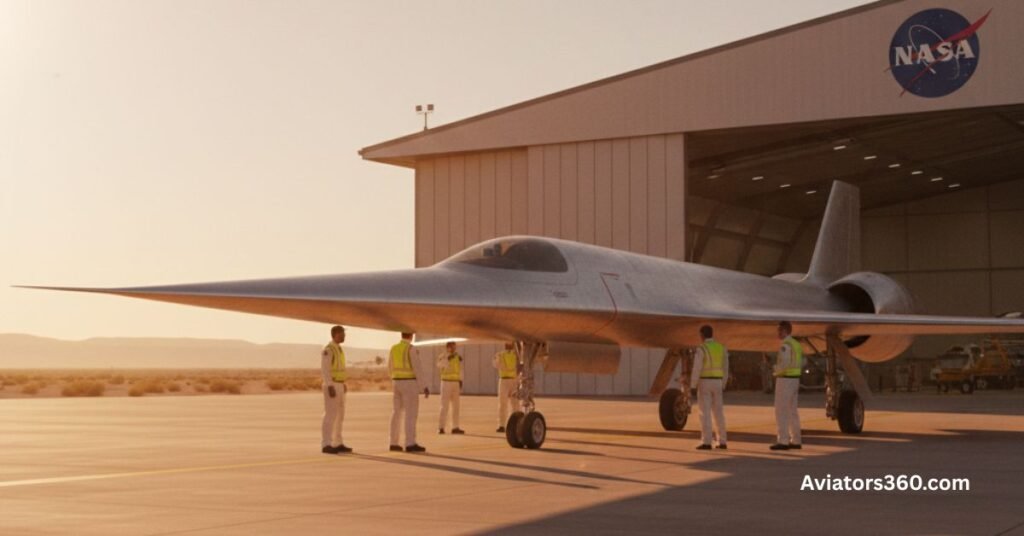
Imagine a future where aircraft fly faster than sound — but without the thunderous sonic boom that once shook buildings and disturbed communities. That future is closer than ever with the Lockheed Martin X-59 QueSST, an experimental aircraft designed to demonstrate “quiet supersonic” flight. With its successful first flight in late 2025, this aircraft may become the foundation for the return of commercial supersonic travel, this time without noise bans and regulatory barriers.
This blog explains what the X-59 is, why it matters, how it works, the progress so far, and what the future may hold for global aviation.
What Is the X-59 QueSST?
The X-59 QueSST (Quiet Supersonic Technology) is a single-pilot, experimental aircraft built by Lockheed Martin for NASA’s mission to make supersonic flight quiet enough to be allowed over land. For decades, supersonic aircraft like the Concorde were restricted because of the disruptive sonic boom they generated. The X-59 is designed to reshape this boom into a low-level “sonic thump,” opening the door to a completely new category of high-speed aircraft.
Its purpose is simple but revolutionary: prove that supersonic travel can be quiet, safe, and acceptable to the public. If successful, it could influence regulators worldwide to update rules that currently prohibit supersonic flights over populated areas.
What Makes X-59 Special — The “Quiet Boom” Breakthrough
Traditional supersonic jets produce a loud sonic boom when they exceed the speed of sound. This shockwave has always been the main reason governments banned civilian supersonic operations over land.
The X-59 changes this through a combination of engineering innovations: Extremely Long, Slender Nose
The front section is designed to control how shockwaves form and spread. Instead of merging into a loud boom, they disperse into smaller, softer waves. Aerodynamic Body Shape
The fuselage and wings are arranged to distribute pressure smoothly, reducing the intensity of the sound reaching the ground. Top-Mounted Engine
The jet engine is placed on top of the aircraft so its sound is directed upward, away from communities below. External Vision System
Since the long nose blocks forward visibility, the X-59 uses a digital cockpit with advanced cameras. This allows the pilot to see ahead without compromising the aircraft’s aerodynamic design.
Together, these innovations aim to transform the traditional sonic boom into a quiet, unobtrusive “thump” that most people won’t even notice.
Specifications & First Flight Milestone
Key technical specifications:
· Speed: Around Mach 1.4
· Altitude: Up to 55,000 feet
· Length: Approximately 30 meters
· Engine: A powerful, modified turbofan delivering high thrust with reduced noise
· Crew: Single pilot with camera-based cockpit view
The aircraft completed its first successful flight in October 2025, taking off from California and performing a 67-minute test mission that confirmed flight stability, control systems, and initial performance expectations. This milestone marked the beginning of a detailed test program that will eventually include supersonic speeds.
Why X-59 Matters — The Global Impact of Quiet Supersonic Flight
The X-59 has the potential to reshape aviation in several powerful ways:
1. Return of Supersonic Passenger Travel
Supersonic travel has been absent for over two decades. If noise concerns are resolved, airlines could operate faster aircraft on key domestic and international routes.
2. Radically Shorter Flight Times
The ability to fly supersonic over land would reduce travel times drastically:
· New York to Los Angeles in under 3 hours
· Delhi to London in about 4 hours
· Tokyo to San Francisco in nearly half the current time
3. Unlocking New Air Routes
Current supersonic restrictions force aircraft to operate only over oceans. Quiet supersonic jets would allow direct routes over continents, saving time and fuel.
4. Boost to Aerospace Innovation
A successful quiet-supersonic mission could ignite an entire new generation of high-speed aircraft — for commercial, military, and emergency operations.
Government Involvement & Potential Regulatory Changes
The future of the X-59 depends heavily on government response.
Regulators around the world have long prohibited supersonic flight over land due to noise complaints. The X-59’s mission is specifically designed to provide real-world data to these authorities.
Governments will play a critical role in: Updating Noise Standards
If the X-59 demonstrates a consistently quiet “thump,” agencies could create new supersonic noise thresholds for future commercial aircraft. Allowing Community Test Flights
Governments will authorize overflight testing above selected cities and towns. Residents’ feedback will help determine whether quiet supersonic operations are socially acceptable. Approving Future Supersonic Aircraft
Airlines and manufacturers will need new certification pathways. Government policy will decide how fast new supersonic jets can enter the market. International Cooperation
Since supersonic travel crosses borders, global aviation bodies must agree on shared rules. Collaborative policymaking will determine how quickly quiet supersonic flight becomes a worldwide reality.
What Comes Next — The Roadmap Ahead
The X-59’s upcoming milestones include:
1. Gradual expansion of flight operations
2. Achieving true supersonic speeds during tests
3. Overflight missions above selected U.S. communities
4. Public response and noise measurement analysis
5. Submission of noise-impact data to global aviation regulators
6. Potential policy changes enabling commercial supersonic travel
If everything proceeds successfully, manufacturers could begin designing commercial quiet-supersonic aircraft by the early 2030s.
Challenges Still Ahead
Some hurdles still remain:
· Public noise acceptance may vary
· Supersonic jets use more fuel
· Environmental considerations must be addressed
· Airports may need new infrastructure
· Ticket prices may initially be high
Despite these challenges, the X-59 represents the most serious attempt in decades to bring back commercial supersonic flight — this time in a sustainable, socially acceptable form.
Conclusion — A New Age of High-Speed Travel
The X-59 QueSST is more than a research aircraft; it represents a vision of the future. With its quiet supersonic capability, innovative design, and successful early testing, it has already taken the first step toward reshaping the global travel landscape.
If the mission succeeds, the world could soon experience a new aviation era — one where flying across continents becomes as fast as watching a movie, and speed no longer comes with the cost of disruptive noise.
X-59 QueSST: Quiet Supersonic Flight — A New Chapter for Global Air Travel