
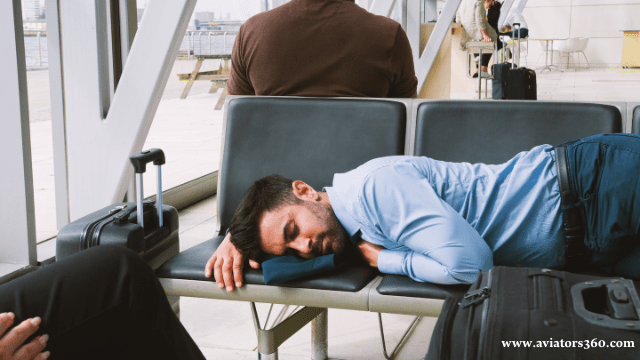
There are few things more frustrating in travel than staring at a departure screen that slowly ticks from “On Time” to “Delayed.” When you approach the counter, you are usually met with vague jargon like “operational issues” or “late arriving aircraft.” While these terms are technically true, they barely scratch the surface. In reality, the aviation industry is a complex web of aging machinery, strained infrastructure, and corporate incentives that often keep passengers in the dark.
If you have ever wondered why flights get delayed without a straight answer, here is an inside look at the real culprits—some of which the airlines might prefer you didn’t know.
The Domino Effect: When Your Plane Isn’t Even There Yet
The number one cause of delays in the United States isn’t weather or mechanical failure—it is the late arrival of the aircraft itself. According to a 2025 analysis of U.S. Bureau of Transportation Statistics data, late-arriving aircraft accounted for nearly 40% of all delays, costing passengers roughly 600,000 hours of lost time .
Aircraft are utilized ruthlessly. An airplane might fly four or five legs per day. If the first flight of the morning is held up due to a slow baggage crew or a minor technical snag in a previous city, that 15-minute gap snowballs. By the time the plane reaches you, the cleaning crew is rushed, the fuel truck is late, and the boarding process becomes chaotic. Airlines often categorize this under “late arriving aircraft,” but they rarely mention that the initial crack in the domino chain was often within their control .
The “Hidden” Airline Delays: Maintenance and Staffing
When a delay is listed under “Air Carrier Delay,” it means the issue is something the airline directly controls. This category represents nearly 32% of delays in the U.S. .
While extreme weather gets all the headlines, mundane reality is often the enemy. Aging global fleets are becoming a significant headache. Due to supply chain disruptions post-pandemic, airlines are forced to keep older planes in service longer than planned. These aircraft require more intensive maintenance, and when a component needs replacing, the spare part might be stuck in a backlog, causing an aircraft to go “tech” (technical stop) for hours or days .
Furthermore, airlines sometimes defer non-critical maintenance to keep planes in the air. However, as operations director at JetFreighters Sub-Saharan Africa noted, “these items have a tendency to trip airlines up when least expected and cause unscheduled downtime” . Add to that the occasional crew shortage or a pilot reaching their legal flight time limit, and you have a recipe for a delay that airlines would rather vaguely attribute to “operations.”
The Crumbling Infrastructure No One Wants to Fund
Here is a hard truth: the sky is crowded, and the people directing traffic are stretched thin.
Air Traffic Control (ATC) shortages are a crisis on both sides of the Atlantic. In Europe, a 2025 Eurocontrol report highlighted that en-route ATFM (Air Traffic Flow Management) delays surged due to “a lack of ATCOs [air traffic control officers]” and limited airspace capacity . In the U.S., the situation is so dire that a Harvard researcher calculated that long delays (three hours or more) are now four times more common than they were in 1990 .
The issue is structural. The FAA is incentivized primarily for safety—which is good—but not necessarily for efficiency. There is little reward for moving you faster. Meanwhile, passenger traffic has grown by about 50% since 2000, but the U.S. hasn’t opened a major new airport since 1995 . When a thunderstorm hits, the system clogs because there aren’t enough controllers to route planes around it efficiently, and the ripple effects can shut down airports like Boston Logan for hours .
The Schedule Padding Scandal
Here is a secret the airlines don’t advertise: your flight isn’t as fast as it used to be, and the delay statistics are rigged.
Airlines have quietly started “padding” schedules. For example, a flight that took two hours in 1995 might now be scheduled for two hours and twenty minutes, even though the flying time hasn’t changed. This is done to improve “on-time performance” metrics. By building in a buffer, a flight that is 15 minutes late departing can still be considered “on time” upon arrival .
According to a Harvard analysis, this schedule padding adds up to roughly $6 billion in lost passenger time annually, because travelers are building extra time into their itineraries that they shouldn’t have to . So, while the official statistics might look better, the reality is that Americans are just spending more time sitting in planes waiting to take off.
Why Airlines Keep You in the Dark
Given all these factors, why do airlines just say “operational reasons” instead of the truth?
There are a few reasons. First, a delay is rarely caused by just one thing. It could start with a lack of parking gates, get worse due to ATC congestion, and be finalized by a crew timeout. At the moment of the announcement, the airline often doesn’t know the final cause .
Second, and more importantly, legal liability. Under regulations like EU261, if a delay is the airline’s fault (like a mechanical issue or staffing), passengers are entitled to compensation (up to €600). However, if it is an “extraordinary circumstance” like weather or ATC strikes, the airline doesn’t have to pay . Therefore, airlines are legally cautious. Admitting a crew shortage too early could open the door to thousands of dollars in compensation claims. It is safer to be vague until they can confirm the delay wasn’t their fault.
Conclusion
Next time you are stuck on the tarmac, remember that the delay is likely the result of a fragile system: a plane arriving late, an overworked air traffic controller, a missing spare part for an aging jet, or simply the buffer time the airline built in to make the stats look better.
Knowing why flights get delayed doesn’t necessarily make the wait less painful, but it does explain why the answer from the gate agent is often frustratingly short. The truth is far more complex—and far more interesting.