
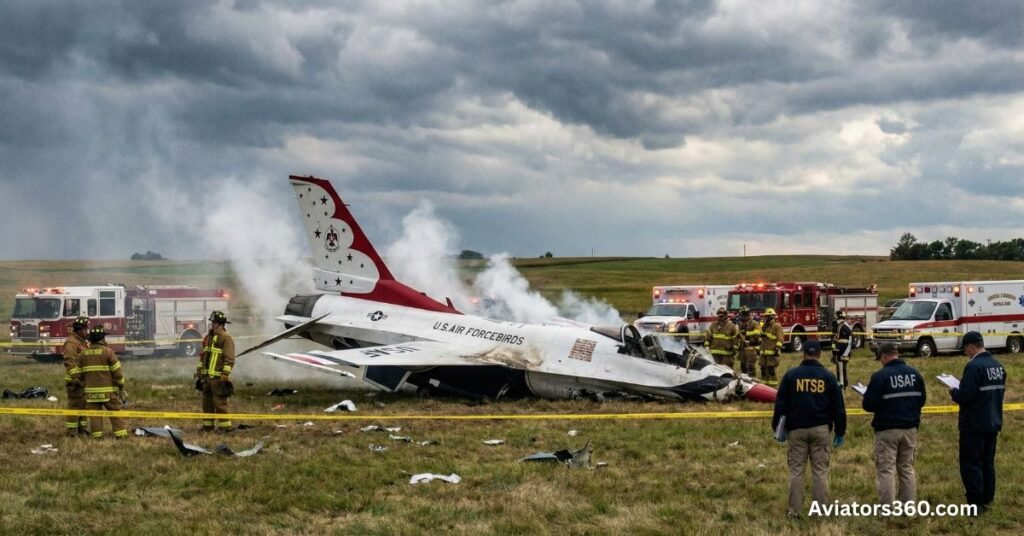
The United States Air Force Thunderbirds were hit by a major setback when one of their F-16 Fighting Falcon jets crashed The crash occurred at roughly 10:45 a.m. local time over controlled airspace during a scheduled Thunderbird training sortie during a routine training mission in California. The incident occurred on 3 December 2025 during a high-performance practice sortie. The pilot managed to eject safely and is in stable condition, but the crash has once again brought attention to the risks associated with high-G aerobatic operations and the growing strain on aging fighter fleets.
This detailed report breaks down exactly what happened, why it may have occurred, and what future steps the Air Force is now expected to take.
What Happened: A High-Intensity Training Flight Turns Critical
On the morning of 3 December 2025, an F-16C assigned to the USAF Thunderbirds demonstration team was conducting a scheduled aerobatic practice. These flights are designed to fine-tune the precision maneuvers the Thunderbirds perform during national airshows.
During one of these maneuvers, the aircraft encountered a critical in-flight event that made continued flight impossible. The pilot quickly initiated the ejection sequence—an action taken only when survival odds within the cockpit drop sharply. The pilot parachuted to safety and was recovered by emergency teams shortly afterward.
The crash site was secured by Air Force personnel, and thankfully, no civilian injuries or property damage were reported, as the aircraft went down in an unpopulated training area.
Why This Happened: Key Factors Under Investigation
A full investigation is now underway, and while final conclusions will take time, several technical and operational factors are being evaluated:
- Mechanical or Structural Failure
The F-16 airframe is robust but aging. Many Thunderbirds aircraft are older jets modified for demonstration flying. Potential issues being examined include:
- Structural fatigue
- Hydraulic system faults
- Control-surface malfunction
- Engine performance irregularities
- Aerobatic Maneuver Stress
Thunderbirds aircraft are flown under extremely demanding conditions:
- Rapid pitch adjustments
- High G-forces
- Tight turn radii
- Split-second throttle transitions
Any slight deviation during a maneuver can trigger instability.
- Pilot Workload and Situational Dynamics
Aerobatic flying requires immense precision. Even the most experienced pilots face:
- Compressed reaction windows
- Rapid decision-making under intense physical stress
- Visual limitations during high-G maneuvers
Investigators will review telemetry to determine how the aircraft’s flight path evolved before the crash.
- Environmental Factors
Even minor environmental triggers can affect fighter performance:
- Sudden wind shear
- Unexpected turbulence
- Bird strikes
- Visibility distortions
Weather data from the time of the crash will be part of the analysis.
- Maintenance and Pre-Flight Checks
Maintenance logs for demonstration aircraft are extensive. Investigators will analyze:
- Recent inspection findings
- Any deferred maintenance items
- Flight-control system history
- Engine-health monitoring data
This will help determine whether the issue was mechanical or operational in nature.
Broader Context: Rising Accident Rates in U.S. Military Aviation
This crash comes at a time when the U.S. military has documented an increase in Class-A aviation mishaps over recent years. Several contributing factors are noted across the fleet:
- Older aircraft reaching structural maturity
- Higher operational tempos
- Pilot shortages leading to increased training pressures
- Wear on engines and hydraulics
As of late 2025, data shows the mishap rate rising compared to earlier years, underscoring the need for renewed focus on training safety, aircraft upgrades, and fleet management.
Historical Note: F-16 Global Losses
Across the world, the F-16 has accumulated more than 670 hull-loss accidents since entering service in the 1970s. While the aircraft is exceptionally reliable, decades of service and diverse operating conditions contribute to cumulative risk.
The crash of a Thunderbird jet is especially significant because demonstration teams operate under peacetime rules with heightened safety protocols.
Immediate Aftermath: What Happens Now?
Following any military aircraft crash, a multi-stage response begins:
- Safety Investigation Board
A board of aviation experts will review:
- Flight data
- Cockpit recordings
- Airframe remains
- Ejection seat telemetry
- Maintenance records
- Temporary Stand-Down of Training
The Thunderbirds typically pause flight activities after a serious mishap. This allows:
- Teamwide safety briefings
- Assessment of operational risks
- Mental and physical recovery for pilots
- Aircraft Fleet Review
Other Thunderbirds F-16s will undergo thorough inspections focusing on:
- Stress points
- Control-surface behavior
- Engine performance
- Flight-control electronics
- Evaluation of Demonstration Schedules
Upcoming Thunderbirds shows may be:
- Rescheduled
- Modified
- Reduced in complexity
depending on investigation results and fleet readiness.
Future Plans: Strengthening Safety & Modernizing the Fleet
The Thunderbirds and the Air Force are expected to take several long-term steps:
- Enhanced Fatigue Monitoring
Better digital tracking of airframe wear and real-time flight-data analytics to detect early warning signs.
- Increased Training Simulator Hours
High-fidelity simulation training to reduce physical aircraft stress during aerobatic practice.
- Review of High-G Maneuver Profiles
Certain maneuvers may be re-evaluated or modified to reduce risk during practice sessions.
- Modernization Initiatives
The F-16 remains capable, but modernization efforts may accelerate:
- Upgraded avionics
- New safety systems
- Structural reinforcement programs
- Updated Maintenance Protocols
More frequent inspection cycles for demonstration aircraft due to their extreme operating conditions.
Conclusion
The Thunderbirds F-16 crash is a stark reminder of the dangers inherent in high-performance military aviation. Despite the risks, the swift actions of the pilot and the effectiveness of emergency response systems ensured that this incident did not result in loss of life.
The upcoming investigation will play a crucial role in shaping future safety measures, training practices, and operational procedures—not just for the Thunderbirds but for military aviation more broadly. The focus now shifts to identifying the root cause, strengthening safeguards, and ensuring that future aerial demonstrations remain both spectacular and safe.