
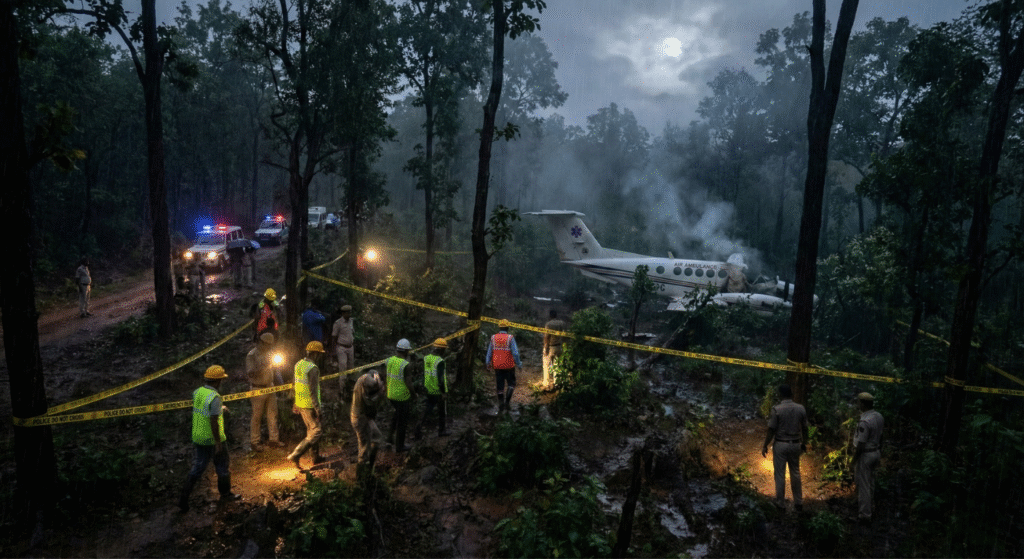
A chartered air ambulance on a medical evacuation mission from Ranchi to Delhi crashed on the evening of February 23, 2026, in a forested area of Chatra district, Jharkhand. All seven people on board—including the patient, two pilots, a doctor, a paramedic, and two attendants—were confirmed dead. The aircraft, a Beechcraft C90 operated by Redbird Airways, lost contact with air traffic control shortly after the pilots requested a weather-related deviation.
Lede — What Happened (Quick Summary)
On the evening of 23 February 2026, a chartered air-ambulance on the Ranchi → Delhi route lost radar contact roughly 20–25 minutes after takeoff and crashed in a remote, forested area near Simaria in Chatra district. All seven people on board—two pilots, a patient, medical staff, and attendants—were killed. Authorities, including the Directorate General of Civil Aviation (DGCA) and the Aircraft Accident Investigation Bureau (AAIB), launched search, recovery, and an investigation .
Timeline (Reconstructed from Reports)
~19:11 IST — Flight departs Ranchi’s Birsa Munda Airport en route to Delhi .
~19:34 IST — Pilots contact Kolkata ATC requesting a weather-related deviation; radar contact is lost shortly after, approximately 100 nautical miles south-east of Varanasi .
Later that night — Wreckage located near Simaria (Chatra); recovery teams confirm seven fatalities. Investigators reach the site and begin on-scene evidence collection .
Who Was on Board
Press manifests and media reporting list seven onboard: two crew and five passengers. The victims were officially identified as :
Captain Vivek Vikas Bhagat (Pilot)
Captain Savrajdeep Singh (Co-pilot)
Sanjay Kumar (Patient, a 41-year-old with severe burn injuries from Latehar)
Dr. Vikas Kumar Gupta (Doctor)
Sachin Kumar Mishra (Paramedic)
Archana Devi (Attendant and patient’s wife)
Dhuru Kumar (Attendant and patient’s nephew)
The flight was arranged by the family of Sanjay Kumar, who had suffered 60-65% burn injuries and was being transferred from Devkamal Hospital in Ranchi to Delhi for advanced treatment .
The Aircraft and Operator
Aircraft type reported: Beechcraft C90 (a light, twin-engine turboprop frequently used for charters and medevac work) .
Registration: VT-AJV .
Operator named in multiple outlets: Redbird Airways Pvt Ltd, a Delhi-based non-scheduled charter and air-ambulance operator that received its air operator permit in 2019 .
Immediate Cause — What We Know (And Don’t)
Known facts: The aircraft took off from Ranchi at 7:11 PM. At 7:34 PM, the pilots contacted Kolkata ATC to “request deviation due to weather.” Shortly after this communication, radar contact was lost . Chatra Deputy Commissioner Keerthishree G. stated that initial reports suggested a thunderstorm may have caused the crash, but emphasized that the exact cause would be determined by the official investigation . Villagers in the Simaria area reported hearing a loud explosion and seeing an object spiraling down .
Unknown / under investigation: Whether the proximate cause was weather (icing/turbulence/low visibility), mechanical failure, spatial disorientation, or a combination. The final determination will await the AAIB’s factual report, which will analyze flight data, cockpit voice recorder (if available and recoverable), wreckage, ATC transcripts, and maintenance records .
Reaction — Families, Officials, Regulators
Families: Relatives of the deceased expressed profound grief. The family of the patient, Sanjay Kumar, who lost both their brother-in-law and sister (Archana Devi) in the crash, highlighted the tragedy of losing a patient who was seeking better care. Dr. Gupta’s father spoke of his son’s merits and his surviving seven-year-old son .
Local and state officials: Chatra DC Keerthishree G. and SDPO Shubham Khandelwal oversaw the recovery operation. Ranchi MP and Minister of State for Defence Sanjay Seth confirmed the details and expressed condolences .
Regulators: The DGCA confirmed the crash and stated an investigation was underway; the AAIB is the technical authority dispatched to determine causal factors .
How This Is Being Covered Across Platforms
National print and TV outlets (Times of India, Hindustan Times, Indian Express) provided minute-by-minute updates, victim names, and local reaction .
Wire services (PTI, Reuters) circulated concise factual briefs suitable for fast readers and overseas audiences .
Social media amplified images and early claims; local TV live feeds posted visuals from the crash scene. This crash is the second small aircraft tragedy in India within a month, following the January 28 Baramati crash that killed Deputy CM Ajit Pawar and four others, putting a spotlight on non-scheduled flight safety .
Aviation Safety Context — Why Medevac Flights Matter and Risks They Face
Air-ambulances routinely operate under time pressure, sometimes into marginal weather and to/from smaller airports. Twin-engine turboprops like the Beechcraft C90 are commonly used for medevac due to cabin flexibility and range—but they are less tolerant of some failure modes than larger airliners . Key systemic risk factors to examine here include: weather briefing and dispatch decision, crew rest/qualification for medevac operations, aircraft maintenance, weight & balance with medical equipment, and ATC communication flow . This crash has renewed criticism of the regulatory framework governing chartered jet operators .
Investigation — What to Expect Next
On-site evidence collection: Wreckage mapping, photographs, component preservation .
Record recovery: ATC transcripts, radar tracks, maintenance logs, pilot licenses and duty rosters, aircraft weight/load documents .
Laboratory analysis: Engines/propulsion, flight control continuity, any fire/explosion markers, metallurgical testing .
Human factors: Toxicology, record of communications, cockpit voice recorder analysis (if the aircraft was fitted with one—small charters sometimes lack full FDR/CVR gear) .
Practical Takeaways & Recommendations (For Operators and Regulators)
Strengthen weather-dispatch protocols for medevac flights with clear go/no-go criteria.
Ensure medevac aircraft meet equipment and avionics standards appropriate for IFR and adverse weather operations.
Mandate and audit documented weight & balance procedures when carrying stretchers and medical systems.
Improve pilot training on emergencies under medevac mission profiles.
Implement faster, standardized incident notification and family-support processes to reduce confusion in the immediate aftermath .
These are standard, actionable measures investigators typically highlight after similar accidents; regulators should evaluate findings from the AAIB report and issue targeted directives if systemic gaps are found.
Sources & Verification
Reporting consolidated from: PTI, The Telegraph India, The Indian Express, Hindustan Times, Times of India, and National Herald. Specific statements regarding timeline, manifest, and regulatory responses were verified against these authoritative sources and official DGCA statements .
Conclusion
This crash is a tragic reminder of the risks involved in emergency air transport—both operational and human. The facts so far point to an in-flight loss of contact after a weather deviation request; only the AAIB/DGCA technical inquiry can produce a definitive cause. This article will be updated to summarize the official investigation findings and regulatory actions as they are published.