
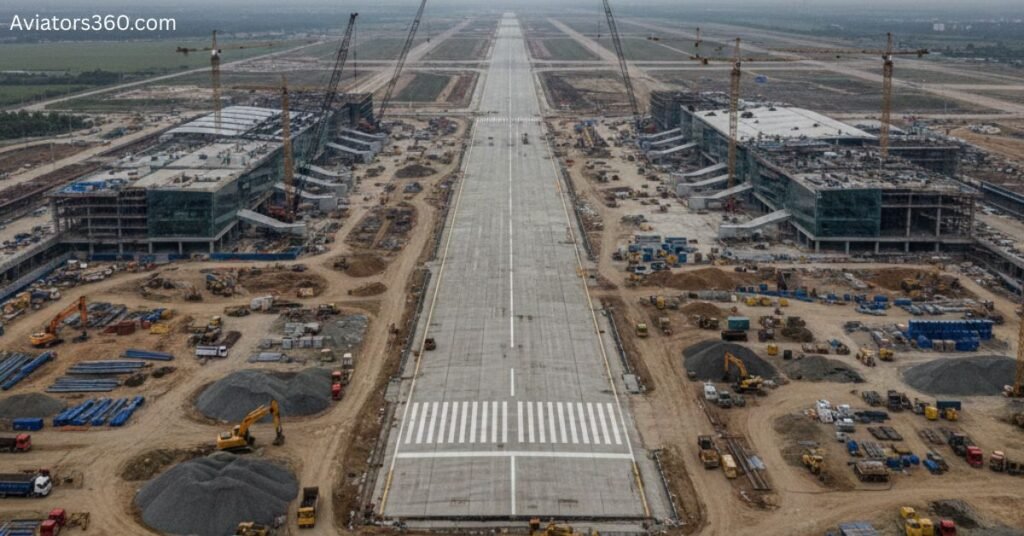
A Long-Awaited Project Faces Another Setback
The much-anticipated Noida International Airport (NIA), poised to become India’s largest airport upon completion, has encountered another delay. Initially slated for a grand opening in September 2024, the inauguration has now been tentatively pushed back to January 2026. This news has been met with disappointment from travelers, businesses, and residents across the National Capital Region (NCR) who have been eagerly awaiting the operational and economic relief this mega-infrastructure project promises. The delay underscores the complex interplay between ambitious construction timelines and the non-negotiable imperatives of regulatory compliance and safety in aviation. Let’s delve into the current status, unravel the reasons behind this postponement, and understand the revised roadmap for India’s next aviation hub.
The Current Status: Awaiting the Final Nod
As of now, the Noida International Airport stands in a state of advanced development but is not yet ready for passengers. The project is being developed by Yamuna International Airport Private Limited (YIAPL), a wholly-owned subsidiary of Zurich Airport International AG.
Pending Regulatory Hurdles
The airport’s operational launch hinges on two critical approvals that are still pending:
Aerodrome License from the DGCA: The Directorate General of Civil Aviation (DGCA) must grant this license after rigorous inspections to certify that the airport’s infrastructure—runways, taxiways, air traffic control systems, and lighting—meets all national and international safety standards.
Security Clearance from the BCAS: The Bureau of Civil Aviation Security (BCAS) is responsible for ensuring that the airport’s security architecture, from perimeter fencing and surveillance to passenger screening processes, is foolproof and operational.
Without these clearances, commercial flights cannot commence. Recent reports, including successful trial runs of the runway, indicate a phased approach to operations. Domestic flights might begin on a limited daytime schedule as early as December 2025, serving as a soft launch. This would be followed by a full-scale 24-hour service and the commencement of international flights in the first half of 2026.
Unpacking the Reasons for the Delay
The rescheduling from September 2024 to early 2026 is attributed to a confluence of factors, primarily centered on construction progress and regulatory integration.
Construction Completeness: The Core Challenge
While significant progress is visible, the airport is a massive ecosystem, not just a terminal and a runway. Delays in completing integrated systems have been a primary contributor. This includes the seamless interconnection of baggage handling systems, check-in counters, security lanes, and boarding gates, all of which require meticulous testing. Furthermore, ancillary infrastructure such as air traffic control (ATC) towers, fire and rescue facilities, and apron management systems must be 100% operational and synchronized.
Meeting the exacting specifications for safety in aviation construction often encounters unforeseen technical challenges, requiring adjustments that impact timelines. Ensuring that every component, from the runway’s surface friction to the terminal’s evacuation protocols, adheres to DGCA mandates is a time-intensive process that cannot be rushed.
The Inevitable Dance with Regulatory Approvals
Regulatory clearances are not mere formalities; they are exhaustive, multi-stage processes. Authorities like the DGCA and BCAS conduct multiple rounds of inspections and audits. Any observation or non-conformity raised during these audits must be rectified and re-inspected, creating a cycle that can extend timelines. The delays in achieving full construction readiness naturally have a cascading effect on the schedule for these regulatory reviews.
The process involves:
Submission of detailed technical and security plans.
Physical inspections of infrastructure.
Demonstration of operational procedures.
Grant of in-principle or conditional approvals.
Final certification after all conditions are met.
This meticulous process, while sometimes perceived as bureaucratic, is fundamental to ensuring the absolute safety and security of future passengers and aircraft.
Looking Ahead: The Revised Roadmap and Future Impact
Despite the delays, the project’s trajectory points towards a transformative impact on Indian aviation.
Phased Operational Rollout
The current plan suggests a pragmatic, phased approach:
Phase 1 (Late 2025): Limited domestic operations, likely with a single runway and a section of the terminal. This allows airlines, ground staff, and airport operators to ramp up operations, debug systems, and ensure smooth processes with lower passenger volume.
Phase 2 (First Half of 2026): Expansion to 24/7 operations and the launch of international flights. This will mark the airport’s full functional capability for the initial phase.
Long-Term Vision Remains Intact
The broader vision for Noida International Airport as a logistics gateway and an aerotropolis remains unchanged. Its strategic location near the Western Dedicated Freight Corridor is set to revolutionize cargo movement. For passengers in Delhi NCR, especially in Noida, Ghaziabad, and West Delhi, it promises significant travel time savings and decongestion at the Indira Gandhi International Airport (IGI).
Conclusion: A Delay for Safety, A Promise for the Future
The delay in the opening of the Noida International Airport, while disappointing, is a testament to the uncompromising standards of aviation safety and security. In an industry where there is no room for error, ensuring that every nut, bolt, and protocol is perfectly in place before the first commercial flight takes off is paramount.
The new tentative timeline of a January 2026 inauguration, with domestic services potentially starting in December 2025, offers a clearer, more realistic picture. For the millions awaiting this new gateway, the wait, though extended, is for a facility being built with a focus on resilience, efficiency, and world-class passenger experience. The Noida International Airport is not just another infrastructure project; it is a critical piece in India’s aviation growth story, and its successful, safe launch is worth the careful preparation.
Stay tuned for further updates as this story develops and India prepares to welcome its newest aviation marvel in the National Capital Region.
Disclaimer:
The information provided in this blog post is based on publicly available news reports and official statements as of the date of publication. The timelines and operational details regarding the Noida International Airport are subject to change based on further developments, regulatory decisions, and construction progress. Readers are advised to consult the official channels of Yamuna International Airport Private Limited (YIAPL), the Directorate General of Civil Aviation (DGCA), and the Bureau of Civil Aviation Security (BCAS) for the most current and authoritative updates. The author and publisher are not liable for any decisions made based on the content of this blog.