
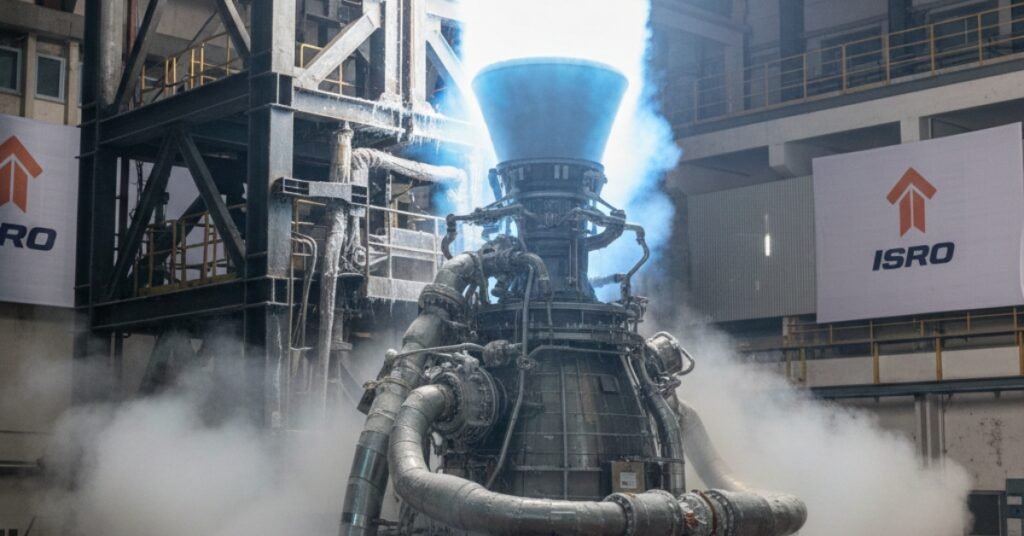
In a major advancement for India’s space capabilities, ISRO has successfully performed a boot-strap mode start test on its CE20 cryogenic engine—an achievement that could redefine the future of multi-orbit missions, deep-space exploration, and the flexibility of India’s LVM3 launch vehicle.
The landmark test took place on 7 November 2025 at the High-Altitude Test (HAT) Facility of the ISRO Propulsion Complex (IPRC), Mahendragiri.
This milestone is not just another test—it is a global first for gas-generator cycle cryogenic engines, demonstrating start-up without any external assistance. For ISRO, this is a technological leap with far-reaching implications.
What is the CE20 Cryogenic Engine?
The CE20 is the powerful cryogenic engine that fuels the upper stage of the LVM3 (Launch Vehicle Mark-3)—India’s heaviest and most reliable rocket, used in missions such as Chandrayaan-2, Chandrayaan-3, and now part of the planned Gaganyaan human spaceflight program.
Key Capabilities of CE20:
Operational thrust range: 19 to 22 tonnes
Already flight-qualified with single-start capability
Fully qualified for Gaganyaan missions
Uses stored gas start-up system for conventional ignition
Under normal conditions, the CE20 engine is ignited using tank head pressure, after which its turbopumps are powered by a stored gas system. While this works flawlessly for single-start missions, future missions demand much more.
Why Restart Capability Is Crucial
Upcoming missions—such as multi-orbit deployments, interplanetary transfers, and complex space science missions—require the ability to restart the engine multiple times during flight.
However, the current configuration requires:
Additional start-up gas bottles
Extra plumbing
Supporting systems
This adds weight, which directly reduces the usable payload capacity for satellites or scientific instruments.
Therefore, the solution lies in achieving a boot-strap mode start, where the engine transitions to stable operation without the need for additional external start-up hardware.
The Breakthrough Test at Mahendragiri
On November 7, 2025, ISRO conducted a 10-second boot-strap mode start test under simulated vacuum conditions in the HAT facility.
What Happened in the Test?
Multi-element igniters were used in:
Thrust chamber
Gas generator
Thrust chamber ignition was performed using natural tank head pressure.
The gas generator was ignited without auxiliary systems, relying solely on internal conditions.
Turbopumps successfully spun up without external start-up gas.
The engine achieved:
Boot-strap start
Smooth ramp-up
Stable steady-state operation
This means the engine now has the capability to start by itself—essentially “self-booting”—with no dependence on additional hardware.
Why This Achievement Is Globally Significant
ISRO has effectively demonstrated:
A world-first boot-strap mode start in a gas-generator cycle cryogenic engine
A fully functional cryogenic engine restart capability without auxiliary systems
A technological leap that boosts the LVM3’s role in:
Multi-orbit missions
Future interplanetary missions
Commercial launches
Payload-heavy operations
Other major space agencies—NASA, ESA, Roscosmos, and CNSA—use cryogenic engines, but a boot-strap mode start in this configuration is extremely rare, making this a pioneering achievement.
How This Will Benefit Future Indian Missions
1. Multi-Orbit Satellite Deployment
LVM3 will be able to:
Insert multiple satellites into different orbits in a single mission
Support commercial clients more efficiently
2. Deep Space Missions
Restarts allow:
Lunar orbit insertion
Slingshot maneuvers
Planetary transfers
3. More Payload Capacity
Without extra start-up gas bottles, the rocket can carry:
Heavier satellites
Larger scientific instruments
More modules for exploration missions
4. Enhanced Gaganyaan Mission Capabilities
While the CE20 is already qualified for Gaganyaan, this upgrade:
Boosts mission safety
Improves flexibility during orbital maneuvers
What’s Next for ISRO?
This breakthrough takes India one step closer to:
Reusable launch systems
High-efficiency cargo missions
Advanced lunar & planetary missions
More competitive commercial launches
With LVM3 evolving rapidly and cryogenic technology becoming more robust, India strengthens its position among global space powers.
Conclusion
The successful boot-strap mode start test of the CE20 cryogenic engine marks one of ISRO’s most strategic and innovative achievements in recent years.
This advancement not only enhances the LVM3’s mission flexibility but also establishes India as a technological leader in cryogenic propulsion.
As ISRO continues pushing boundaries—from Chandrayaan to Gaganyaan and beyond—this breakthrough forms the foundation for the next generation of Indian space missions.