India’s search for a next-generation fighter jet has taken a dramatic turn with renewed discussions around the Russian Sukhoi Su-57E — the export variant of Russia’s only operational fifth-generation stealth fighter. While Russia has pitched the aircraft with attractive offers, the Indian Air Force (IAF) has not rushed into a decision. Instead, it has put forward firm requirements that must be met before any deal is even considered.
Two issues stand out as the biggest sticking points:
1. The IAF’s demand for complete hands-on access and deep evaluation
2. The absence of a twin-seater variant of the Su-57E
This debate is not just about buying a fighter jet. It has deep implications for India’s air combat doctrine, its indigenous AMCA programme, and its long-term military self-reliance. Here’s the complete picture.
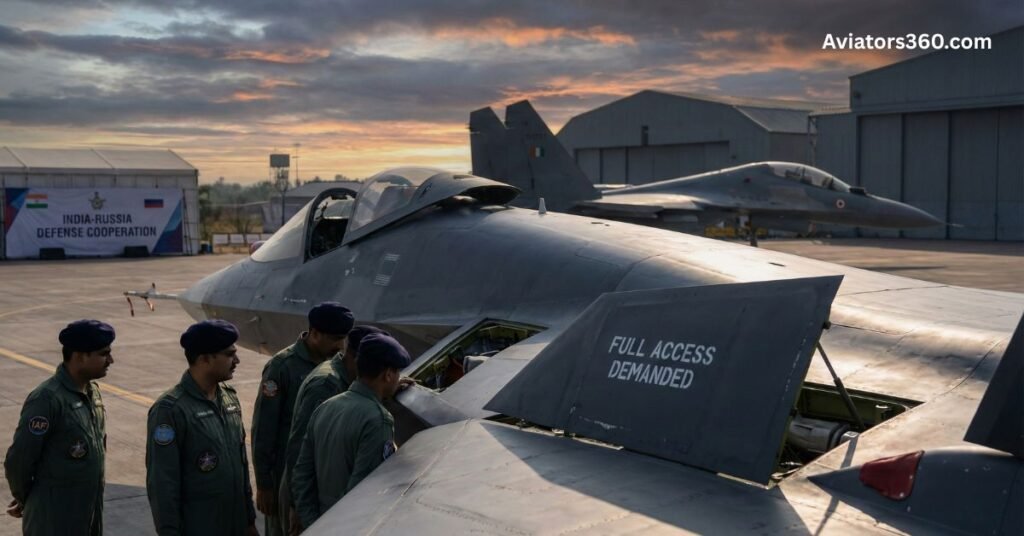
IAF’s Firm Stand: “No Deal Without Full Hands-On Access”
The IAF has clearly communicated that it will not enter into any agreement until it gets full technical access to the Su-57E, including:
- Complete flight trials
- Sensor and avionics testing
- Detailed performance assessment
- Stealth evaluation
- Ground handling and maintainability checks
- Integration feasibility with Indian weapons and systems
This caution comes from experience.
The FGFA Lesson
India earlier walked away from the joint FGFA programme — which was supposed to be based on the Su-57’s early design — because of concerns regarding:
- Stealth effectiveness
- Sensor and radar capability
- Engine reliability
- Avionics maturity
- Overall value for investment
The IAF felt the platform lacked many features expected of a true fifth-generation aircraft at that time.
Because of those setbacks, the IAF is determined to ensure such a situation is never repeated.
Why Hands-On Access Is Non-Negotiable
A stealth fighter’s real value can only be judged through actual operations, not brochures or demonstrations. India wants to verify:
- Whether the Su-57E’s stealth profile is consistent and sustainable
- How its avionics and sensor fusion work in real time
- Its supercruise capability
- Its weapons integration flexibility
- Its reliability under Indian climatic and terrain conditions
- Its operational cost and long-term maintainability
Considering the massive investment a fifth-generation fleet demands, the IAF is insisting on complete transparency before any procurement decision.
The Twin-Seater Problem: Why the Missing Variant Is a Major Hurdle
One of the biggest concerns for the IAF is the absence of a twin-seat version of the Su-57E.
Most advanced air forces prefer dual-seat variants of complex next-generation jets because they offer major advantages.
Why a Twin-Seater Matters for India
- Pilot Training and Transition
Moving from 4th-generation jets to a stealth-dominant, sensor-heavy platform is a significant leap.
A second crew member helps reduce workload during missions, especially in early training phases.
- Better Mission Management
Stealth operations often involve complex tasks such as:
- Electronic warfare
- Multi-domain coordination
- Real-time data fusion
- Network-centric targeting
- Swarm drone control
A weapon systems officer (WSO) in the second seat dramatically improves mission effectiveness.
- Test and Evaluation Requirement
During India’s trial phase, having a co-pilot or system operator is invaluable for capturing data, identifying issues, and handling unexpected system behaviours.
- Future-Proofing for Complex Warfare
As warfare becomes more AI and data-driven, two-seat jets offer flexibility for:
- Loyal wingman drone management
- Multi-target engagement
- High-speed data analysis
Without a two-seat version, the IAF fears a steeper learning curve and operational limitations during early integration.
Russia’s Offer: Tech Transfer, Local Production, and More
Russia has responded positively to India’s concerns and has put attractive offers on the table, including:
- Full Technology Transfer
This includes access to:
- Avionics source code
- AESA radar technology
- Stealth materials and coatings
- Sensor fusion systems
- Engine technology
- Data links and electronic warfare suites
Such deep technology access is rarely offered by any nation.
- License Production in India
Russia is willing to set up a large-scale production line in India under a Make in India arrangement.
This can significantly boost India’s aerospace manufacturing ecosystem.
- Willingness to Develop a Twin-Seater Variant
Russia has indicated it is open to creating a dual-seat Su-57 variant if India demands it.
This could become an India-specific version of the aircraft.
- Integration of Indian Weapons
Indian-origin missiles and systems could be integrated into the aircraft, enhancing strategic autonomy.
Why This Decision Matters for India’s Future
The stakes are extremely high. India’s future air power depends on what it decides now.
- Immediate Access to Fifth-Gen Capability
The indigenous AMCA programme is progressing but will take several more years before the first prototype even flies.
Su-57E offers a potential quick-entry path into the fifth-generation era, which is crucial given regional developments.
- Strengthening Squadron Numbers
IAF’s squadron strength is significantly below sanctioned levels.
Adding 2–3 squadrons of Su-57E can help bridge the capability gap in the short-to-mid term.
- Boost to Indigenous Programmes
Technology transfer from Su-57E can accelerate AMCA development by providing:
- Stealth know-how
- Material science advancement
- Testing and production experience
- Engine insights
- Avionics and electronics expertise
India can use this as a stepping stone toward complete self-reliance in future platforms.
- Geopolitical and Strategic Positioning
A Su-57E acquisition—paired with local manufacturing—positions India as a major aerospace power in Asia.
It also strengthens the India–Russia defence relationship while balancing other global partnerships.
What Happens Next? Possible Scenarios
Scenario 1: Full Deal with Co-Production
India signs the deal, gets full trials, tech transfer, and possibly a twin-seater version.
HAL sets up an assembly line, accelerating India’s aerospace ecosystem.
Scenario 2: Limited Buy + Full Evaluation
India procures a small batch of aircraft first, evaluates performance, and then decides on long-term induction.
Scenario 3: Use Su-57E as an Interim Solution
India buys limited squadrons as a stop-gap until AMCA matures.
Scenario 4: India Walks Away
If Russia cannot provide the required access or a twin-seater variant, India may reject the offer — similar to the FGFA decision.
Conclusion
The Su-57E discussion is one of the most important defence decisions India faces today.
The aircraft offers tempting advantages: stealth, advanced sensors, next-gen capability, and unprecedented technology transfer.
But the IAF is taking a cautious, experience-driven approach.
It wants real performance, real access, real transparency — not promises.
Whether India chooses to induct the Su-57E or wait for AMCA, this decision will shape the nation’s air combat capabilities for decades.
For now, the Su-57E remains a promising but carefully scrutinized opportunity — one that could redefine India’s air power if the negotiations align with India’s operational and technological expectations.