
India’s aviation sector is undergoing a historic transformation. With passenger traffic rising rapidly and airlines expanding fleets at an unprecedented pace, safety oversight has become a national priority. After the fatal Air India crash that exposed several systemic concerns, the Directorate General of Civil Aviation (DGCA) has rolled out a sweeping reform: a 360-degree Special Safety Audit Framework.
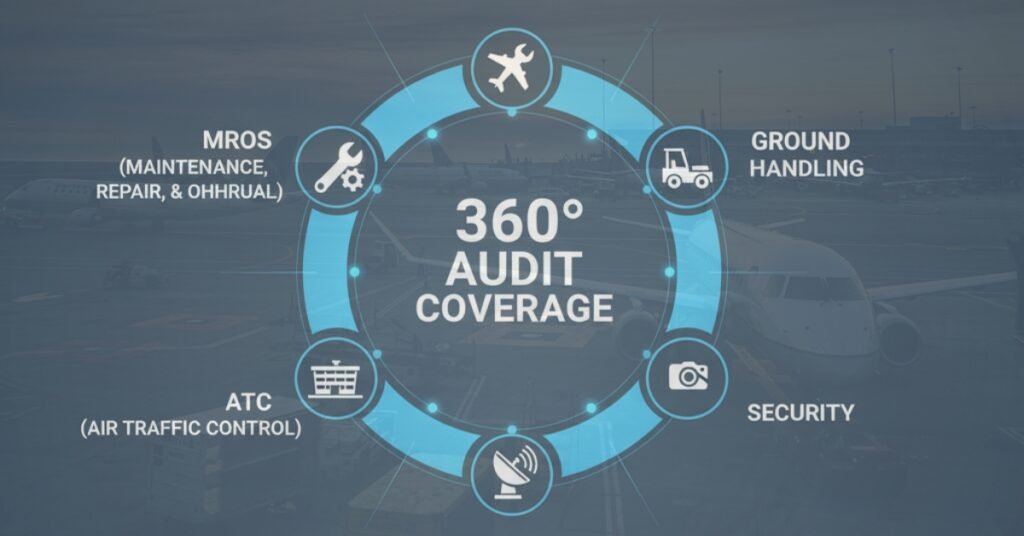
This initiative is already being described as the most comprehensive safety oversight upgrade in the history of Indian aviation. According to The Times of India and The Economic Times, the DGCA has officially deployed multi-disciplinary inspection teams that will conduct integrated audits across airlines, airports, ground handlers, MROs, flying schools, and air traffic management systems. Unlike the earlier siloed audit model, this new system evaluates India’s aviation ecosystem as a unified structure.
And for a sector preparing to become the world’s third-largest aviation market, this could not have come at a more critical time.
Why DGCA Introduced the 360-Degree Audit Framework
As reported by Reuters in June 2025, DGCA identified recurring technical defects on multiple aircraft across Indian fleets — pointing to deeper, systemic issues rather than isolated lapses. Further, Skift’s June 2025 aviation report highlighted that safety gaps were found not just in airlines but across airports and ground operations as well.
The fatal Air India incident heightened the urgency. DGCA realized that traditional inspections — fragmented across separate directorates — were no longer sufficient. The regulator needed a system that:
- Detects risks before they escalate
- Strengthens India’s adherence to ICAO safety standards
- Ensures systemic accountability across all aviation stakeholders
- Boosts India’s global aviation safety rating
This new 360-degree framework is therefore designed not just as a regulatory reform, but as a long-term safety vision for the next decade.
What the 360-Degree Audit Covers
DGCA’s integrated audit is one of the broadest ever implemented in India. According to Business Standard’s July 2025 report, the audits cover:
- Scheduled airlines like Air India, IndiGo, Vistara, SpiceJet, Akasa Air
- Non-scheduled charter operators
- All MRO (Maintenance, Repair & Overhaul) organisations
- Flying Training Organisations (FTOs)
- Approved Training Organisations (ATOs)
- Aerodrome operators including AAI and private airports
- Air Navigation Service Providers (ANSPs)
- Ground Handling Agencies (GHAs)
- Safety system & technology partners
This wide net ensures that every link in the aviation chain — from the cockpit to the control tower to the supply chain — is subject to detailed scrutiny.
How the New Audit Works
The DGCA follows a three-phase, data-driven inspection model, as confirmed by IANS and multiple national outlets:
- Pre-Audit Review (5–7 days)
- Safety reporting data analysis
- Review of training logs
- Maintenance & engineering documentation
- DGCA CAR compliance evaluation
- On-Site Audit (3–5 days)
Multi-disciplinary teams inspect:
- Aircraft maintenance hangars
- Flight operations & dispatch centres
- Airport safety systems
- ATC units
- Simulators & training institutes
- Ground handling procedures
- Emergency response plans
- Post-Audit & Corrective Action (10–15 days)
Each entity must submit a Corrective Action Plan (CAP) within 15 days. DGCA then continues to monitor compliance until every finding is closed.
According to The Economic Times, findings are categorised based on severity, and serious violations can trigger penalties, financial fines, operational restrictions, or even license suspension.
Key Focus Areas of the 360-Degree Audit
✔ Safety Management Systems (SMS)
DGCA is now aligning strongly with ICAO Annex 19, focusing on hazard identification, reporting culture, and proactive risk management.
✔ Maintenance Quality & Reliability
This includes CAR-145 compliance, OEM procedure adherence, and prevention of repetitive defects — a concern recently flagged by Reuters.
✔ Flight Operations & Crew Safety
Key checks include:
- SOP implementation
- Crew rostering & fatigue management
- Pilot proficiency
- Training standards
- FDM (Flight Data Monitoring) effectiveness
✔ Aerodrome & Ground Safety
DGCA will assess runway safety, FOD control, firefighting readiness, apron operations, and ground-handling compliance.
✔ Regulatory Compliance
Every organisation must demonstrate adherence to DGCA Civil Aviation Requirements (CARs) and licensing norms.
Why This Matters for India’s Aviation Future
- Stronger Passenger Safety
A more holistic oversight approach reduces the likelihood of operational or maintenance-related incidents.
- Enhanced Global Standing
A stronger DGCA framework improves India’s ranking in ICAO’s USOAP (Universal Safety Oversight Audit Programme).
- Increased Airline Reliability
Better safety compliance reduces delays, lowers technical cancellations, and strengthens consumer trust.
- Future-Proofing India’s Aviation Growth
With India on the path to becoming the third-largest aviation market, this audit system lays the foundation for sustainable long-term growth.
Challenges DGCA May Still Face
Even though the framework is robust, implementation may face hurdles:
- Limited availability of senior auditors
- Dependence on industry cooperation
- Need for continuous follow-up beyond the audit period
- Balancing confidentiality with public reassurances
- Maintaining transparency without compromising safety reporting culture
However, most aviation analysts — including experts quoted in Business Standard — believe that despite these hurdles, India is moving in the right direction.
Conclusion: A Defining Moment for Indian Aviation
DGCA’s 360-degree Special Safety Audit Framework is more than a regulatory step — it’s a strategic overhaul aimed at shaping the future of Indian aviation. By shifting from reactive investigations to proactive, risk-based oversight, India is aligning with the world’s most advanced aviation safety systems.
If executed with consistency, this initiative could redefine India’s aviation landscape for the next decade, create safer skies for millions of travelers, and position India as a global leader in aviation safety practices.