
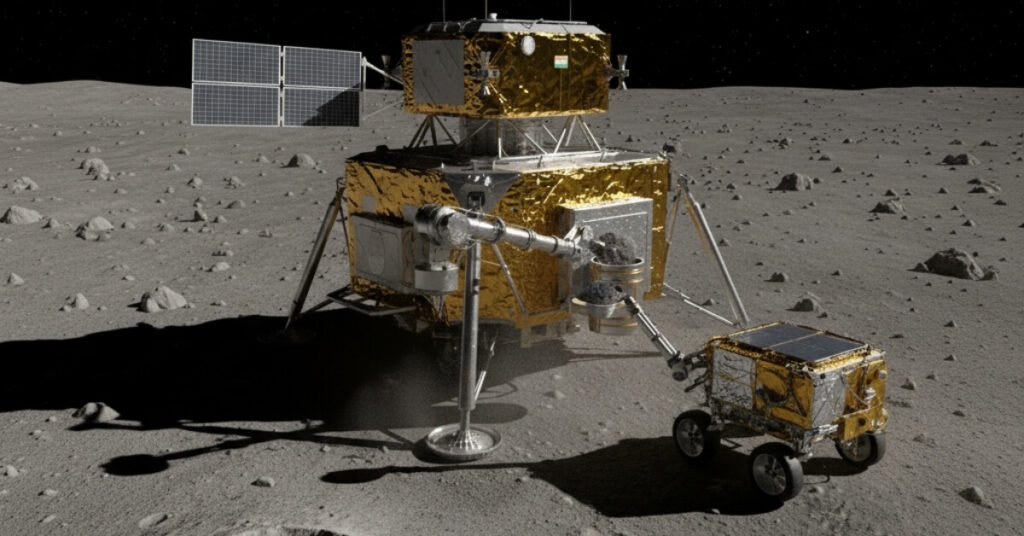
India’s space programme is preparing for one of its most ambitious steps yet — the Chandrayaan-4 Lunar Sample-Return Mission, tentatively planned for launch in 2028. ISRO Chairman S. Somanath recently confirmed that the mission has received approval from the Central Government, marking the beginning of India’s bold attempt to bring lunar soil and rock samples back to Earth for the very first time.
This mission will upgrade India from lunar landing success to deep-space sample-return capability, a domain currently dominated only by the USA and China.
A Quick Look Back: Chandrayaan-1, 2, and 3
🔹 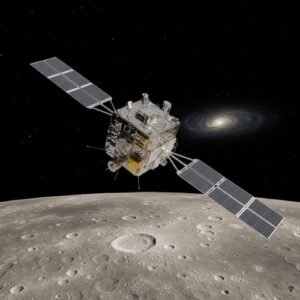 Chandrayaan-1 (2008)
India’s first lunar mission made historic discoveries, including confirming the presence of water molecules on the Moon. It placed India among the elite group of lunar-capable nations and transformed global lunar science.
🔹 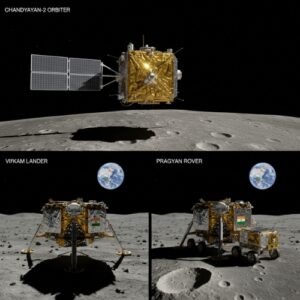 Chandrayaan-2 (2019)
This mission carried an orbiter, lander, and rover. Although the lander Vikram crash-landed, the orbiter continues to operate successfully, sending high-resolution images and mapping the lunar surface.
🔹 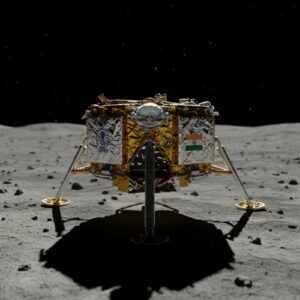 Chandrayaan-3 (2023)
A monumental success. India became the first nation to soft-land on the Moon’s south pole. Vikram lander and Pragyan rover operated flawlessly, proving India’s advanced landing capability.
Chandrayaan-4: India’s First Lunar Sample-Return Mission
Chandrayaan-4 marks a massive technological leap. For the first time, ISRO will attempt to:
🌕 Key Objectives
Collect lunar soil and rock samples from the Moon’s surface
Transfer the samples to a return module in lunar orbit
Bring the samples safely back to Earth
Strengthen India’s understanding of lunar geology, water-ice presence, and early Solar System evolution
🚀 Mission Architecture
This complex mission is expected to involve multiple spacecraft modules, including:
A lander for surface collection
An ascent module to lift off from the Moon
A transfer and return module to bring samples back to Earth
The mission demands precision docking, ascent, and safe re-entry — technologies ISRO is currently developing.
ISRO Chief’s Latest Statement: Chandrayaan-4 Targeting 2028
ISRO Chairman S. Somanath and VSSC Director S. Unnikrishnan Nair (Mr. Narayanan) confirmed that the agency is steadily executing its roadmap for the next phase of exploration.
Mr. Narayanan said:
“ISRO is targeting seven more launches before the end of the current financial year, including a commercial communication satellite and multiple PSLV and GSLV missions. A major milestone will be the launch of the first PSLV manufactured entirely by Indian industry. We are targeting 2028 for Chandrayaan-4.”
This marks a major push toward faster, more frequent, and increasingly complex missions.
LUPEX (Chandrayaan-5): India–Japan Mission Expected in 2027–2028
Alongside Chandrayaan-4, another highly awaited mission is LUPEX, also referred to as Chandrayaan-5 — a collaborative lunar polar exploration between ISRO and JAXA (Japan Aerospace Exploration Agency).
🗓 Expected Launch Window: 2027–2028
🔭 Mission Goals
Explore permanently shadowed regions (PSRs) near the lunar south pole
Search for water-ice and other volatiles
Deploy a large JAXA rover for deep exploration
Test long-duration lunar operations
Conduct scientific studies using payloads from India, Japan, Europe, and possibly NASA
This mission lays the foundation for future human exploration, as PSRs are rich in resources needed for future lunar bases.
India’s Growing Lunar Ambition
Together, Chandrayaan-4 and LUPEX signal ISRO’s shift from landings to resource analysis, sample return, and long-duration exploration. These missions also support the long-term goals of:
Creating a sustained lunar exploration ecosystem
Developing advanced robotic technologies
Preparing for manned missions under Gaganyaan and beyond
Strengthening global partnerships in space exploration
Conclusion
With Chandrayaan-4 targeting a 2028 launch, and LUPEX expected around 2027–2028, India is stepping into the next level of lunar science and technological innovation. From Chandrayaan-1’s water discovery to Chandrayaan-3’s south-pole landing, ISRO is now preparing to bring lunar samples home—an achievement that will place India among the world’s most advanced spacefaring nations.
The decade ahead looks transformative for Indian space exploration, as ISRO continues to chase new milestones and redefine global expectations with its ambitious missions.