
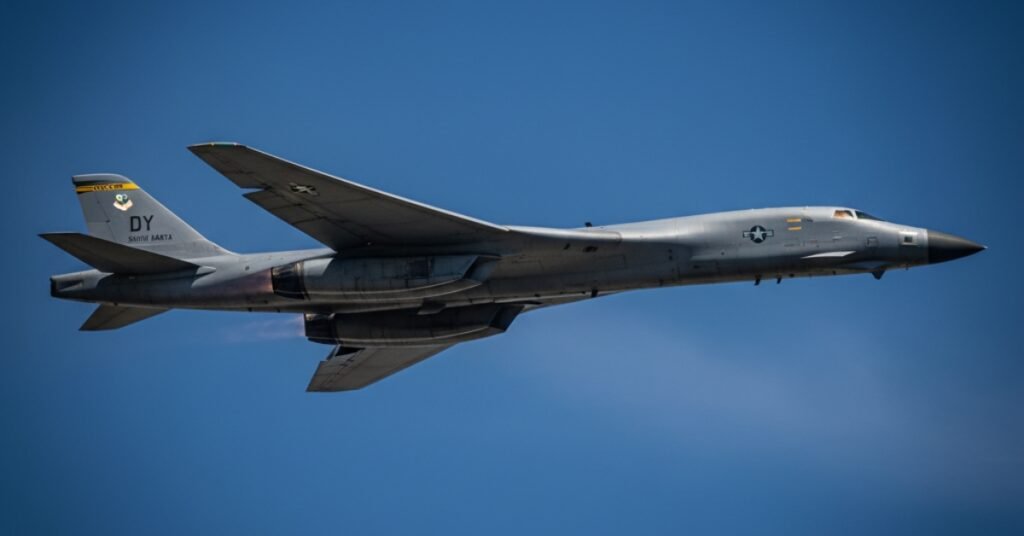
The skies over Bengaluru, India’s aerospace capital, recently echoed with a sound they had never heard before—the distinct, thunderous roar of the US Air Force’s B-1B Lancer strategic bomber. This wasn’t just another aircraft at Aero India; it was a flying symbol of a rapidly transforming military partnership. The arrival of the “Bone” (a pilot’s nickname derived from “B-One”) is more than a static display; it’s a powerful message etched across the stratosphere, marking an undeniable deepening of Indo-US defence cooperation.
But what does this mean for the future? And is there more to this story than just a diplomatic handshake?
Why the B-1B Lancer is a Game-Changer
The B-1B Lancer is not your average fighter jet. It is a long-range, multi-role heavy bomber capable of:
Massive Payloads: It can carry the largest conventional payload of both guided and unguided weapons in the US Air Force inventory.
Supersonic Speed: It can punch through enemy defenses at supersonic speeds, a rarity for heavy bombers.
Global Reach: Designed for intercontinental missions, its presence in India signals an interoperability that extends far beyond the Indian Ocean Region.
For decades, such strategic assets were kept at arm’s length. Their deployment to India for a public airshow signifies a level of trust and strategic alignment that was unthinkable two decades ago. It underscores the operationalization of foundational agreements like LEMOA (Logistics Exchange Memorandum of Agreement) and BECA (Basic Exchange and Cooperation Agreement), which facilitate the sharing of geospatial intelligence and secure communication.
This “strategic thunder” is a clear signal to adversaries that the Indo-Pacific partnership has tangible, high-end military teeth.
The Future Outlook: What to Expect Next
The B-1B’s visit is a precursor to a more integrated future. Here’s what we can expect:
Enhanced Interoperability: We will see more joint exercises involving complex platforms. Imagine Indian Su-30MKIs or Rafales flying alongside B-1Bs in simulated strike missions, practicing for a coordinated response in the vast Indo-Pacific.
Technology Collaboration: The focus will shift from mere buyer-seller relationships to co-development and co-production. Projects like the GE Aerospace jet engine deal for Indian Tejas Mk2 jets are a prime example, paving the way for cutting-edge technology transfer.
Maritime Domain Awareness: With BECA, Indian and US forces can share real-time satellite and sensor data, creating a seamless maritime picture to track potential threats across the Indian Ocean.
The Intriguing Twist: A Bomber’s Visit and India’s Next Fighter Jet?
Now, for the twist that has defence analysts buzzing. The B-1B’s arrival comes at a fascinating time—amidst ongoing trade deal tussles between India and the US. While the two nations are strategically closer than ever, disagreements on trade policies and tariffs persist.
This creates a compelling question: Is the B-1B’s display also a not-so-subtle sales pitch?
India is continuously modernizing its air force. The recent focus has been on the MRFA (Multi-Role Fighter Aircraft) program, a multi-billion dollar initiative to acquire 114 new fighter jets. While European contenders like the Rafale are strong favourites, the US is aggressively pushing its F-15EX Eagle II and the F-21 (a customized F-16 variant).
The display of the B-1B, a crown jewel of American airpower, serves as a potent reminder of the technological might of the US defence industry. It says, “If we trust you with our most strategic assets, imagine what else we can offer.”
Could the ongoing trade tensions actually be used as leverage in a larger defence package? It’s possible. A mega-deal for fighter jets could be structured in a way that balances trade deficits and satisfies strategic goals for both nations. The bomber’s flight could be the opening move in a high-stakes negotiation, showing India the pinnacle of US capability to make the case for its fighter jets.
Conclusion: More Than Just an Airshow Spectacle
The thunder over Bengaluku was a sound of change. The B-1B Lancer’s visit is a definitive milestone, proving that the Indo-US defence relationship has moved into a new, more confident, and operationally significant phase. While challenges like trade disagreements remain, the strategic imperative to secure a free and open Indo-Pacific is a far more powerful force.
The coming months will reveal whether this “strategic thunder” was merely a diplomatic gesture or the prelude to a game-changing acquisition that will reshape the Indian Air Force’s fleet for decades to come. One thing is certain: the skies are speaking, and we should all be listening.