
By Aviators360 Team | April 9, 2026
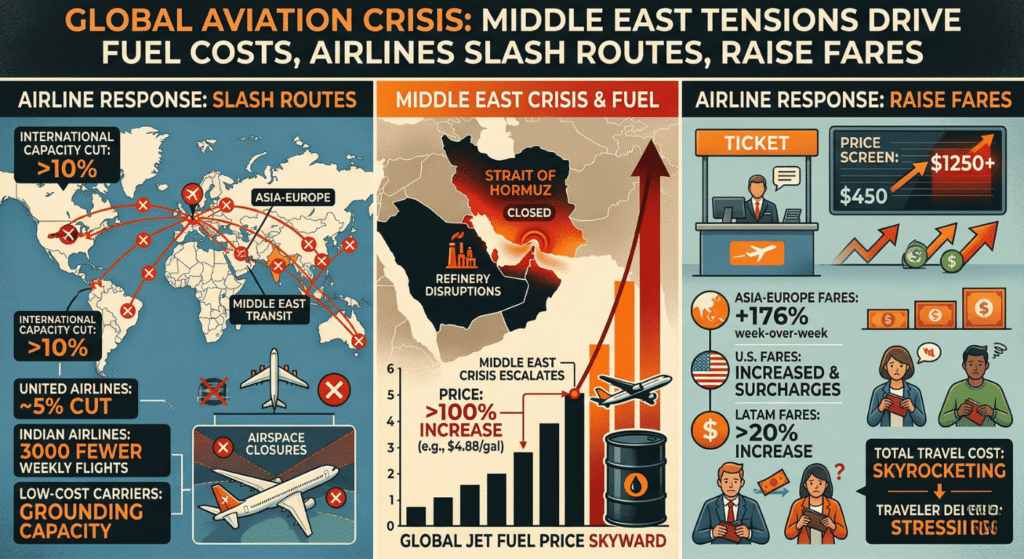
The global aviation industry is in the grip of its most severe fuel crisis since the 1970s oil shocks. With jet fuel prices more than doubling in just six weeks, airlines across the world are taking drastic measures: slashing routes, grounding aircraft, and passing unprecedented costs to passengers.
At Aviators360, we have analyzed the latest data from IATA, tracked airline announcements across four continents, and spoken to industry experts. Here is the full picture of how Middle East tensions are reshaping global air travel.
The Numbers That Explain the Crisis
Before the US-Israeli war on Iran began in late February, jet fuel traded at approximately $830 per tonne (roughly $99 per barrel) .
By the first week of April, that price had soared to $1,838 per tonne —an all-time high . IATA reported global average jet fuel prices reaching $209 per barrel last week .
For context, that is a 121% increase in just over one month .
The reason? The Strait of Hormuz, through which approximately 50% of Europe’s jet fuel imports pass, has been effectively closed by Iranian forces in response to US and Israeli attacks . The Gulf region’s refineries—including Kuwait’s Al-Zour refinery, which alone supplies roughly 10% of Europe’s jet fuel imports—have seen their output disrupted .
As one aviation expert put it: “Fuel usually represents 25% to 30% of an airline’s operating costs. At current prices, it now accounts for 45% ” .
Airlines in Emergency Mode: A Global Roundup
The response from carriers has been swift and severe. Here is how airlines across the world are reacting.
United States
United Airlines CEO Scott Kirby warned staff that sustained high fuel prices would add $11 billion to annual costs—more than double the airline’s best-ever annual profit of under $5 billion . United is cutting approximately 5% of planned flights, targeting redeye routes and slower travel days like Tuesdays, Wednesdays, and Saturdays .
Delta Air Lines CEO Ed Bastian said higher fuel prices will add $2 billion in operating expenses in the second quarter alone. The airline has scrapped plans to add summer flights, leaving about 3.5% fewer seats than originally planned .
Both airlines, along with Southwest and JetBlue, have raised checked baggage fees . United has even extended its “pay for what you want” model to premium cabins, making advance seat selection and refundable tickets optional extras .
Europe
The Lufthansa Group has suspended flights to Dubai and Tel Aviv until May 31, with Eurowings pushing its suspension to October 2026 . The group is evaluating the possibility of grounding up to 40 aircraft .
Air France-KLM is adding a €50 (approx. $54) surcharge to long-haul economy round-trips, describing it as a “contractual adjustment” that will remain until fuel volatility subsides .
British Airways has cancelled Abu Dhabi routes until near year-end and introduced surcharges on long-haul Asia-Pacific routes, adding roughly €150 ($163) to London-Singapore tickets .
SAS (Scandinavian Airlines) has cancelled approximately 1,000 flights .
Ryanair CEO Michael O’Leary warned that jet fuel supplies could face disruption starting in May if the conflict continues .
Asia-Pacific
Air India has introduced fuel surcharges reaching as high as $280 per leg on international routes, effective April 10. North America and Australia flights carry the $280 fee, while Europe routes face a $205 surcharge . For domestic travel, the airline replaced its flat fee with a distance-based grid .
IndiGo, India’s largest carrier, introduced distance-based fuel charges starting April 2. International long-haul sectors to the UK and Europe now carry a flat fee of approximately $120 per leg .
Air New Zealand is cutting flights on routes in and out of Auckland, Wellington, and Christchurch. “Like airlines globally, we’re experiencing jet fuel prices that are more than double what they would usually be,” a spokesperson said .
Cathay Pacific doubled its fuel levy across all long-haul routes effective April 1. Surcharges for flights to North America, Europe, and the Southwest Pacific are now approximately HK$1,560 ($200) .
Korean Air tripled its international fuel surcharges on April 1, with new fees ranging from approximately $31 to $225 per one-way trip .
Qantas added immediate surcharges of $100 to $800 depending on route and cabin class .
China Eastern Airlines raised surcharges on domestic flights .
Vietnam Airlines cancelled around 20 domestic flights per week starting in April due to a lack of jet fuel .
Middle East
Emirates and Qatar Airways have reduced operations to skeleton repatriation schedules . Emirates is now adding fuel surcharges of $322 for economy and $1,023 for business/first class per leg on flights to the Americas .
The Rerouting Nightmare: Longer Flights, Higher Costs
Beyond fuel prices, airlines face the challenge of finding safe paths through increasingly restricted airspace.
Since the war began, at least eight countries have shut their airspace: Iran, Israel, Iraq, Jordan, Qatar, Bahrain, Kuwait, and the UAE . By March 3, cancellations across seven major Middle East airports had exceeded 12,300 flights .
The Middle East had become a critical detour route after Russian and Ukrainian airspace closed in February 2022. With this corridor now largely shut too, airlines face a narrowing set of viable paths .
Routes between East and West are now bottlenecked through temporary safer corridors—north via Central Asia or south via North Africa and the Arabian Peninsula . On some of the busiest Europe-to-Asia routes, flight times have increased by one to three hours .
“Every additional minute in the air translates into higher fuel burn and tighter margins,” explained Mazen Sammak, a pilot and aviation expert. “Fuel is one of the main components of an airline ticket price, accounting for roughly 25 to 40 percent” .
Insurance companies have also applied much higher war risk premiums, especially in a region where rockets and drones are used .
The Financial Toll: $53 Billion and Counting
The top 20 global airlines, including Qatar Airways and Emirates, are estimated to have lost approximately $53 billion due to disruption and higher operating costs .
BNP Paribas estimates that global schedules for April have been cut roughly 5% compared with earlier plans. Most reductions are in the Middle East, though smaller cuts are emerging in Europe, Asia, and North America .
The crisis is widening the gap between financially stronger airlines and weaker operators. Smaller carriers—particularly those serving regional needs like pilgrimage routes to Najaf—are not equipped to last long periods without flying .
As Fadi Ramadan, a pilot based in Cyprus, noted: “There are a lot of small airlines that serve regional needs that are not equipped to last long periods of time without flying” .
The Passenger Impact: Higher Fares, Fewer Choices
For travelers, the crisis translates into a perfect storm of higher prices and reduced options.
Ticket prices have increased by up to 560% on some routes globally . US and European domestic flight fares have risen 200% to 300% in some cases .
Budget airlines and price-conscious travelers are feeling the pinch first and most acutely. “Leisure travelers and budget conscious travelers are going to absolutely feel it first because it may make the difference between going and not going,” said Shye Gilad, a former airline captain now teaching at Georgetown University .
Anna Del Vecchio, a Seattle resident who annually visits family in Philadelphia before flying to Paris, found ticket prices hovering around $1,400—nearly double what she has paid in past years. “It wasn’t even scratching the surface for the flight this time,” she said, “so I decided to delay the trip” .
For business travelers, the uncertainty is equally challenging. Bill Moorehouse, a solutions director who travels every four to six weeks, told AP: “When you have business trips and you have a carefully coordinated schedule, you don’t want unknowns and disruptions. And right now, it just feels like it’s more likely that things could go wrong” .
The Structural Shift: Gulf Hubs Under Threat
Perhaps the most profound long-term question is what this crisis means for the Middle East’s position as a global aviation hub.
Before the war, Dubai was the world’s second-biggest airport for passenger transit, after Atlanta, while Doha had passenger levels rivalling Hong Kong and Frankfurt . The region’s carriers built highly efficient hub-and-spoke networks around their geography.
But when that geography becomes unreliable, the entire model looks vulnerable .
European and Asian carriers that have long-distance planes available have started direct flights between East and West, bypassing Gulf hubs altogether .
“For years, regional carriers built highly efficient hub-and-spoke networks around their geography,” said Laith Rashid, an Airbus A320 pilot. “But when that geography becomes unreliable, the entire model looks vulnerable. This is not a temporary bump in the road. It feels more like a structural crack in the system” .
Traffic has a way of finding new paths, and secondary hubs in Southern Europe, North Africa, or Central Asia could quietly gain ground .
What Comes Next: The IATA Warning
Even if a ceasefire holds—and on April 8, the US and Iran agreed to a two-week truce with the Strait of Hormuz temporarily reopened—the aviation industry faces a long recovery .
Willie Walsh, director of the International Air Transport Association (IATA), warned this week that even if the ceasefire succeeds, it will still take months for jet fuel supplies and prices to normalise .
“Given the disruption to refining capacity in the Middle East, it will still take months for supply to be restored,” Walsh said. “I don’t think it’s going to happen in weeks” .
He noted that past experience shows the industry will respond by raising ticket prices further. “That is unavoidable,” he said .
Analysts at Vortexa warn that “starting from an already tight market, the current lack of Middle East jet fuel exports is worsening the situation. Given global jet fuel exports are currently at their lowest point in four years, the same level of air travel demand will likely not be sustainable if disruptions persist” .
The Aviators360 Take
At Aviators360, we have covered aviation crises before—9/11, the 2008 financial crash, COVID-19, the Ukraine war. Each time, the industry has shown remarkable resilience.
But this crisis is different.
It combines simultaneous shocks: a fuel price spike worse than any since the 1970s, the closure of critical airspace that forces longer routes, the suspension of a key global hub network, and demand uncertainty as passengers rethink travel plans .
For passengers, the message is clear: expect higher fares and fewer flight options for the foreseeable future. Even if oil prices drop, airlines can take months—sometimes up to a year—to adjust fares as they wait for energy markets to stabilize .
For the industry, the challenge is existential for some carriers. The gap between strong and weak airlines will widen. Some smaller players may not survive .
But aviation has always found a way. As Ramadan noted, “COVID created an unprecedented disruption worldwide, but the industry recovered surprisingly quickly” .
The question is not whether the industry will recover—it is what the map of global aviation will look like when it does.
*We will continue to track this developing story. For real-time updates on fuel prices, airline surcharges, and route changes, stay tuned to Aviators360—India’s trusted voice in aviation insights.*
Disclaimer: This article is based on information available as of April 9, 2026. Fuel prices, airline policies, and geopolitical conditions are subject to rapid change. Passengers are strongly advised to check with their airline directly before traveling