
Introduction: A Precarious Industry
The mid-2000s in Indonesia were a boom time for aviation. New, low-cost carriers were springing up, making air travel accessible to millions. Among them was Adam Air, an airline whose slogan promised “The Best Way to Fly.” But beneath the glossy marketing and competitive fares lay a foundation built on sand. The true cost of this rapid expansion would be paid not in Rupiah, but in safety, and it would be horrifyingly exposed on a seemingly routine flight to Surabaya.
This is not just the story of a hard landing. It is the story of a single incident that acted as a stark, unheeded warning, cracking open the facade of an airline hurtling toward catastrophe.
The Flight: KI-172, A Routine Journey Turns Critical
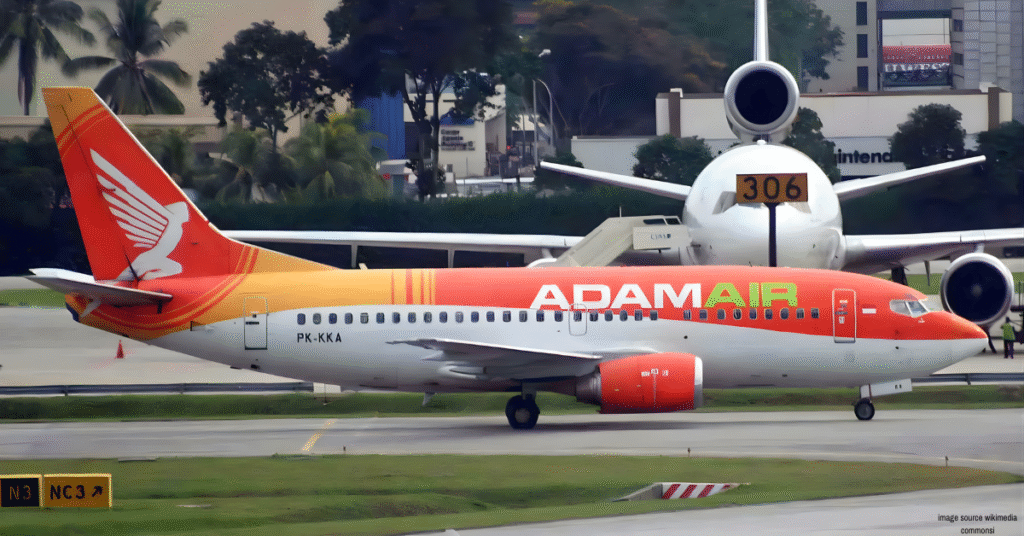
On February 21, 2007, Adam Air Flight KI-172 was operating a domestic route from Denpasar, Bali, to Juanda International Airport in Surabaya, East Java. The aircraft was a Boeing 737-300, a workhorse of the global aviation industry, with the registration PK-KKC. On board were 96 passengers and 6 crew members, all expecting a short, uneventful hop.
As the aircraft began its descent into Surabaya, the weather began to deteriorate. The area was experiencing heavy rain and significant turbulence. While challenging, these conditions are well within the operational capabilities of a Boeing 737 and its trained crew. However, what happened next was far from a standard procedure.
Witnesses on the ground and data from the flight recorder would later paint a terrifying picture. The aircraft approached the runway but flared too high, essentially dropping onto the tarmac with immense force. The impact was so violent that passengers were thrown from their seats, and the overhead bins sprang open, showering the cabin with luggage.
Miraculously, the pilots managed to keep the aircraft on the runway and bring it to a stop. The immediate danger seemed to have passed. But the real damage was hidden from plain view.
The Aftermath: A Fuselage Cracked in Two
As the shaken passengers disembarked, the full extent of the trauma inflicted upon PK-KKC became apparent. The aircraft hadn’t just experienced a “hard landing”; it had undergone a structural failure that pushed it to the very brink of disintegration.
The force of the impact had cracked the fuselage right through the middle of the passenger cabin. The airframe was visibly bent, and the skin was ruptured. In aviation terms, this is a catastrophic event. The fuselage is a pressurized vessel, and a breach of its integrity at altitude could have led to an explosive decompression and the complete breakup of the aircraft.
The fact that this rupture occurred on the ground was the only thing that prevented a total disaster. Flight KI-172 was a hairsbreadth from becoming a fatal accident. The aircraft was so badly damaged it was declared a hull loss—a total write-off.
A Pattern of Neglect: The Investigation Unearths a Toxic Culture
The cracked fuselage of PK-KKC was a symptom of a much deeper sickness within Adam Air. The official investigation, led by Indonesia’s National Transportation Safety Committee (NTSC), peeled back the layers of this near-disaster to reveal a culture of staggering negligence.
Key findings included:
Poor Maintenance Practices: The investigation found that Adam Air’s maintenance programs were chronically substandard. There were records of repeated, unresolved issues with the aircraft’s systems, including its autopilot and navigation units. The airline was operating on a razor’s edge, deferring essential repairs to keep planes in the air.
Inadequate Pilot Training and CRM: The crew’s handling of the adverse weather conditions was heavily criticized. The cockpit resource management (CRM)—the system of communication and decision-making between pilots—was found to be poor. The investigation suggested that the pilots may have been inadequately trained to handle wind shear and crosswinds, leading to the botched landing.
Disregard for International Standards: Adam Air was found to be consistently cutting corners, ignoring both manufacturer (Boeing) guidelines and international safety standards set by bodies like the International Civil Aviation Organization (ICAO). The pursuit of profit had blatantly overridden the commitment to safety.
A Chilling Prelude: The Ghost of Flight KI-574
What makes the story of PK-KKC even more haunting is the context. Just one month earlier, on January 1, 2007, another Adam Air Boeing 737-400 (Flight KI-574) had crashed into the Makassar Strait off Sulawesi. All 102 people on board were killed.
The cause of that crash? A catastrophic failure of the inertial navigation system, which the pilots failed to address correctly, leading to a loss of control. The parallels were undeniable: inadequate maintenance, insufficient training, and systemic failure.
The Surabaya incident was a screaming red flag. It was a second, massive warning sign that the problems within Adam Air were not isolated but endemic. The cracked fuselage was a physical manifestation of the airline’s broken safety culture.
The Inevitable Collapse: The End of Adam Air
The double tragedies of early 2007 shattered public confidence in Adam Air. Passengers voted with their feet, and the Indonesian government was forced to act under intense national and international pressure.
Regulators suspended Adam Air’s license for routes to and from Surabaya and launched a sweeping audit of its entire operation. The audit confirmed the worst fears. The airline’s safety certificates were progressively revoked throughout 2008. Unable to operate and drowning in debt and infamy, Adam Air officially ceased all operations in June 2008.
Its demise was not an accident of the market; it was a direct consequence of its actions.
Legacy and Lessons Learned
The story of Adam Air Flight KI-172 is a sobering case study in aviation safety. It serves as a powerful reminder that safety is not a given; it is a culture that must be built, maintained, and fiercely protected.
The legacy of this incident and the fatal crash that preceded it was profound for Indonesia:
Regulatory Overhaul: The Indonesian government drastically reformed its aviation safety oversight, leading to the creation of a more robust and independent regulatory body.
Global Scrutiny: The European Union banned all Indonesian airlines from its airspace—a ban that took years of rigorous work to lift, forcing the entire industry to reform.
A Permanent Memorial: The story stands as a permanent memorial to the victims of Flight KI-574 and a stark lesson that in aviation, there is no room for compromise. The passengers and crew of KI-172 were the lucky ones who survived to tell a tale that ultimately grounded an unsafe airline.
The crack in the fuselage of PK-KKC was more than a structural failure; it was the crack through which the world saw the truth about Adam Air. It was the landing that didn’t just mark a runway, but one that marked the end of an era of impunity and the beginning of a hard-won journey toward safer skies.