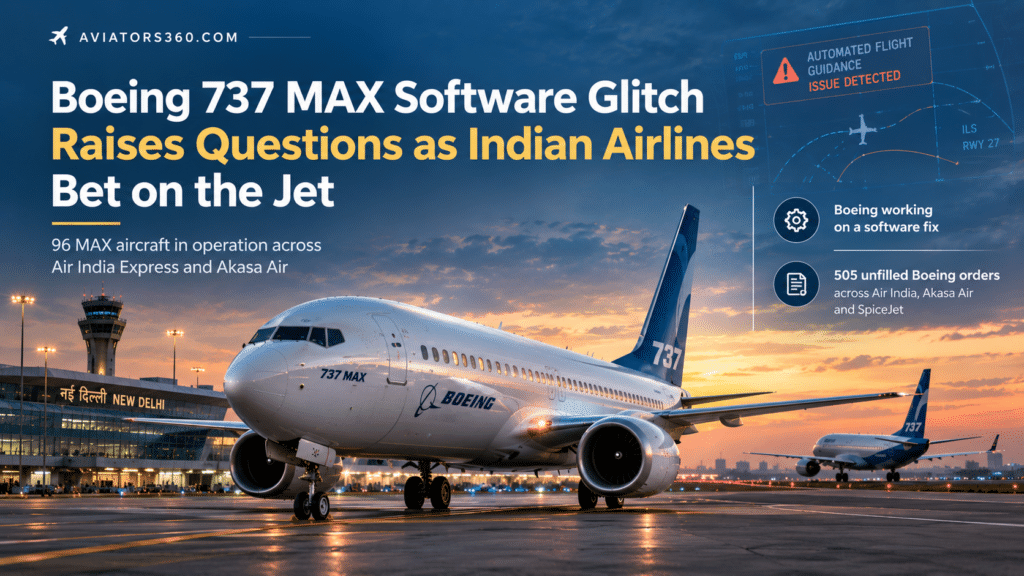
A newly identified software issue on the Boeing 737 MAX has put the aircraft back in the spotlight, particularly in India, where airlines are building large fleets around Boeing’s popular narrowbody jet.
The issue involves automated flight guidance during a specific landing scenario. Boeing has informed 737 operators and is working on a permanent software update. The company has also reinforced existing pilot procedures for handling the situation safely.
The development is particularly relevant to India because Air India Express and Akasa Air together operate around 96 Boeing 737 MAX aircraft. Air India Express has approximately 53 aircraft of the type, while Akasa Air operates 43.
What Is the Boeing 737 MAX Software Issue?
The problem can occur during a go-around, when pilots discontinue a landing and prepare for another approach.
According to current reports, the issue can arise when the flight crew changes the aircraft’s planned altitude or flight path after a missed approach. Under the specific circumstances, pilots may experience reduced automation or lose access to certain automated flight-guidance functions.
Boeing said it notified operators about the issue last month and provided information reinforcing existing procedures. Its engineers are now developing a software update intended to permanently resolve the problem.
Importantly, the aircraft can still be flown manually. Pilots are trained to manage the aircraft without the affected automated functions, and Boeing has emphasized existing procedures for dealing with the situation.
What Is Akasa Air Saying?
Akasa Air has responded to concerns about the software issue by saying that there is no impact on the safety of its operations.
The airline said it is coordinating closely with Boeing and that its aircraft continue to operate according to established procedures and applicable regulatory requirements. Akasa currently operates 43 Boeing 737 MAX aircraft.
The airline has not publicly specified whether any of its individual aircraft have experienced the reported issue.
Air India Express, which operates more than 50 737 MAX aircraft, had not immediately provided a public response in some reports.
Why the Issue Matters to Indian Aviation
The timing is significant because Indian airlines have placed substantial bets on the Boeing 737 MAX.
Air India, Akasa Air and SpiceJet collectively have hundreds of Boeing aircraft on order. According to customer order data reported by The Economic Times, the three airlines have 505 unfilled Boeing orders, including 737 MAX aircraft as well as other Boeing models.
Akasa Air alone has 183 unfilled 737 MAX orders, according to the same report. The airline is also reportedly discussing a potential additional order of more than 200 737 MAX aircraft, with a decision expected in 2027.
This makes the resolution of the software issue important not only for current operations but also for the long-term fleet strategies of Indian carriers.
Air India Is Also Expanding Its 737 MAX Fleet
Air India is another major Indian customer for the 737 MAX.
In January 2026, Boeing announced that Air India had ordered an additional 30 737 MAX aircraft, consisting of 20 737-8s and 10 737-10s. The purchase expanded the airline’s existing Boeing order book as it continues rebuilding and modernizing its fleet.
The 737 MAX is intended to support domestic and short-haul regional services where airlines require relatively efficient narrowbody aircraft with sufficient range for a broad network.
What Happens Next?
Boeing is working on a permanent software fix while operators continue following the procedures already provided by the manufacturer.
The U.S. Federal Aviation Administration has also said it will convene a corrective action review board and take immediate action if it identifies a safety concern.
For Indian airlines, the immediate focus will be on implementing Boeing’s guidance, monitoring their fleets and incorporating any approved software updates.
The incident also highlights an important reality of modern aviation: aircraft increasingly depend on sophisticated software and automated systems, but pilots remain trained to manage situations when automation becomes unavailable.
The Bigger Picture for Boeing and India
The Boeing 737 MAX remains a major part of India’s future aviation growth. With passenger demand increasing and airlines placing large aircraft orders, narrowbody jets will remain central to domestic and regional connectivity.
Boeing forecasts that India and South Asia will require thousands of new aircraft over the next two decades, with the majority expected to be single-aisle aircraft.
That makes India an important market for the 737 MAX programme.
The latest software issue therefore arrives at a significant moment. Boeing must resolve the technical problem efficiently, while Indian airlines must continue managing their expanding MAX fleets and future deliveries.
For passengers, the most relevant takeaway is that the reported issue concerns a specific flight-guidance scenario, airlines have existing procedures for handling it, and Boeing is developing a permanent software fix. Current statements from Akasa Air say the issue has not affected the safety of its operations.
Key Takeaways
- Boeing has identified a software issue affecting automated flight guidance on some 737 MAX aircraft.
- The issue can occur during a specific go-around and landing scenario.
- Boeing has informed operators and is developing a permanent software update.
- Air India Express and Akasa Air operate approximately 96 Boeing 737 MAX aircraft combined.
- Akasa Air says there is no impact on the safety of its operations.
- Indian airlines have hundreds of Boeing aircraft on order.
- Akasa Air is also reportedly considering another major 737 MAX order.
- The development highlights the growing importance of software reliability as modern aircraft become increasingly automated.