
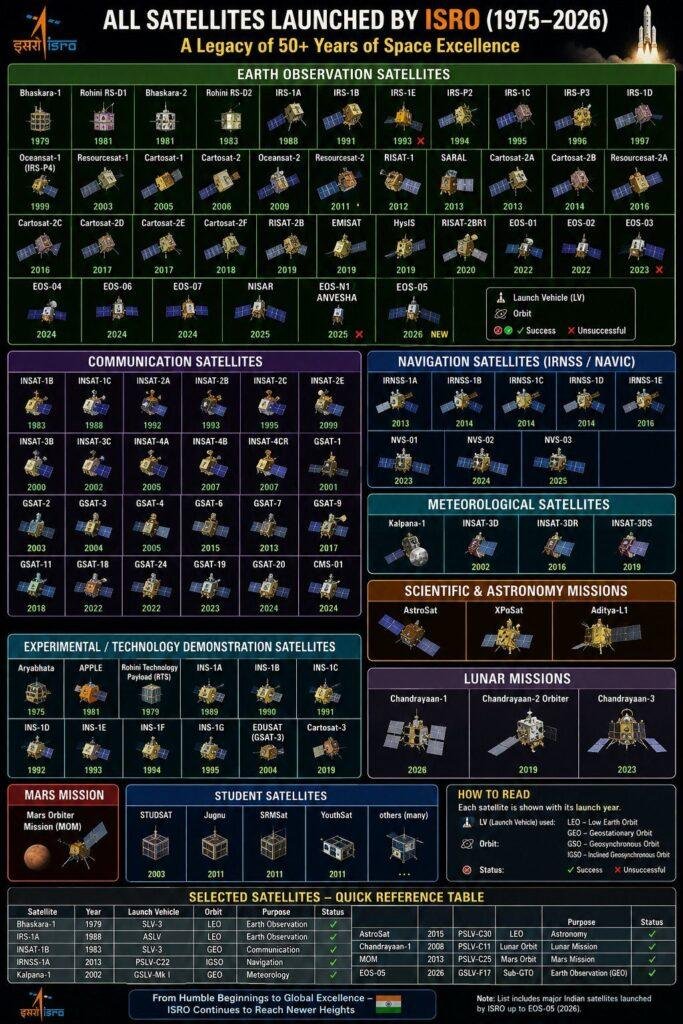
The Indian Space Research Organisation (ISRO) scripted a new chapter in the nation’s space history on September 4, 2026, with the successful launch of the EOS-05 satellite. This state-of-the-art Earth observation spacecraft is India’s first-ever imaging satellite designed to operate from a geosynchronous orbit, a feat that places a permanent, unblinking “eye in the sky” over the Indian subcontinent .
The Launch and the ‘Naughty Boy’
At precisely 2:55 AM, the Geosynchronous Satellite Launch Vehicle (GSLV-F17) lifted off from the second launch pad at the Satish Dhawan Space Centre in Sriharikota . After a smooth 27.5-hour countdown, the 51.7-metre-tall rocket, affectionately nicknamed the “Naughty Boy” by ISRO scientists for its historically unpredictable performance, flawlessly injected the 2,367 kg satellite into its intended sub-geosynchronous transfer orbit just 18 minutes later . This marked the 19th flight of the GSLV and the heaviest satellite ever carried by this variant of the launch vehicle .
The mission’s success was a moment of immense relief and pride for ISRO, serving as a powerful comeback after a nearly eight-month lull in launches. It effectively put behind the failure of the GSLV-F10/EOS-03 mission in August 2021 and recent setbacks with the PSLV . A beaming ISRO Chairman, Dr. V. Narayanan, confirmed the mission’s success, stating, “I am very happy to announce that the GSLV-F17 vehicle has successfully and precisely injected the advanced EOS-05 geo imaging satellite in the intended and required orbit” .
A New Perspective: The Power of Geosynchronous Orbit
So, what makes EOS-05 truly revolutionary? Most of India’s existing Earth-observation satellites, such as those in the Cartosat and RISAT series, operate in Low Earth Orbit (LEO), circling the planet at a much lower altitude. While these satellites provide high-resolution images, they are in constant motion, meaning they can only image a specific location when they pass over it, which may happen only once every few days .
EOS-05 is built on a fundamentally different concept. It is positioned at an altitude of roughly 36,000 km above the Earth’s equator. At this height, the satellite’s orbital period matches the Earth’s rotation, allowing it to remain stationary over the same broad region—in this case, the South Asian landmass . This geosynchronous vantage point provides a continuous, real-time view, effectively acting as a dedicated sentinel for the nation .
Capabilities and Applications
The satellite is equipped with advanced multi-spectral and hyperspectral sensors, enabling it to capture images with a spatial resolution of 42 metres, the highest for an Indian camera in geostationary orbit . Its ability to observe the same area frequently is its greatest strength. It can capture and transmit images covering the entire country in about 30 minutes and revisit priority targets in as little as five minutes .
This rapid and repeated imaging capability has vast applications:
Disaster Management: For monitoring rapidly evolving events like cyclones, floods, and forest fires, where a picture from a few hours ago is already outdated, EOS-05 provides near real-time intelligence to aid in emergency response and mitigation .
Strategic and Security Monitoring: The satellite will provide crucial “strategic data” for the country, offering a continuous watch over India’s vast borders, maritime zones, and the wider neighbourhood .
Agriculture and Environment: It will support agriculture by monitoring crop health, vegetation changes, and soil moisture, while also assisting in forestry, environmental assessment, and natural resource management .
A Milestone for India’s Space Programme
ISRO officials, while acknowledging its strategic applications, dismissed suggestions that EOS-05 is solely a “spy satellite”, emphasizing its broad civilian and scientific utility . Dr. Narayanan noted that while the satellite has an assured mission life of seven years, he is confident it will work effectively for more than nine .
The launch was met with widespread congratulations from across the nation. Prime Minister Narendra Modi hailed it as a reflection of India’s excellence and innovation in the space sector, while Home Minister Amit Shah termed it a significant step for India’s space journey .
With the successful deployment of EOS-05, India has not only enhanced its Earth observation capabilities but has also mastered a complex technology, securing a powerful and persistent platform for both national progress and security.