
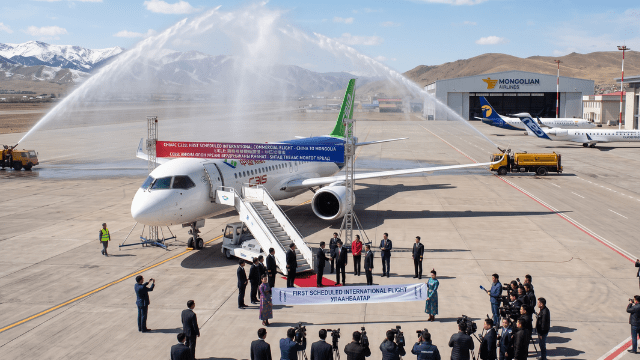
On August 12, 2026, a Chinese-made C919 passenger jet operated by Air China departed Beijing Capital International Airport and landed at Mongolia’s new Ulaanbaatar airport, marking the aircraft’s first scheduled international commercial flight . The daily round-trip service (CA723/CA724) was greeted with a water salute upon arrival, signaling a symbolic milestone in Beijing’s long-standing ambition to challenge the decades-old aviation duopoly of Boeing and Airbus .
The C919, a narrow-body single-aisle jet designed to compete directly with the Boeing 737 MAX and Airbus A320neo families, has been in domestic commercial service since May 2023 . As of mid-2026, C919s operated by Air China, China Eastern, and China Southern were serving 57 routes across 25 cities, having safely carried over 7.5 million passengers . The Ulaanbaatar route, however, moves the aircraft beyond its domestic comfort zone, giving COMAC and its airline partners a chance to accumulate operational experience away from the home market and test international support capabilities, including maintenance cooperation and spare-part arrangements .
Can COMAC Challenge the Duopoly?
The short answer: not yet, but the trajectory is significant.
Industry analysts point to both promise and persistent hurdles. The C919’s first international flight is a step forward, but it is a cautious one. Mongolia was chosen in part because of existing bilateral aviation arrangements and airworthiness certification agreements, making it a low-risk entry point . This is a far cry from securing approval from major Western regulators like the European Union Aviation Safety Agency (EASA) or the U.S. Federal Aviation Administration (FAA), which remains a critical gatekeeper for widespread global sales. EASA has indicated the certification process could take three to six years or more . Without these certifications, the C919’s appeal in mature aviation markets—Europe and North America—will remain severely limited .
Furthermore, the C919 is still heavily reliant on foreign components. Its engines, for instance, are manufactured by CFM International, a joint venture between U.S.-based GE Aerospace and France’s Safran . This dependence makes COMAC vulnerable to geopolitical tensions and supply chain disruptions . The manufacturer is developing a domestic engine alternative, but that is a long-term project .
Production and scale also remain major challenges. While COMAC has built up a substantial order backlog exceeding 1,000 aircraft, deliveries have been slow. By the end of 2025, only 32 C919s had been delivered, compared to roughly 100 narrow-body aircraft that Airbus delivered to China in a single year . COMAC aims to produce 200 aircraft annually by 2029, but analysts view this as a stretch given current production rates . The company’s slow pace of development and production means it is still a long way from genuinely competing with the established production lines and global support networks of Boeing and Airbus .
The Opportunity in the Gap
Despite these obstacles, COMAC is not without advantages. The timing is strategic. Airlines across Asia-Pacific are facing prolonged delivery delays from Boeing and Airbus due to production bottlenecks and supply chain issues . This creates a window for a third option. IATA Director General Willie Walsh has acknowledged that COMAC will take time but could become a serious global competitor in the long run .
COMAC is also pursuing a targeted international strategy. The company has already secured operators for its smaller C909 regional jet in Southeast Asia, including Indonesia’s TransNusa, Lao Airlines, and Vietjet . It is actively marketing the C919 in developing regions—Southeast Asia, the Middle East, and Africa—where airlines are cost-sensitive and less dependent on Western certifications . In some cases, COMAC has paired aircraft sales with attractive financing, leasing arrangements, and even equity participation in foreign carriers, as seen with Lao Airlines, where COMAC secured a 49% stake . This financing-led approach provides a competitive edge in fiscally constrained markets .
Verdict
The C919’s first international flight is a genuine milestone. It proves the aircraft can operate beyond Chinese borders and demonstrates China’s commitment to building a national champion in civil aviation. However, it is an early step on a very long road.
For now, COMAC remains a supplementary player rather than a true competitor to Boeing and Airbus . To truly challenge the duopoly, COMAC must secure Western certification, ramp up production to meet its ambitious targets, build a global support and maintenance network, and reduce its reliance on foreign suppliers. As one analyst noted, “In the mid-2030s, it may have enough production… airlines could pivot to the C919” . The ambition is clear, but the execution will take a generation.