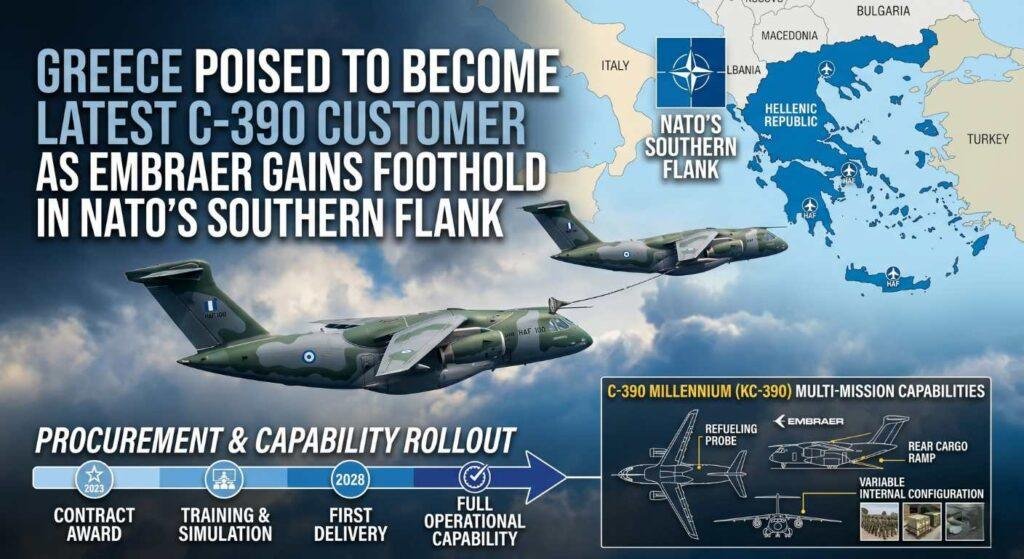
The Hellenic Air Force (HAF) is on the verge of a significant transformation of its tactical airlift capabilities. Following a decisive approval by a Greek parliamentary committee, the country is poised to become the latest operator of the Embraer C-390 Millennium, a move that signals a major shift away from legacy Lockheed Martin platforms toward next-generation, jet-powered efficiency .
The acquisition, which is part of a broader €28 billion defense modernization plan, is expected to be finalized pending ratification by the Government Council for Foreign Affairs and Defence (KYSEA) . Here is everything you need to know about the deal and why it matters for NATO.
The Deal: Numbers and Timelines
Athens has approved a procurement program valued at approximately €597.6 million ($640 million) for three aircraft. This figure includes contractual reserves and initial support packages. The direct cost for the three airframes is estimated at €473.7 million, roughly €157.9 million per unit—a competitive price point for a medium airlifter .
According to current timelines, Athens expects the first aircraft to arrive in 2027, with the final delivery scheduled for 2030 . The deal is structured as a government-to-government agreement involving Portugal, a NATO ally that already operates the Millennium and will likely facilitate training and initial logistical support .
Why the C-390? The End of the Hercules Era
The Hellenic Air Force has historically been a bastion of the C-130 Hercules, having operated the platform for over five decades. However, the fleet—comprising aging C-130B/H models—has faced increasing availability issues and high maintenance costs due to sheer age .
Initially, it was presumed that Athens might opt for the modernized C-130J Super Hercules. However, the selection of the C-390 represents a strategic bet on a more modern, jet-powered platform . Here is how the Brazilian-made jet compares to its turboprop rival:
Speed and Altitude: The C-390 cruises at 470 knots (870 km/h) and can reach 36,000 feet. This allows it to fly above adverse weather and complete time-sensitive missions much faster than the turboprop Hercules .
Payload Capacity: While the C-130J is a workhorse, the C-390 carries a larger payload. It can handle a maximum load of 26 tons (or 23 tons over standard range), surpassing the stretched C-130J .
Operational Costs: Embraer and defense analysts argue that despite being a jet, the C-390 offers lower lifecycle costs due to its use of commercial IAE V2500 engines, which share commonalities with civil aviation fleets .
The “Tanker” Gap: A Strategic Asset
Beyond troop and cargo transport, the acquisition addresses a critical capability gap for the Hellenic Air Force. The C-390 is available in a KC-390 configuration, which includes aerial refueling pods.
For years, Greece has relied on other NATO allies for probe-and-drogue refueling support. The KC-390 can act as a tanker for fighters or helicopters, or receive fuel itself to extend its range. This dual-role capability provides the HAF with operational autonomy previously unavailable from their medium airlift fleet .
Industrial Cooperation: The HAI Factor
A crucial component of the deal—and a likely deciding factor—is the industrial partnership. On May 22, 2026, Embraer signed a Memorandum of Understanding (MoU) with the Hellenic Aerospace Industry (HAI) .
This agreement establishes in-country Maintenance, Repair, and Overhaul (MRO) capabilities for the C-390.
*“This agreement … is designed to equip the HAF with the operational and support autonomy needed to manage its future C-390 aircraft fleet.”* – Embraer Statement, May 2026 .
By involving HAI, Embraer is offering Greece more than just a plane; it offers a industrial ecosystem, creating local high-tech jobs and ensuring that maintenance does not require the fleet to be sent abroad .
The European Momentum
Greece joining the C-390 club adds to a rapidly growing list of European nations. The Millennium has already been selected by:
Portugal (Acquisition)
Hungary (Acquisition)
Netherlands & Austria (Joint procurement of 9 units)
Czech Republic
Sweden
Lithuania
For Greece, operating the same platform as key EU and NATO partners enhances interoperability. Joint training missions, shared logistics pools, and common maintenance doctrines are significant force multipliers for a country managing complex regional threats .
Conclusion
While the final signature from the KYSEA council is still pending, the parliamentary approval of the budget and the solidified partnership with HAI make Greece’s status as the next C-390 customer a near certainty.
For the Hellenic Air Force, the Millennium represents a leap into the next generation of tactical aviation—trading the legacy roar of the Hercules’ turboprops for the quiet, high-speed efficiency of a modern jet.
Sources:
Aeroflap, eKathimerini, Embraer (Official Press Release), Janes, Greek Reporter, AeroTime.