
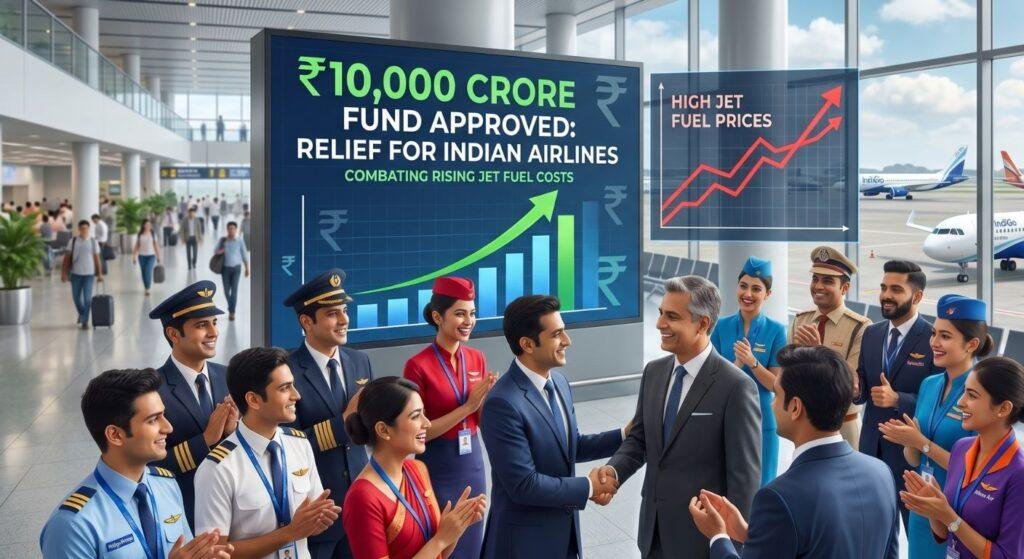
New Delhi: In a significant move to stabilize the aviation industry, the Indian government has approved a one-time budgetary support of ₹10,000 crore to create an Aviation Turbine Fuel (ATF) price stabilization mechanism . This decision, which comes in response to a sharp surge in global fuel prices due to the ongoing West Asia conflict, has been widely welcomed by major airlines across the country .
🔥 The Trigger: A 2.5x Surge in Fuel Prices
The government’s intervention was prompted by an unprecedented spike in aviation fuel costs, which directly impacts airline operating costs (typically 40-60%) .
Price Hike: International ATF prices rose nearly 2.5 times, from approximately ₹60.5 per litre in March 2026 to ₹142 per litre in May 2026 .
Strain on Sector: This surge placed immense financial strain on carriers and oil marketing companies (OMCs), threatening operational stability and the potential for sharp airfare hikes .
💰 How the ₹10,000 Crore Fund Works
The mechanism is designed as a temporary, self-correcting measure rather than a permanent subsidy .
Interest-Free Advance: The government will provide an interest-free advance of up to ₹10,000 crore to OMCs to compensate them for losses incurred when selling fuel below market rates .
Capped Prices: Under the scheme, ATF prices for airlines have been capped.
Domestic Flights: Capped at ₹75.6 per litre .
Effective Rate: The fixed benchmark price, including airport charges and taxes, works out to approximately ₹115 per litre in Delhi .
Recovery Mechanism: Once global fuel prices moderate, the amount paid to OMCs will be recovered and returned to the Consolidated Fund of India .
Duration: The support will remain in force for 36 months (with annual review) or until the entire amount is recovered .
✈️ Airline Reactions: “A Welcome Relief”
Carriers across the board have expressed gratitude, calling the government’s move a timely and progressive intervention .
Air India: “Air India warmly welcomes and deeply appreciates… this progressive measure provides much-needed support to the Indian aviation ecosystem and reinforces the Government’s commitment to strengthening connectivity,” the airline posted on X .
IndiGo: The airline described the decision as a “welcome relief” that reflects the government’s understanding of aviation’s critical role in enabling economic growth and connecting people .
SpiceJet: The airline noted that the measure will help provide “greater predictability and stability at a time when the aviation industry continues to grapple with geopolitical uncertainties and elevated fuel costs” .
Akasa Air: Akasa Air stated that the support will “ensure stability of airline operations amid global volatility, while supporting the sector’s continued contribution to connectivity, economic growth, and nation building” .
🛡️ Key Benefits for Passengers and the Economy
Beyond supporting airlines, the government emphasized that the stabilization fund is designed to protect the broader public interest .
Shielding Passengers: The primary goal is to shield air passengers from sudden fare spikes driven by global price surges .
Protecting Jobs: The move aims to protect approximately 77 lakh jobs that are dependent on the aviation ecosystem, including those in tourism, hospitality, and logistics .
Ensuring Connectivity: The scheme helps maintain domestic and international connectivity, including flights to Tier-2 and Tier-3 cities, which could have been jeopardized by rising operational costs .
Safeguarding Infrastructure: It also protects substantial public investment in airport infrastructure by keeping airline operations viable .