
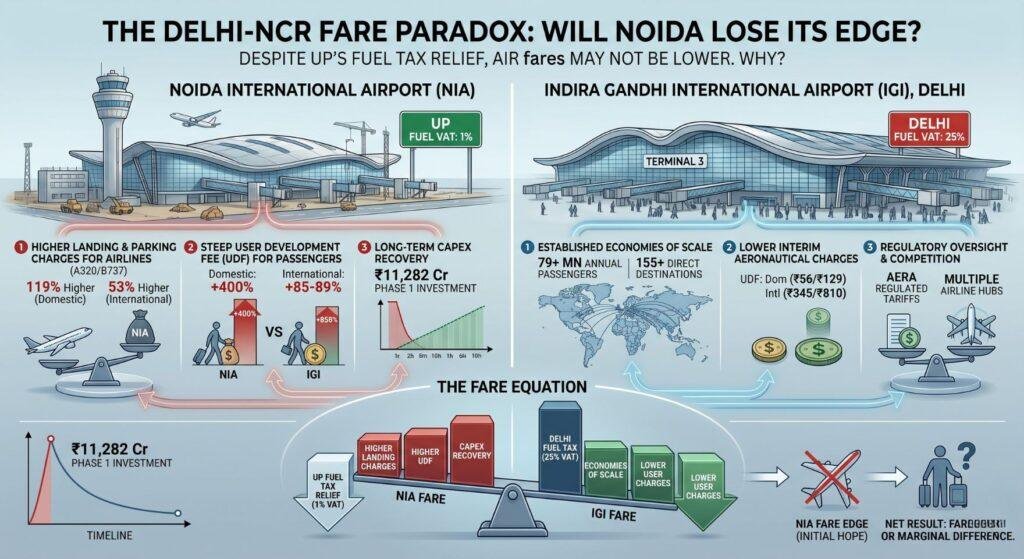
The upcoming Noida International Airport (Jewar Airport) in Gautam Buddh Nagar was widely expected to undercut Delhi’s Indira Gandhi International Airport (IGI) on airfares, thanks to aggressive tax breaks from the Uttar Pradesh government. However, a deeper look reveals that this fare advantage may be short-lived — or may never materialize at all. Here’s why.
The Fuel Tax Relief: A Promising Start
In a strategic move, the UP government slashed Value Added Tax (VAT) on Aviation Turbine Fuel (ATF) from 25% to just 1% for the first three years of operations at Jewar. This is significantly lower than Delhi’s 25% VAT. Since ATF constitutes 30–40% of an airline’s operating costs, the savings appear substantial on paper.
Why the Fare Edge Could Disappear
1. Higher Ground Handling & Airport Charges
Unlike IGI, which benefits from decades of infrastructure amortization, Noida International Airport is a new private-operator model airport. Landing, parking, and user development fees (UDF) will likely be higher to recover project costs. Airlines will pass these on to passengers.
2. Limited Catchment & Low Initial Traffic Density
IGI serves a mature market of over 7 crore people in the NCR. Jewar’s initial catchment is smaller, leading to lower flight frequencies. Without high-density operations, airlines cannot achieve the economies of scale needed to translate fuel savings into cheaper tickets.
3. Operator Profit Margins
The airport operator (Zurich Airport International) is a profit-driven entity. Competitive pressures may force it to keep charges moderate initially, but long-term profitability goals will push costs upward — potentially matching or exceeding IGI’s effective rates.
4. Connectivity Costs
Jewar is farther from central and south Delhi. For many flyers, the additional commute cost (taxi, metro extension not yet ready) and time may erode any ticket savings, making IGI more attractive despite higher base fares.
The Verdict
While the 1% VAT on ATF gives Jewar a temporary edge, factors like higher airport charges, lower passenger density, operator margins, and poor last-mile connectivity will likely neutralize the fare advantage within 2–3 years. In the long run, Noida International Airport may compete on efficiency and reduced congestion, not cheaper tickets.
For airlines and passengers, the real winner will be determined by how quickly the Noida airport scales operations and controls non-fuel costs.