
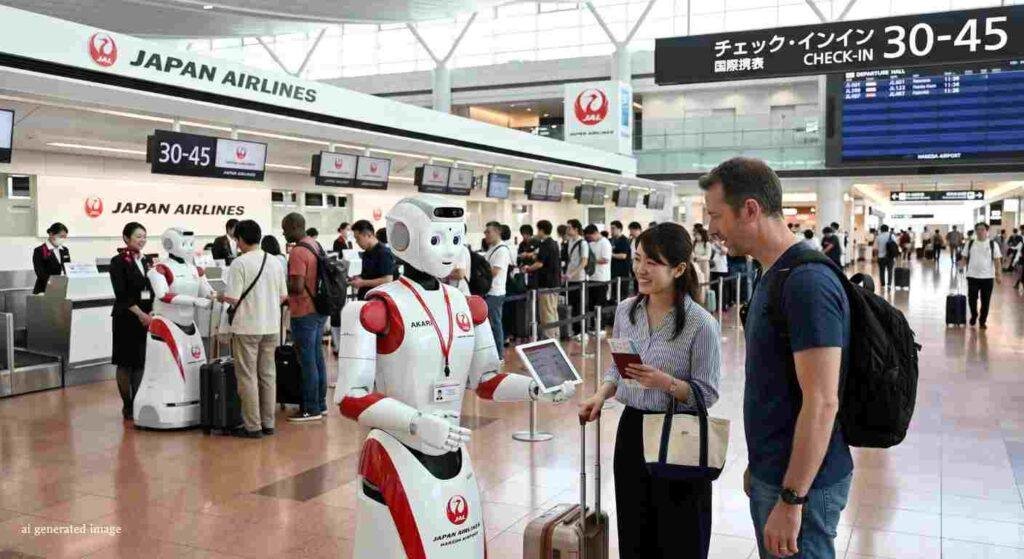
Japan Airlines (JAL) has announced a groundbreaking two-year trial of humanoid robots at Tokyo’s Haneda Airport, set to begin in May 2026. In partnership with GMO Internet Group’s AI robotics division, the airline will deploy Chinese-made humanoid robots to assist with ground handling operations, including baggage loading and unloading .
The initiative, which will run through 2028, represents Japan’s first demonstration of humanoid robots for airport ground operations. It comes as Japan’s aviation sector faces mounting pressure from two converging forces: record-breaking inbound tourism and a rapidly shrinking working-age population .
Why Humanoid Robots? The Labour Crisis in Context
Japan’s aviation industry is at a breaking point. The Japan National Tourism Organization reported over seven million foreign visitors in just the first two months of 2026, following an all-time record of 42.7 million visitors in 2025 .
Meanwhile, Japan’s aging population continues to shrink the domestic labour pool. Authorities estimate the country will need more than 6.5 million foreign workers by 2040 to sustain economic growth . Airport ground handling—which involves physically demanding tasks in confined spaces around aircraft—has been particularly hard hit.
“While airports appear highly automated and standardized, their back-end operations still rely heavily on human labor and face serious labour shortages.”
— Tomohiro Uchida, President, GMO AI & Robotics Corp.
JAL currently employs approximately 4,000 ground handling staff, who are facing increasing workloads as passenger numbers surge .
The Technology: China-Made, Human-Like Flexibility
The trial will use humanoid robots manufactured by Hangzhou-based Unitree, standing approximately 130 cm tall .
Why humanoid robots instead of traditional automation? According to JAL’s announcement, fixed automated systems and single-purpose robots “have had difficulty adapting flexibly to existing infrastructures and complex operational workflows.” Humanoid robots can operate within current airport facilities and aircraft layouts without significant modifications .
Current capabilities:
Continuous operation for 2–3 hours before requiring recharge
Ability to push cargo containers on conveyor belts
Designed for tight spaces around aircraft where traditional equipment struggles
A media demonstration on April 27, 2026 showed the robots pushing cargo and even waving to personnel, highlighting their designed ability to work alongside human workers .
The Trial: Phased Testing Through 2028
The demonstration project will be led by JAL Ground Service Co. —the airline’s subsidiary responsible for cargo handling and aircraft guidance—in collaboration with GMO AI & Robotics Corp. , which promotes the social implementation of AI and robotics .
Timeline and phases :
| Phase | Timeline | Focus |
|---|---|---|
| Phase 1 | May 2026 onward | Initial testing of robot safety and capability in airport environments |
| Phase 2 | 2026–2028 | Repeated operational checks mirroring real-world airport conditions |
| Future Expansion | Beyond 2026 | Cabin cleaning, ground support equipment operation |
The initial focus is on baggage and cargo loading/unloading—a physically demanding role that contributes significantly to worker strain and turnover .
Future Applications: Beyond Baggage Handling
If the initial trial proves successful, JAL and GMO plan to expand robot use to other labour-intensive areas :
Aircraft cabin cleaning —a role requiring navigation of tight seating configurations
Operating ground support equipment —including tugs and belt loaders
Additional cargo handling tasks beyond the initial scope
The ultimate goal, according to project leaders, is to create “a sustainable operational structure through labor savings and workload reduction” .
Humans Still in Charge: Safety and Oversight
Despite the push toward automation, JAL has been explicit that robots are meant to augment, not replace, human workers.
“Replacing physically demanding tasks with robots is likely to inevitably reduce workers’ burden, providing significant benefits to employees.”
— Yoshiteru Suzuki, President, JAL Ground Service Co.
However, Suzuki emphasized that certain responsibilities will remain exclusively human, including safety management and oversight of critical ground operations .
GMO AI & Robotics President Tomohiro Uchida framed the initiative as a solution to labour shortages rather than a replacement strategy, stating his company aims “to help address the shortage through the use of humanoid robots” .
Broader Context: Robots Already in Japanese Airports
This is not Japan’s first foray into airport robotics, but it represents a significant expansion into direct ground handling work .
Robots are already in use at several Japanese airports for:
Security patrols —monitoring terminal areas
Retail operations —assisting in shops and information kiosks
Cleaning services —floor maintenance in passenger areas
The Haneda trial marks one of the first deployments of humanoid robots in the physically demanding “back-end” operations that keep flights moving but have remained stubbornly human-dependent .
What This Means for Aviation
The JAL-GMO partnership reflects a growing recognition that traditional automation has limits. While airports have long featured automated check-in kiosks, baggage sortation systems, and passenger boarding bridges, the intricate, space-constrained work of ground handling has resisted mechanization.
Humanoid robots—with their human-like dimensions and dexterity—offer a potential breakthrough. They can navigate the tight spaces between aircraft fuselages and ground equipment, lift and position cargo containers, and eventually perform cabin cleaning without requiring expensive airport redesigns .
Haneda Airport, which handles more than 60 million passengers annually, provides an ideal testing ground . If successful, the model could be replicated at other Japanese airports facing similar labour pressures—and potentially worldwide as the aviation industry grapples with post-pandemic staff shortages and rising travel demand .
Looking Ahead
The two-year trial beginning May 2026 will be closely watched by airport operators, airlines, and robotics firms globally. Success could accelerate the adoption of humanoid robots in aviation ground operations, transforming a sector that has long relied on intensive human labour.
For now, JAL emphasizes that the robots are coming to help the humans, not replace them. Whether this marks the beginning of a new automation wave in aviation—or a limited experiment in niche applications—will become clearer as the trial progresses.
What do you think? Will humanoid robots solve aviation’s labour shortage, or are there limits to what automation can achieve in ground handling? Share your thoughts in the comments below.
Follow Aviators360 for the latest updates on aviation technology, labour trends, and industry innovation.