
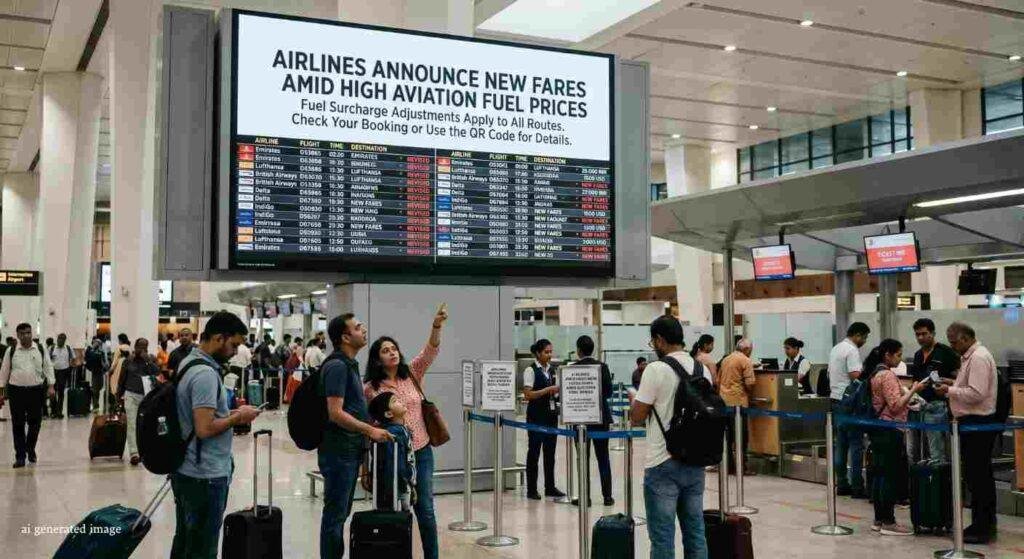
Major global carriers including United Airlines, Emirates, Lufthansa, Delta Air Lines, and Air Canada have announced sweeping changes to their fare structures as the ongoing West Asia conflict sends jet fuel prices soaring to unprecedented levels. The crisis, triggered by the closure of the Strait of Hormuz following the escalation of the US-Israel-Iran conflict on February 28, 2026, has forced airlines worldwide to raise ticket prices, impose fuel surcharges, and slash flight capacities .
The Crisis by the Numbers
The scale of the current aviation crisis is unprecedented in recent history:
| Metric | Before Crisis (Feb 2026) | Current (April 2026) |
|---|---|---|
| Jet Fuel Price per Barrel | $85–99 | $200–209 |
| Fuel Share of Operating Costs | 30–40% | 55–60% |
| Global Flight Cancellations | — | 150,000+ (March–June) |
| Airfare Increase (Select Routes) | Baseline | 40–240%+ |
The closure of the Strait of Hormuz—through which more than one-fifth of the world’s seaborne oil passes—has effectively halted a significant portion of global jet fuel shipments, creating a supply shock that shows no signs of abating .
How Major Foreign Airlines Are Responding
🇪🇺 Europe: Widespread Cancellations and Surcharges
Lufthansa Group has announced the cancellation of 20,000 short-haul flights between May and October 2026, targeting “unprofitable” routes. The group is also retiring 27 older short-haul aircraft and four long-haul A340-600s. Fuel hedge coverage stands at 77%, but the financial strain remains severe .
KLM Royal Dutch Airlines canceled 160 European flights (approximately 1% of operations) and suspended services to London and Düsseldorf. The airline has extended its suspension of flights to Dubai until June 14, 2026, and doubled its long-haul fuel surcharge from €50 to €100 per round trip .
Scandinavian Airlines (SAS) canceled approximately 1,000 flights in April 2026 alone, primarily targeting short-haul, high-frequency routes. Domestic flights in Norway have been particularly affected .
Air France-KLM has increased long-haul fares by approximately €50–€60 per return ticket, with further adjustments expected if fuel prices remain elevated .
British Airways has adjusted multiple long-haul routes, increasing block times and fuel uplift requirements. Tickets on UK routes have surged over 40% amid the crisis .
🇺🇸 North America: Capacity Cuts and Fee Hikes
United Airlines announced a 5 percentage point reduction in planned capacity for Q2 and Q3 2026. The airline warned that fuel expenses could increase by 11billionthisyear—morethandoublingitsbest−everprofit.ForflightsoriginatingfromthePhilippines,UnitedisimplementingthemaximumCABLevel18fuelsurchargeof₱14,561.87(approximately11billionthisyear—morethandoublingitsbest−everprofit.ForflightsoriginatingfromthePhilippines,UnitedisimplementingthemaximumCABLevel18fuelsurchargeof₱14,561.87(approximately250) on long-haul international routes .
Delta Air Lines slashed capacity by 3.5 percentage points in Q2 2026 and suspended planned capacity growth for the second half of the year. The airline raised checked baggage fees by $10 for the first and second bags and warned that elevated fuel prices could persist through 2027 .
Air Canada suspended six international routes and temporarily suspended several domestic services. Summer 2026 capacity has been reduced by 1% for the year .
WestJet cut approximately 5.5% of its services in June 2026 and introduced fuel surcharges across its network .
🇦🇪 Middle East: Long-Haul Impact
Emirates has been particularly hard-hit due to its reliance on long-haul flights. The airline has implemented the Philippines CAB’s Level 18 fuel surcharge, capping at ₱14,561.87 for long-haul routes from Manila to Dubai, London, and New York. Ticket prices have increased substantially, and the airline has adjusted operational schedules to mitigate cost pressures .
🌏 Asia-Pacific: Severe Operational Disruptions
Cathay Pacific raised its surcharge for long-haul flights by over US$200 per leg. The airline has promised to review the surcharge every two weeks, but uncertainty around costs has left passengers confused .
Japan Airlines (JAL) and All Nippon Airways (ANA) are reshaping domestic travel. ANA is overhauling its fare system effective May 19, introducing three tiers—”Simple,” “Standard,” and “Flex”—with the cheapest option eliminating advance seat selection and limiting baggage to one piece. Both carriers are increasing surcharges and fees on long-haul flights while experimenting with leaner domestic models .
AirAsia has implemented fuel surcharges across its network, labeled as “YQ” in booking breakdowns. Notably, passengers using AirAsia Points to pay for flights must still pay the full surcharge in cash, as points typically cover only the base fare .
Philippine Airlines (PAL) implemented the Level 18 fuel surcharge across its network. Domestic surcharges range from ₱593 to ₱1,734 per passenger, while international long-haul routes face the maximum ₱14,561.87 surcharge .
Cebu Pacific, the Philippines’ largest budget carrier, implemented Level 18 surcharges ranging from ₱593–1,734 for domestic routes and ₱2,000–5,000 for short-haul international routes to destinations like Hong Kong, Tokyo, and Bangkok .
Vietnam Airlines suspended several domestic routes, while Vietjet Air reduced capacity by 18% due to fuel shortages and rising costs .
The Philippines’ Level 18 Surcharge Explained
The Philippines’ Civil Aeronautics Board (CAB) has set a Level 18 fuel surcharge for the period of May 1–15, 2026, marking a significant shift in pricing for both domestic and international flights .
The surcharge structure includes:
| Flight Category | Surcharge Range (₱) |
|---|---|
| Domestic Routes | 593 – 1,734 |
| Short-Haul International | 2,000 – 5,000 |
| Long-Haul International | Up to 14,561.87 |
This surcharge applies to all flights originating in the Philippines, affecting carriers including United, Emirates, PAL, Cebu Pacific, AirAsia, and Delta .
Consumer Backlash and Calls for Transparency
The surge in fuel surcharges has sparked significant backlash from consumers and industry professionals. The World Travel Agents Associations Alliance (WTAAA) has demanded urgent transparency in airline pricing practices, specifically calling for :
Incorporation of surcharges into base fares to improve price transparency
Fair and prompt refund treatment for surcharges in case of flight cancellations
Clear and consistent surcharge labels to prevent confusion
WTAAA argues that inconsistent surcharge labels and fragmented pricing practices have created confusion for both consumers and travel agents, who are left to explain hidden costs to passengers .
Impact on India: Double the Hit
Indian travelers are facing a double impact from the crisis. The Economic Times reports that international travel demand from India has dropped by 15–20% compared to the same period last year, with travel to the UAE and Gulf region—which earlier accounted for about 35% of outbound trips—now “almost negligible” .
Comparative fare data reveals the severity :
| Route | Before Crisis | Current (April 2026) | Increase |
|---|---|---|---|
| Delhi–London | ₹35,000 | ₹1.2 lakh | 240%+ |
| Mumbai–New York | ₹70,000 | ₹2.25 lakh | 220%+ |
Travel to Europe has also dropped significantly, with tour package prices rising 20–25% and the rupee weakening from ₹84 to ₹94 against the US dollar over the past year .
What This Means for Travelers
✈️ Expect Higher Fares Across the Board
Airlines are passing fuel costs directly to passengers through a combination of base fare increases and explicit fuel surcharges. Budget carriers like Cebu Pacific and AirAsia are particularly impacted, as their low-cost models are most sensitive to fuel price volatility .
🚫 Reduced Flight Options
With over 150,000 flights canceled globally between March and June 2026, passengers will find fewer available seats on many routes. Airlines are prioritizing long-haul, high-demand routes while cutting short-haul and less profitable services .
⏰ Book Early and Stay Flexible
Industry experts recommend booking flights well in advance to secure the best prices. Last-minute fares are expected to continue rising. Consider flying during off-peak hours, such as mid-week departures, which could offer savings compared to weekend flights .
🔍 Check Surcharge Transparency
With WTAAA calling for greater transparency, passengers should carefully review booking breakdowns for surcharge labels like “YQ” (AirAsia’s fuel surcharge code) and ask travel agents to clarify any additional fees before purchasing tickets .
The Bigger Picture: Is This the End of Affordable Air Travel?
As IATA Director General Willie Walsh confirmed on April 17, 2026, the airline industry could face widespread cancellations in Europe by the end of May 2026 due to a lack of jet fuel. The International Energy Agency (IEA) has warned that European jet fuel reserves are at critical levels, with only six weeks of supply remaining as of mid-April 2026 .
The crisis has fundamentally altered the economics of air travel. With jet fuel prices showing no signs of returning to pre-conflict levels and the Strait of Hormuz remaining closed, the era of affordable air travel that passengers enjoyed for the past decade may be coming to an end—at least for the foreseeable future .
Bottom Line
Foreign airlines across Europe, North America, Asia, and the Middle East have announced new airfares, fuel surcharges, and capacity cuts in response to the most severe jet fuel crisis in modern aviation history. Passengers should prepare for higher ticket prices, fewer flight options, and continued volatility as the West Asia conflict shows no signs of resolution.
Stay tuned to Aviators360 for real-time updates on airline fare changes, fuel surcharge revisions, and global travel advisories.
Have you booked international travel recently? How much more are you paying compared to last year? Share your experience in the comments below.