
By Aviators360 Team | April 9, 2026
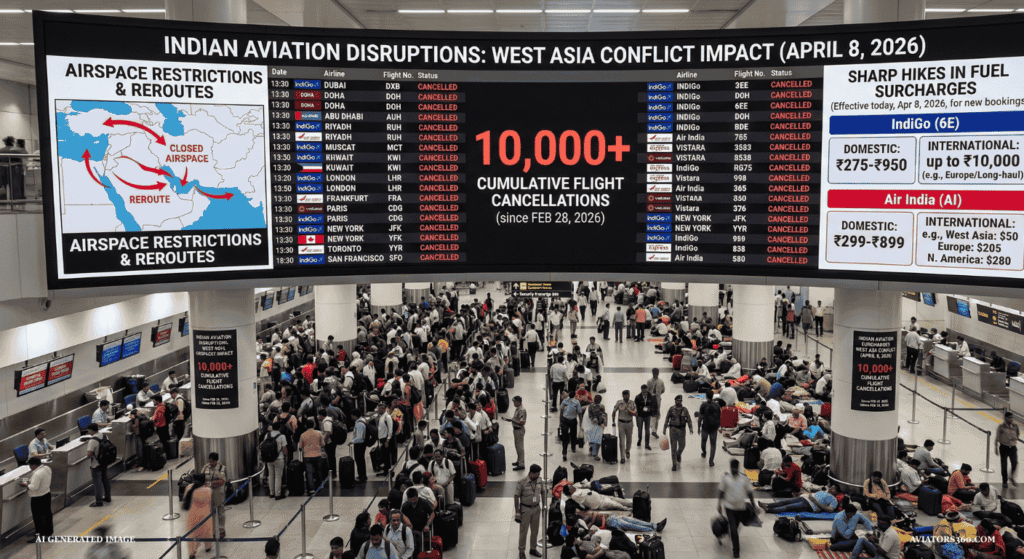
The numbers are staggering. Over 10,000 flights cancelled since late February. Daily operations to West Asia plummeting from 300-350 to just 80-90 flights. Fuel surcharges on international routes shooting up to as high as ₹10,000 per sector.
Indian aviation is facing one of its most severe operational crises in recent memory, driven entirely by the ongoing conflict in West Asia. At Aviators360, we have analyzed the latest government data, airline announcements, and industry impact assessments to bring you a complete picture of the disruption.
The Scale of the Crisis: 10,000+ Flights Gone
On April 7, 2026, the Ministry of Civil Aviation held an inter-ministerial briefing that laid bare the devastating impact of the West Asia war on Indian carriers .
According to Asangba Chuba Ao, Joint Secretary in the Ministry of Civil Aviation, Indian carriers used to operate an average of 300 to 350 daily flights to the Middle East (both directions combined). Today, that number has collapsed to just 80-90 flights per day .
“Cancellations by Indian carriers since the beginning of the situation, from February 28, total over 10,000,” Ao stated at the briefing .
To put this in perspective: the conflict has wiped out nearly 75% of India’s air connectivity to the Gulf and wider West Asia region.
The conflict, which began with US and Israeli strikes on Iran following the death of Iran’s supreme leader Ali Khamenei, has led to airspace closures or severe restrictions in multiple countries . These include:
| Country | Status |
|---|---|
| Israel | Airspace closed |
| Jordan | Severe restrictions |
| Lebanon | Airspace closed |
| Kuwait | Completely closed |
| Qatar | Severe restrictions |
| Bahrain | Completely closed |
| UAE | Severe restrictions |
The Domino Effect: Half of International Operations Vanish
Perhaps the most alarming statistic to emerge from the briefing is this: 50 per cent of all international operations by Indian carriers were to West Asia .
“That has definitely impacted their revenue income, which obviously affects the financials of an airline,” Ao acknowledged .
The scale of the hit varies by carrier. Data from aviation analytics platform Cirium reveals the full extent :
| Airline | Impact |
|---|---|
| Air India Express | 1,215 flight cancellations in March — half of its total scheduled international flights |
| SpiceJet | Over 55% of international flights cancelled |
| Air India | 13% of total international flights cancelled in March (up from 2% in February) |
| IndiGo | Nearly 10% of 7,432 international flights cancelled |
Together, IndiGo and the Air India Group reduced their seat capacity between India and West Asia by a staggering 313,000 seats in March compared to February .
The Fuel Nightmare: Prices Double, Surcharges Soar
While flight cancellans are the most visible impact, the financial bleed extends far beyond grounded aircraft.
Aviation Turbine Fuel (ATF) accounts for approximately 40 per cent of an airline’s operating cost . Since the conflict began, international ATF prices have more than doubled .
The government intervened on April 1 to cap the domestic ATF increase at 25 per cent for scheduled Indian airlines . But for international operations, no such relief was provided.
The result? Airlines have been forced to pass on the pain to passengers through steep fuel surcharges.
IndiGo’s Revised Fuel Surcharges (Effective April 2, 2026)
| Route Type | Distance | Surcharge (₹) |
|---|---|---|
| Domestic (short) | Up to 500 km | ₹275 |
| Domestic (medium) | 500-1,000 km | ₹450-650 |
| Domestic (long) | 1,000+ km | ₹950 |
| GCC/Middle East | Up to 2,000 km | ₹3,000 |
| GCC/Middle East | 2,000+ km | ₹5,000 |
| Europe long-haul | – | Up to ₹10,000 |
Source: IndiGo official announcement
The airline noted that fully neutralizing the rise in fuel costs would require an even steeper fare increase, but it has chosen to transfer only a limited portion to customers .
Rerouting Chaos: Longer Flights, Higher Costs
The airspace closures have forced Indian carriers to completely reimagine their flight paths to Europe and North America.
Previously, flights from India to the West followed a fairly straight corridor across West Asia. Today, with Iranian, Iraqi, Jordanian, and other airspaces closed or severely restricted, planes are being rerouted through longer, safer corridors — either north via Central Asia or south via North Africa and the Arabian Peninsula .
These detours add one to three hours of flight time on major international routes, leading to:
Higher fuel consumption per flight
Increased crew costs due to extended duty hours
Additional expenses for intermediate refueling stops (some long-haul flights now refuel at airports like Vienna)
DGCA Steps In: Pilot Duty Rules Relaxed
To help airlines cope with longer flight times and crew shortages, the Directorate General of Civil Aviation (DGCA) has granted a temporary relaxation in Flight Duty Time Limitations (FDTL) for pilots operating long-haul flights .
Under this relaxation:
Permissible flight time has been extended to approximately 11.5 hours
Duty periods have been extended accordingly
The relaxation is valid until April 30, with the DGCA stating it will be “revisited” as the situation evolves .
“The move aims to ensure smoother flight operations and maintain schedule reliability, especially for international routes affected by rerouting,” Ao explained .
Passenger Movement: 7.88 Lakh Travelers Since Conflict Began
Despite the chaos, the Ministry of External Affairs (MEA) reported that approximately 7,88,000 passengers have traveled from the West Asia region to India since February 28 .
MEA Spokesperson Randhir Jaiswal noted that flights continue from countries where airspace remains open, but services have been significantly affected due to restrictions .
Indian nationals stranded in affected countries are being evacuated through alternative routes:
| Origin | Evacuation Route |
|---|---|
| Iran | Via Armenia and Azerbaijan (land borders) |
| Israel | Via Jordan and Egypt |
| Iraq | Via Jordan and Saudi Arabia |
| Kuwait/Bahrain | Via Saudi Arabia |
As of April 7, the Indian Embassy in Iran had facilitated the exit of 1,864 Indian nationals, including 935 students and 472 fishermen . Approximately 7,500 Indians remain in Iran.
Government Response: Damage Control in Motion
The Ministry of Civil Aviation has rolled out several measures to mitigate the crisis :
ATF price moderation: Domestic fuel prices capped at a 25% increase, though international routes face the full brunt
Foreign carrier cargo dispensation: Emirates, Kuwait Airways, and Jazeera Airways permitted to operate passenger aircraft for all-cargo services
24/7 control room: MEA operating round-the-clock to assist stranded nationals
Stakeholder consultations: Ministry actively working with airlines to explore further support measures
“Passenger safety, cargo continuity, and sectoral resilience remain our top priorities,” the Ministry stated .
The Ceasefire: A Lifeline, But Not a Solution
On April 7, US President Donald Trump announced a two-week double-sided ceasefire with Iran, suspending bombing and attack campaigns in return for Iran reopening the Strait of Hormuz .
For the bleeding Indian aviation sector, the ceasefire has not come a day too soon.
However, officials caution that recovery will be gradual :
Kuwait and Bahrain remain completely closed
Iranian airspace reopening depends on ceasefire negotiations
The US Energy Information Administration has warned that Middle East oil production shutdowns may not recover until late 2026
“What the ceasefire does for Indian carriers is, at least, prevent the bleeding from worsening,” an India Today analysis noted. “It does not immediately bring back the 200-odd daily flights suspended due to the war” .
The Financial Toll: Losses Still Being Counted
While final numbers are still being calculated, the financial impact is already severe.
A report by EY India warned that prolonged geopolitical instability over six months could raise structural costs across fuel, insurance, and regulatory compliance .
The report recommended:
Scenario-based planning for airlines
Revenue diversification through cargo operations
Investment in digital and operational resilience
“Geopolitics is evolving into a core design constraint for the aviation sector and could also serve as a source of competitive advantage for resilient operators,” EY noted .
What This Means for Passengers
If you are planning to fly internationally in the coming weeks, here is what to expect:
| Factor | Impact |
|---|---|
| Ticket Prices | Up significantly due to fuel surcharges; Europe flights may see ₹10,000+ add-ons |
| Flight Availability | Reduced options to West Asia; some routes suspended entirely |
| Flight Duration | Longer travel times on Europe/US routes due to rerouting |
| Refund/Rebooking | Airlines offering flexible policies for affected routes |
| Domestic Travel | Relatively stable due to government ATF cap |
The Aviators360 Take
At Aviators360, we have covered the Indian aviation sector through the pandemic, the Ukraine war, and now this crisis. The West Asia conflict is different.
Unlike COVID-19, which grounded planes globally but left infrastructure intact, this crisis is actively dismantling a key part of India’s international aviation network. The Gulf has long been Indian carriers’ most profitable international market. Losing 75% of that capacity overnight is a body blow from which recovery will take months, not weeks.
The government’s interventions — capping domestic ATF hikes, relaxing pilot duty rules, facilitating evacuations — have been swift and appropriate. But they are stopgaps, not solutions.
The two-week ceasefire offers hope, not certainty. Airspace closures are sovereign decisions that may outlast the ceasefire. And even when skies reopen, the financial damage to airlines will take time to repair.
For passengers, the message is clear: expect higher fares and fewer options for the foreseeable future. For the industry, this is a stress test unlike any other. And for the government, the challenge is to keep the sector flying until the storm passes.
*We will continue to track this developing story. For real-time updates on flight cancellations, fuel surcharges, and government measures, stay tuned to Aviators360 — India’s trusted voice in aviation insights.*
Disclaimer: This article is based on information available as of April 9, 2026. Flight schedules, surcharges, and government measures are subject to change. Passengers are strongly advised to check with their airline directly before traveling.