
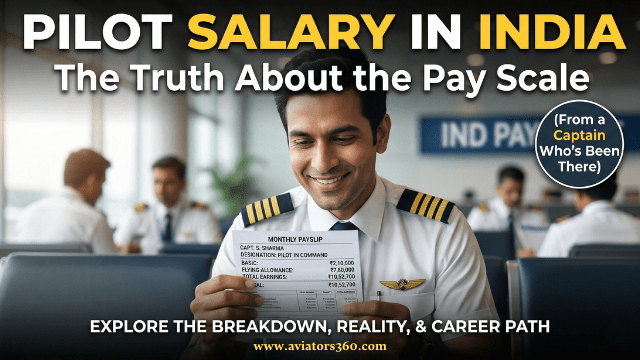
By Ashutosh Bansal, Aviators360
If you are here, you are probably staring at one of two screens: a DGCA exam syllabus wondering if this grind is worth it, or an offer letter from an airline wondering if they are trying to lowball you.
Let’s cut the noise.
Every time you search for “pilot salary in India,” Google throws out a number. ₹5 Lakhs? ₹80 Lakhs? It’s all over the place. And honestly? Most of it is outdated.
I’ve been in the left seat for a while now, and I’ve seen the payslip swings—from the pre-COVID boom to the current surge in hiring. If you want to know what you actually take home, not just the “Cost to Company (CTC)” fluff, read on.
Here is the real breakdown of the Pilot Salary India scenario in 2024-25.
Table of Contents
The Golden Rule: It’s All About Flying Hours
Pilot Salary Breakdown by Rank
Cadet Pilot / Trainee
First Officer (Junior)
Senior First Officer / Command Trainee
Captain (The Left Seat)
Airline-Wise Salary Comparison Table
Aircraft Type Impact on Salary
The Hidden Perks That Actually Matter
Pilot Salary Progression Timeline (Data)
FAQs: Pilot Salary India
The Aviators360 Take: Is the Money Worth It?
The Golden Rule: It’s All About Flying Hours
Unlike a 9-to-5 IT job, your salary isn’t just your “Basic Pay.” In aviation, your bank balance depends on one thing: How much you fly.
Most airlines in India follow a structure:
Basic Salary (The fixed part, usually low)
Flying Allowance (Paid per hour of flight)
Per Diem (Layover money)
If you are stuck on the ground (due to weather, rostering issues, or a fleet grounding), your salary drops. But when you’re flying full throttle? The numbers look very different.
Pilot Salary Breakdown by Rank
1. The Cadet Pilot / Trainee
The Investment Phase
Let’s be honest. You don’t “earn” in the first 6-9 months of joining an airline. If you are a fresher joining a regional carrier or a major airline as a Trainee First Officer, you are still investing.
Stipend: ₹25,000 to ₹50,000 per month (during type rating and line training).
Post-Training: Once you clear your line check, expect ₹1.5 Lakhs to ₹2.5 Lakhs per month net.
The Reality: You will be broke for the first year. This is where most people quit mentally. If you survive this, the graph goes vertical.
2. First Officer (Junior)
The Grind Phase
This is where you are flying domestic sectors, waking up at 3:00 AM, and probably holding the junior-most rank. But this is also where you start seeing the actual potential.
IndiGo / Akasa / Air India Express (Low Cost): ₹3.5 Lakhs to ₹5 Lakhs per month (Gross).
Air India / Vistara (Full Service): ₹3 Lakhs to ₹4.8 Lakhs per month (Gross).
Note: As a Junior FO, your salary swings by ₹50,000 to ₹1 Lakh every month based on how many hours you clock. If you fly 70-80 hours a month, you hit the higher end.
3. Senior First Officer / Command Trainee
The Waiting Phase
This is the tricky part. You are now experienced, waiting for that promotion to Captain. This “command upgrade” queue can take years depending on the airline’s expansion.
Salary: ₹5 Lakhs to ₹7.5 Lakhs per month.
At this stage, you are flying the same routes as a Captain, earning about 60% of what the person sitting next to you is making. It hurts. But the moment you get that fourth stripe? Everything changes.
4. Captain (The Left Seat)
The Earning Phase
This is the number everyone wants to know. How much does a Captain make in India?
It depends on the airline and the aircraft type.
Domestic Captains (A320 / B737):
Low Cost Carriers (IndiGo, SpiceJet, Akasa): ₹7 Lakhs to ₹9.5 Lakhs per month.
Full Service (Air India, Vistara): ₹8 Lakhs to ₹12 Lakhs per month.
Wide Body Captains (B777 / B787 / A330):
International routes: ₹12 Lakhs to ₹18 Lakhs+ per month.
The Catch: To get that ₹18 Lakhs figure, you need to be a “Line Training Captain” or a “Type Rating Instructor” (TRI) flying maximum hours on international sectors. It’s not an overnight journey.
Airline-Wise Salary Comparison Table (2025)
| Airline | First Officer (Monthly Gross) | Captain (Monthly Gross) | Fleet Type | Per Diem (Approx) |
|---|---|---|---|---|
| IndiGo | ₹3.8 L – ₹5.2 L | ₹7.5 L – ₹9.8 L | A320, A321, ATR | $3–$5/hr |
| Air India | ₹3.5 L – ₹5 L | ₹8.5 L – ₹12 L (Domestic) | A320, B777, B787 | $4–$6/hr |
| Akasa Air | ₹3.6 L – ₹4.8 L | ₹7 L – ₹9 L | B737 MAX | $3–$4/hr |
| SpiceJet | ₹3.2 L – ₹4.5 L | ₹6.8 L – ₹8.5 L | B737, Q400 | $2.5–$4/hr |
| Air India Express | ₹3.4 L – ₹4.5 L | ₹7 L – ₹8.8 L | B737 | $3–$4/hr |
| Vistara (merged with AI) | ₹3.8 L – ₹5 L | ₹8 L – ₹10 L | A320, B787 | $4–$5/hr |
| Star Air | ₹2.5 L – ₹3.5 L | ₹5 L – ₹6.5 L | Embraer | $2–$3/hr |
| Charter / Private Jets | ₹1.5 L – ₹3 L | ₹4 L – ₹7 L | Various | Variable |
Data compiled from industry sources and pilot reports (2024–2025). Actual figures vary based on flying hours, seniority, and company policies.
Aircraft Type Impact on Salary
Not all aircraft pay the same. Here’s how the aircraft you fly affects your paycheck:
| Aircraft Type | Typical Role | Captain Salary Range | Notes |
|---|---|---|---|
| ATR / Q400 | Regional / Domestic | ₹5 L – ₹7 L | Lower entry barrier, shorter sectors |
| A320 / B737 | Domestic & Short-Haul International | ₹7 L – ₹10 L | Most common fleet in India |
| A330 / B787 | Medium-Haul International | ₹10 L – ₹14 L | Higher per diem, longer layovers |
| B777 / B747 | Long-Haul International | ₹14 L – ₹18 L+ | Top of the pyramid, requires seniority |
| Private Jets (Charter) | On-demand | ₹4 L – ₹8 L | Unpredictable hours, but high flexibility |
The Hidden Perks That Actually Matter
When I talk to aspirants at Aviators360, they only look at the salary figure. But here is what separates a pilot from a banker:
Per Diem: When you land in Bangkok, London, or Dubai, you get paid in cash (foreign currency) to cover your meals and expenses. Good pilots save this entirely. I’ve seen colleagues save ₹30,000–₹50,000 just in per diem cash every month.
Rent Free Accomodation: Most airlines provide a “Crash Pad” or hotel accommodation in the base city. If you’re smart, you don’t pay rent.
Income Tax: Since a huge chunk of your salary is “Flying Allowance,” the tax structure is favorable compared to a corporate executive drawing the same gross pay.
Staff Travel: Free or heavily discounted tickets for you and your family on your airline and partner carriers. This alone is valued at ₹5 Lakhs–₹10 Lakhs per year for a family that travels internationally.
Medical Insurance: Comprehensive coverage (typically ₹10 Lakhs–₹25 Lakhs) for you and your dependents.
Pilot Salary Progression Timeline (Data)
Here’s what the journey looks like in numbers over a 15-year career:
| Year | Rank | Monthly Gross (Approx) | Cumulative Earnings (Approx) |
|---|---|---|---|
| Year 0–1 | Cadet / Trainee | ₹25k – ₹50k (stipend) | ₹3 L – ₹6 L |
| Year 1–3 | Junior First Officer | ₹2.5 L – ₹4 L | ₹40 L – ₹80 L |
| Year 3–6 | Senior First Officer | ₹4 L – ₹6 L | ₹1.6 Cr – ₹2.5 Cr |
| Year 6–9 | Command Trainee / Junior Captain | ₹6 L – ₹8 L | ₹2.5 Cr – ₹4 Cr |
| Year 10–15 | Captain / Training Captain | ₹8 L – ₹15 L | ₹6 Cr – ₹12 Cr+ |
| Year 15+ | Senior Captain / TRI/TRE | ₹12 L – ₹18 L+ | ₹10 Cr – ₹18 Cr+ |
Note: These are gross earnings before tax. Actual take-home depends on flying hours, allowances, and tax planning.
FAQs: Pilot Salary India
Q1: What is the starting salary of a pilot in India?
A fresher pilot after completing training typically earns ₹1.5 Lakhs to ₹2.5 Lakhs per month as a Junior First Officer. During the initial type rating and line training phase (6–9 months), the stipend is ₹25,000–₹50,000 per month.
Q2: Which airline pays the highest salary to pilots in India?
Air India (post-merger with Vistara) and IndiGo are currently the top paymasters. For wide-body Captains, Air India leads with packages up to ₹18 Lakhs+ per month. For narrow-body Captains, IndiGo and Air India are competitive in the ₹8 Lakh–₹12 Lakh range.
Q3: How much does an IndiGo pilot earn per month?
IndiGo First Officer: ₹3.8 Lakhs – ₹5.2 Lakhs (gross)
IndiGo Captain: ₹7.5 Lakhs – ₹9.8 Lakhs (gross)
These figures depend on flying hours (70–80 hours per month) and seniority.
Q4: Do pilots get paid during training?
Yes, but it’s a stipend, not a full salary. During type rating and line training, most airlines pay ₹25,000–₹50,000 per month. Full flying allowance kicks in only after clearing the line check.
Q5: What is the salary of a female pilot in India?
There is no gender-based pay disparity in Indian aviation. Salaries are determined by rank, flying hours, and airline policy. India has one of the highest percentages of female pilots globally (over 15%), and pay is equal across genders.
Q6: How many flying hours do pilots get per month?
Most Indian airline pilots fly between 60–80 hours per month. DGCA regulations cap flying at 1,000 hours per year (approx 83 hours per month). Salary varies directly with hours flown—more hours = higher pay.
Q7: What is the retirement age for pilots in India?
The retirement age for commercial pilots in India is 65 years (as per DGCA regulations). However, most airlines have an internal retirement policy between 60–65 years.
Q8: How does pilot salary in India compare to the Middle East?
Middle Eastern carriers (Emirates, Etihad, Qatar) typically pay higher tax-free salaries:
India (Captain): ₹7 L–₹18 L (taxable)
Middle East (Captain): ₹12 L–₹25 L (tax-free)
However, the cost of living, family stability, and commuting factors make this a personal trade-off.
The Aviators360 Take: Is the Money Worth It?
I get asked this every day. “Ashutosh, should I spend 1 Crore on a Cadet Pilot Program?”
Here is my honest answer: The money is great, but you cannot look at the starting salary.
If you join as a Cadet today:
Year 1: You struggle (Stipend).
Year 3: You earn decent money (₹3–4 Lakhs/month).
Year 8: You are a Captain taking home north of ₹8 Lakhs/month plus international travel.
That trajectory is rare in any other profession in India. But the cost of entry is high, and the lifestyle is brutal. You will miss birthdays, weddings, and festivals.
If you are chasing the paycheck, you will burn out. If you are chasing the lifestyle of flying, the paycheck is a beautiful side-effect.
What’s your next step?
Are you preparing for your DGCA exams, or are you confused between a Cadet Program and the conventional CPL route?
Drop your questions in the comments below or reach out to the Aviators360 team. I reply to every aspiring pilot personally—because I remember being in your shoes, refreshing my bank account after the first flight.
Blue skies and tailwinds.
— Ashutosh Bansal
Founder, Aviators360
Disclaimer: Salaries are indicative based on current market trends (2024–2025) and depend on the airline’s specific policies, flying hours, seniority, and experience. Figures are gross monthly earnings unless stated otherwise.