The call came at 11:38 p.m. Eastern Time.
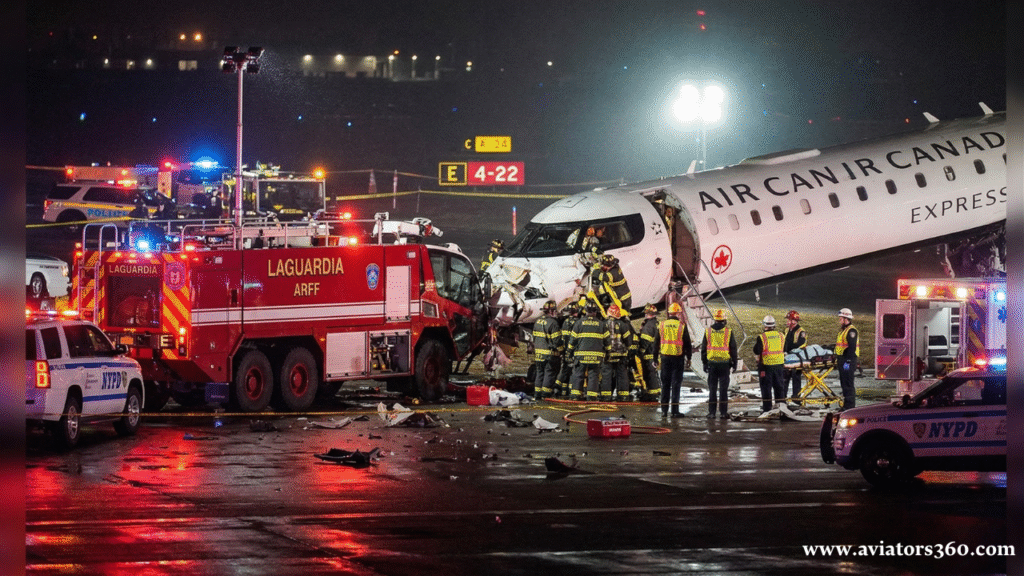
What should have been a routine landing on a rain-slicked runway at New York’s LaGuardia Airport turned into every aviator’s worst nightmare. An Air Canada Express regional jet, arriving from Montreal with 76 souls on board, collided with a Port Authority fire truck on Runway 4. The impact sheared off the aircraft’s nose, flipped the emergency vehicle onto its side, and sent four people to the hospital—two of them fighting for their lives.
At Aviators360, we’ve been tracking this developing story since the first alerts flashed across our monitors. Here’s what we know, what went wrong, and what this means for aviation safety.
The Incident: What Happened
Air Canada Express Flight 8646, a Bombardier CRJ-900 operated by regional partner Jazz Aviation, departed Montreal Trudeau International Airport shortly after 10:30 p.m. ET on Sunday, March 22, 2026 . The flight was uneventful—a short 75-minute hop across the border, carrying 72 passengers and 4 crew members .
As the aircraft approached LaGuardia’s Runway 4, weather conditions were far from ideal. Light rain and fog had been affecting the airport throughout the evening, and LaGuardia had already warned passengers of potential disruptions due to poor visibility .
The plane touched down and began its landing roll, decelerating to approximately 24 miles per hour (39 kilometers per hour) . That’s when disaster struck.
According to flight tracking data from FlightRadar24, the aircraft collided with an Airport Rescue and Firefighting (ARFF) vehicle—a fire truck operated by the Port Authority of New York and New Jersey—that was crossing the runway . The impact speed, while relatively low in aviation terms, was catastrophic for both the aircraft and the vehicle.
The result: the CRJ-900’s nose was sheared off and tilted upward at a dramatic angle. The fire truck lay on its side nearby, a mangled wreck of metal and emergency lights .
The Human Toll: Both Pilots Critical
The injuries tell a stark story of what happens when a 76-passenger jet meets a fire truck on a runway.
According to NBC News, citing sources familiar with the incident, four people sustained serious injuries :
The pilot and co-pilot of Air Canada Express Flight 8646 were badly injured and remain in critical condition . The cockpit of the CRJ-900 bore the brunt of the impact, and those seated at the controls paid the highest price.
A police sergeant and an officer—both aboard the Port Authority fire truck—suffered broken limbs and were listed in stable condition at a local hospital .
Notably, no passengers or cabin crew were reported injured in the collision . The aircraft’s fuselage, while damaged at the forward section, remained largely intact, allowing passengers to be evacuated safely.
The New York Fire Department and Port Authority Police responded en masse, swarming the runway with emergency vehicles and tending to the injured .
The Critical Question: How Did This Happen?
In aviation, runway incursions—when a vehicle, aircraft, or person enters a runway without authorization—are among the most closely monitored safety risks. This incident raises urgent questions about how a fire truck ended up in the path of a landing aircraft.
Audio recordings from LiveATC.net, captured by air traffic control at LaGuardia, offer a chilling glimpse into the moments before impact .
In the recording, an air traffic controller is heard granting permission for an operations truck to cross the runway. Seconds later, the controller’s voice turns urgent, ordering the vehicle to stop. Then, the grim confirmation:
“JAZZ 646, I see you collided with the vehicle. Just hold position. I know you can’t move. Vehicles are responding to you now.”
The audio suggests a breakdown in coordination. Whether the vehicle entered the runway without clearance, whether there was a miscommunication, or whether weather conditions played a role remains under investigation.
The Federal Aviation Administration (FAA) and the National Transportation Safety Board (NTSB) have both been notified. The NTSB confirmed receipt of the incident notification and is expected to launch a full investigation .
The Aftermath: LaGuardia Shuts Down
The collision triggered an immediate and complete ground stop at LaGuardia Airport .
The FAA issued an emergency order halting all arriving and departing flights. The airport was expected to remain closed until at least 2:00 p.m. ET on Monday, March 23, though the FAA noted a “high” likelihood of extension .
Arriving flights were diverted to nearby airports, including John F. Kennedy International (JFK) and Newark Liberty International (EWR). Some flights returned to their points of origin .
For travelers, the disruption was compounded by existing weather-related delays. LaGuardia had already been warning passengers of potential cancellations due to fog and rain earlier in the evening .
The Aircraft: CRJ-900
The aircraft involved was a Bombardier CRJ-900, a twin-engine regional jet widely used by airlines across North America . Manufactured by Mitsubishi (following Bombardier’s regional jet division sale), the CRJ-900 typically seats between 76 and 90 passengers .
Jazz Aviation, the operator of the flight, is a regional partner of Air Canada operating under the Air Canada Express brand. The airline has not yet released a detailed statement beyond confirming awareness of the incident .
A Broader Pattern: Runway Safety Under Scrutiny
This incident is a stark reminder that runway safety remains one of aviation’s most persistent challenges. Even as commercial air travel has become statistically safer than ever, ground operations—where aircraft, vehicles, and personnel intersect—remain high-risk environments.
The FAA has long prioritized runway safety through initiatives like the Runway Safety Council and improved airfield signage and lighting. But incursions still occur, and when they do, the consequences can be devastating.
In this case, the vehicle involved was not just any ground vehicle—it was an Aircraft Rescue and Firefighting (ARFF) truck, specifically designed to respond to aircraft emergencies . Its presence on an active runway at the moment of an aircraft’s landing raises serious questions about communication protocols and situational awareness.
What Comes Next
The NTSB will lead the investigation, working alongside the FAA and the Port Authority of New York and New Jersey. Key areas of focus will likely include:
Air traffic control communications: Was the vehicle cleared to cross? Was the clearance understood and acknowledged?
Vehicle operations: Why was the fire truck on the runway at that moment? Was it responding to another incident or conducting routine operations?
Weather factors: Light rain and fog may have reduced visibility for both the flight crew and the vehicle operator .
Aircraft systems: The CRJ-900’s landing roll and deceleration rates will be analyzed to understand the timeline of events.
The Port Authority has not yet released a statement on the incident, and the names of the injured pilots and officers have not been made public .
Final Thoughts
At Aviators360, our thoughts are with the injured pilots, the police officers, and their families. The aviation community is a small one, and when tragedy strikes, we feel it deeply.
This incident is a sobering reminder that safety is never guaranteed—it is earned, every day, through vigilance, communication, and a relentless commitment to getting it right. The investigation will determine what went wrong on Runway 4 at LaGuardia. But for now, we wait, we watch, and we hope for the recovery of those who put their lives on the line to keep our skies safe.
*We will continue to follow this story as it develops. For real-time updates on LaGuardia operations and the NTSB investigation, stay tuned to Aviators360—India’s trusted voice in aviation insights.*
Disclaimer: This article is based on information available as of March 23, 2026. Investigation findings and injury reports are subject to confirmation by official authorities. Aviators360 will update this story as new information becomes available.