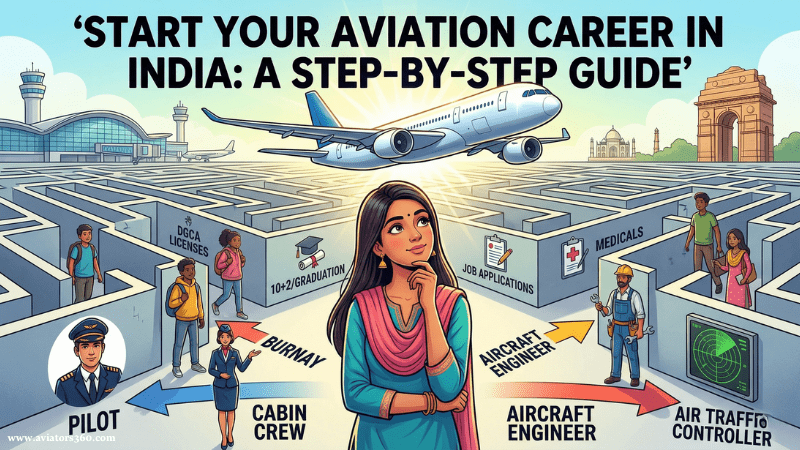
The Indian aviation industry is soaring. As the third-largest domestic aviation market in the world, India is projected to require thousands of new pilots, engineers, and cabin crew members over the next decade. For many young Indians, the dream of a career in aviation represents not just a job, but a lifestyle of prestige, travel, and technological engagement.
However, the path to the tarmac can seem clouded in confusion. With numerous licenses, regulatory bodies (like the DGCA), and substantial financial investments involved, where does one even begin?
I’m Ashutosh Bansal from Aviators360, and in this step-by-step guide, I’ll walk you through the various entry points into the Indian aviation sector. Whether you want to be in the cockpit, the cabin, or the control tower, this roadmap will help you take off.
Step 1: Self-Assessment – Which Role Suits You?
Aviation is not just about pilots. Before you invest time and money, you must identify which career path aligns with your skills and physical attributes.
The Cockpit (Pilot): For those who love technology, responsibility, and have strong decision-making skills. Requires the highest financial investment and strict medical fitness.
The Cabin (Crew): For those with excellent interpersonal skills, a passion for service, and the ability to handle emergencies calmly. It is the face of the airline.
The Ground (Management & Staff): For logistics enthusiasts. This includes roles in Air Traffic Control (ATC), Airport Operations, Customer Service, and Security. It is often more stable with regular hours compared to flying staff.
The Hangar (Engineering): For technical minds. Aircraft Maintenance Engineers (AME) are the backbone of flight safety, responsible for certifying that aircraft are fit to fly.
Step 2: Educational Eligibility
The educational requirements vary based on the role you choose. Here is the basic eligibility for the most sought-after careers:
For Pilots (CPL):
Subjects: Physics and Mathematics in Class 12 (10+2) from a recognized board.
Marks: Minimum 50% aggregate (though 60% is preferable for competitive edge).
Note: If you didn’t have PCM in 12th, you can still become a pilot by appearing for the National Institute of Open Schooling (NIOS) exams for Physics and Math as a private candidate.
For Cabin Crew:
Education: 10+2 (Higher Secondary) from any stream. Graduation is preferred by full-service carriers like Air India and Vistara.
Age: Usually 18 to 27 years (varies by airline).
Physical: Height requirements (usually 155 cm+ for females, 170 cm+ for males), clear skin, and no visible tattoos.
For Aircraft Maintenance Engineering (AME):
Education: 10+2 with Physics, Chemistry, and Mathematics (PCM). This is a strict requirement regulated by the DGCA.
For Airport Management/Ground Staff:
Education: Graduation in any stream is preferred, though diplomas in Aviation Management are a plus.
Step 3: The Medical Examination
Aviation is one of the few industries where your health determines your career eligibility. You cannot start training without a medical certificate.
For Pilots: You must obtain a Class 1 Medical from a DGCA-approved medical center. This is a rigorous check-up testing your vision (6/6 correctable), cardiovascular health, hearing, and mental health. You also need a Class 2 Medical to start the course.
For Cabin Crew & ATC: You require a Class 2 Medical or a company-specific medical assessment. Vision standards are slightly relaxed compared to pilots.
Pro Tip from Aviators360: Do not quit your existing job or take a large education loan until you have cleared your Class 1 Medical. If you fail the medical, you cannot become a pilot, and the training fees are non-refundable.
Step 4: Choosing the Right Institute and Licensing
The quality of your training determines your employability. In India, the regulator is the Directorate General of Civil Aviation (DGCA) .
For Aspiring Pilots (CPL):
To become a Commercial Pilot, you must clear the DGCA exams (Air Navigation, Meteorology, Regulations, Technical General, and Technical Specific) and complete:
200 Hours of Flying: This is the most expensive part. You can do this in India (expensive but convenient) or abroad (cheaper but requires converting the license back to DGCA standards).
RTR (Aero): A Radio Telephony license issued by the Ministry of Communications.
Type Rating: To fly for an airline, you need a “Type Rating” on an aircraft (like the Airbus A320 or Boeing 737). This usually costs an additional ₹15-25 Lakhs.
For Aircraft Maintenance Engineers (AME):
Instead of a degree, you pursue a 3-year AME license course approved by the DGCA. You will specialize in either Mechanical (Airframes & Engines) or Avionics (Electrical & Instruments). After the course, you undergo apprenticeships to get your license endorsed.
For Cabin Crew & Ground Staff:
Unlike pilots, you do not need a DGCA license to be cabin crew. Airlines conduct their own training (indoctrination) after hiring. However, doing a certificate course in Aviation Management or Hospitality from a reputed institution (like Frankfinn or Aviators360’s partnered academies) gives you a massive advantage in campus placements.
Step 5: The Financial Roadmap
Let’s address the elephant in the room: cost.
Pilot (CPL + Type Rating): ₹50 Lakhs to ₹1 Crore. Solution: Education loans (many banks offer aviation-specific loans), scholarships, or cadet pilot programs (which cost more but guarantee a job interview).
AME: ₹8 Lakhs to ₹15 Lakhs for the 3-year course.
Cabin Crew/Ground Staff: ₹1 Lakh to ₹3 Lakhs for grooming and soft skills courses.
Ashutosh’s Advice: If you are aiming for a pilot career but face financial constraints, consider the National Cadet Corps (NCC) Air Wing or the IndiGo Cadet Pilot Program. These offer structured paths, though they are highly competitive.
Step 6: The License to Job Transition
Getting the license is only 50% of the battle. The remaining 50% is getting the Airline Transport Pilot License (ATPL) or securing a job.
For Pilots: The industry is cyclical. When you finish training, you may have to work as a Flight Instructor or wait for airline vacancies. Networking is key. Stay in touch with your flying club and platforms like Aviators360 for recruitment updates.
For Engineers: After obtaining your AME license, you must complete a 6-month to 2-year apprenticeship with an airline or MRO (Maintenance, Repair, and Overhaul) organization to gain “certifying staff” status.
For Crew: Walk-in interviews are common. Airlines look for grooming, communication skills, and confidence. Knowing a second language (like Hindi, Bengali, or Tamil) is often a bonus point.
Conclusion: Your Journey with Aviators360
Starting a career in aviation in India requires three things: the right information, the right medical status, and the right mentorship.
At Aviators360, we have helped hundreds of young aviators navigate the complex DGCA paperwork, select the right flying schools, and prepare for airline interviews. The journey from the ground to the cockpit is challenging, but with a clear roadmap, it is absolutely achievable.
If you are ready to take the first step, contact Aviators360 today. Let’s chart your flight path together.
About the Author:
Ashutosh Bansal is a renowned aviation mentor and the founder of Aviators360. With years of experience in pilot training and career counseling, Ashutosh has guided countless students toward successful careers in the Indian aviation industry.
FAQs
Q1: Can I become a pilot if I don’t have Maths in 12th?
Yes. You must appear for the 10+2 level exams in Physics and Math from a recognized board (like NIOS) as a private candidate. You cannot obtain a CPL without these subjects.
Q2: What is the age limit to start pilot training in India?
There is no upper age limit to start training for a Commercial Pilot License (CPL), but airlines in India generally prefer to hire pilots up to the age of 40-45 for fresher roles.
Q3: Is there a height requirement for cabin crew in India?
Yes. Most airlines require female candidates to be at least 155 cm (5’1″) and male candidates to be at least 170 cm (5’7″) to ensure they can reach the overhead compartments.
Q4: Which is better: Cadet Pilot Program or regular CPL?
Cadet programs are structured, cost more, but offer a direct path to a specific airline (like IndiGo or Air India). Regular CPL is cheaper but requires you to find a job after training on your own.
Q5: Does Aviators360 help with job placement?
Yes. Aviators360 provides end-to-end career support, including DGCA ground classes, flying school selection, interview preparation, and placement assistance for pilots, cabin crew, and ground staff.