
Overview: A Chain of Unforeseen Events
On a day that tested operational resilience, Air India flight AI101, operating from Delhi to San Francisco with the advanced Airbus A350-900 (registration VT-JRB), was forced into a rare air-turn back to its origin. The flight’s challenges began with geopolitical airspace closures and culminated in a minor ground incident amid Delhi’s dense winter fog, underscoring the complex variables in modern aviation.
The Initial Diversion: Iranian Airspace Closure Forces Return
Flight AI101 had departed Delhi’s Indira Gandhi International Airport (DEL) as scheduled when the crew received critical updates. New NOTAMs (Notices to Airmen) and real-time advisories confirmed the sudden closure of Iranian airspace due to regional security concerns.
Facing this unexpected barrier on a critical west-bound corridor, the crew, in coordination with Air India’s Operations Control Centre and air traffic control, assessed rerouting options. With no alternate path available that met strict fuel, safety, and operational requirements for the long-haul A350, the prudent and safety-first decision was made to return to Delhi.
This decision highlights a core tenet of airline safety: avoiding airspace uncertainty trumps schedule adherence, especially for extended over-water and remote area operations.
A Secondary Challenge: Ground Incident in Dense Fog
Upon its return to Delhi, the aircraft and crew faced a second, unrelated challenge. The airport was experiencing severe winter fog, with visibility drastically reduced. While the landing was safely completed using low-visibility procedures, the conditions set the stage for a rare ground incident.
During the taxi-in to its parking bay:
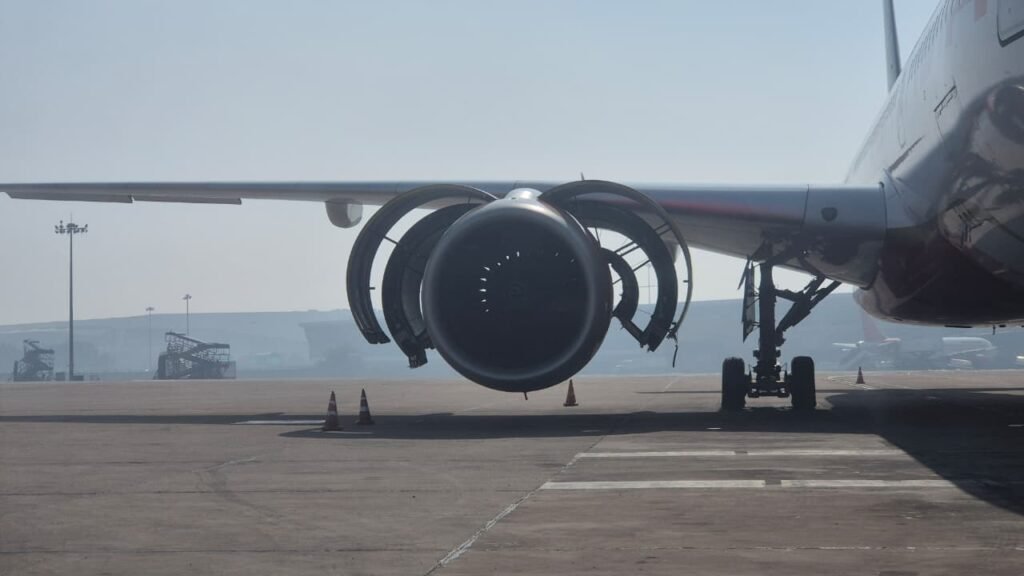
At very low taxiing speed, the aircraft’s Engine No. 2 (the right-side engine) ingested a loose LD3 cargo trolley.
These aluminum containers are standard for widebody baggage and cargo handling but are substantial ground equipment.
The severely reduced visibility due to the dense fog is considered a primary contributing factor, as the trolley likely entered the aircraft’s path unseen.
The crew followed immediate safety protocols, stopping the aircraft and initiating an engine shutdown. Airport ground staff and Air India’s engineering team responded promptly to the situation.
Aircraft Status, Investigation, and Passenger Care
Following the event, standard and thorough safety measures were enacted:
Passenger Safety: All passengers were safely disembarked via airbridge. No injuries were reported.
Aircraft Grounding: VT-JRB was taken out of service for a comprehensive technical inspection.
Engine Assessment: Maintenance crews began detailed examinations, including borescope inspections, to assess any internal damage to the engine core caused by the foreign object ingestion.
Regulatory Notification: Air India has informed the Directorate General of Civil Aviation (DGCA), India’s aviation regulator, which will oversee the investigation.
The incident, while operationally significant, was contained without fire or further damage. The focus now shifts to the engineering assessment to determine the extent of repair needed and the procedural review to understand how the ground equipment entered the active taxiway area during low-visibility operations.
Analysis: A Compound Operational Scenario
This event presents a compound operational scenario where two unrelated challenges—a geopolitical airspace closure and severe weather—converged on a single flight.
Safety Culture Highlight: The decision to return to base over uncertain airspace demonstrates applied safety culture. The crew prioritized long-term security over short-term schedule pressure.
Ground Handling Risks: The subsequent taxi incident brings focus to the critical importance of ground resource management, especially during Low Visibility Procedures (LVPs). Ensuring apron and taxiway areas are clear of loose equipment is paramount in fog.
A350 Resilience: The Airbus A350’s design includes stringent standards for foreign object ingestion. The full assessment will determine the robustness of the engine in this specific event.
Passengers booked on the disrupted San Francisco route were accommodated on alternative flights. The aviation industry will observe the investigation’s findings, which will contribute to ongoing safety enhancements in both flight planning and ground operations under adverse conditions.