
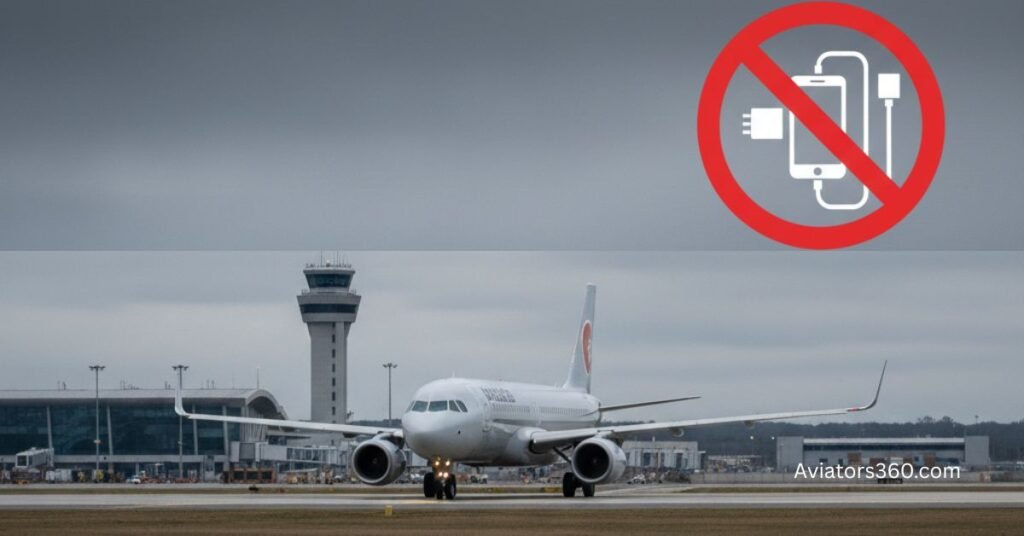
In a decisive move to protect the integrity of the Indian skies, the Directorate General of Civil Aviation (DGCA) has officially “pulled the plug” on in-flight charging via power banks. Issued in late 2025 and seeing strict enforcement as of January 2026, the new safety mandate marks a significant shift in how passengers interact with their electronic devices during travel.
This directive isn’t just a minor rule change; it is a response to a series of alarming global and domestic incidents where lithium-ion batteries transformed from convenient energy sources into dangerous ignition points mid-air.
The New Reality: What the DGCA Mandate Actually Says
The DGCA’s Dangerous Goods Advisory Circular (No. 01/2025) has laid out clear, uncompromising rules for both passengers and airlines. The primary objective is to minimize the presence of high-energy lithium sources that are unmonitored or actively generating heat through charging.
Key Restrictions for Passengers:
- Total Ban on Power Bank Use: Passengers are strictly prohibited from using power banks to charge phones, tablets, or laptops during a flight.
- No In-Seat Recharging: Connecting a power bank to the aircraft’s own USB or seat-mounted power outlets is now forbidden.
- Hand Baggage Only: Power banks and spare lithium batteries must be carried in hand luggage. They are strictly banned from checked-in bags.
- No Overhead Bin Storage: In a new twist, the DGCA has specified that power banks should not be stored in overhead compartments. They must remain accessible—ideally under the seat or in a seat-back pocket—where smoke or heat can be detected immediately.
The Science of Danger: Why Lithium Batteries Fail
To understand the severity of these rules, one must look at the chemistry of the lithium-ion battery. These batteries are prized for their high energy density, but that same density makes them volatile under certain conditions.
The Phenomenon of Thermal Runaway
The primary concern for aviation experts is Thermal Runaway. This is a chain reaction where an internal short circuit or external damage causes a battery cell to overheat uncontrollably. As the temperature rises, it triggers adjacent cells to fail, leading to a self-sustaining fire that can reach temperatures of 600°C to 1000°C.
Contributing Factors to Fire Risks:
- Manufacturing Defects: Low-quality or “counterfeit” power banks often lack the internal separators needed to prevent short circuits.
- Physical Stress: Being crushed in a crowded overhead bin or dropped can damage the internal structure of the battery.
- Overcharging & Heat: The act of charging generates heat. When a device is tucked away in a bag while charging, that heat cannot dissipate, significantly increasing the risk of ignition.
A Trail of Smoke: Recent Incidents That Forced the Ban
The DGCA’s move follows a string of harrowing incidents across the globe in 2025 that served as a wake-up call for the industry.
Date | Flight | Incident Details |
Oct 19, 2025 | IndiGo (Delhi to Dimapur) | A power bank ignited in a passenger’s seat-back pocket while taxiing, forcing a return to the bay. |
Oct 18, 2025 | Air China (Hangzhou to Seoul) | A battery in an overhead bin caught fire mid-flight; smoke filled the cabin, causing panic. |
Jan 28, 2025 | Air Busan (Busan to Hong Kong) | A suspected power bank fire destroyed an Airbus A321 on the ground. The aircraft was a total loss. |
Feb 24, 2025 | Batik Air (Johor Bahru to Bangkok) | A power bank ignited just before landing, leading to an emergency evacuation. |
These cases highlighted a critical flaw: when a fire starts in an overhead bin, it is often obscured. By the time smoke is visible, the fire is already “energetic” and difficult to extinguish with standard cabin equipment.
Airlines and Crew: The New Safety Protocols
The DGCA has not placed the burden solely on passengers. Airlines are now required to overhaul their safety risk assessments and crew training modules.
Enhanced Crew Training
Cabin crews are being trained to recognize the “early warning signs” of thermal runaway, such as a sweet, metallic smell, slight hissing sounds, or localized bulging of a device. They are now equipped with specialized fire containment bags and fire-resistant gloves to isolate smoking devices before they erupt into flames.
Communication and Infrastructure
Airlines must now make mandatory announcements regarding the power bank ban before take-off. Furthermore, airports have been directed to install prominent signage and safety videos at check-in counters and boarding gates to ensure no passenger is caught off-guard.
Future Outlook: Will Air Travel Ever Go “Battery-Free”?
While a total ban on lithium batteries is unlikely given our reliance on technology, the future of flight safety is leaning toward preventive vigilance.
- Watt-Hour Limits: Regulations are tightening around capacity. Currently, the limit stands at 100wh (roughly 27,000mAh), but we may see stricter caps on the number of devices allowed per person.
- Smart Monitoring: Future aircraft cabins might integrate infrared sensors in overhead bins to detect heat signatures before smoke even appears.
- Battery Standards: There is a growing push for international certification (like UL standards) to be mandatory for any battery-powered device brought on board.
Conclusion: A Small Inconvenience for Greater Safety
The ban on in-flight charging and the restriction of power banks to accessible hand luggage may feel like an inconvenience in our “always-connected” world. However, when weighed against the catastrophic potential of a lithium fire at 35,000 feet, the logic is undeniable.
Safety in aviation is built on the lessons of the past. By “powering down” during the flight, passengers are contributing to a safer environment for everyone on board.
Also Read : The Remarkable Rise of Shravan Kumar Vishwakarma: From Tempo Driver to Shankh Air Founder
Also Read : IIT Madras Builds a Plane That Can Fly Without a Runway
Disclaimer :
This blog post is for general information only. The content is based on publicly available news regarding DGCA directives and common knowledge of lithium battery safety. It is presented in simplified terms for easier understanding by a general audience.
The author is not an aviation expert, regulator, or airline representative. This is not official safety advice from the DGCA or any airline.
Aviation rules change. Always follow the latest official instructions from your airline and the flight crew. For authoritative rules, check the official DGCA website (dgca.gov.in) or your airline’s guidelines.
Mentions of future technologies or products are for discussion only, not an endorsement.
By reading this, you agree the author is not liable for any decisions made based on this info
Pingback: How AI Improves Flight Operations Before Takeoff