
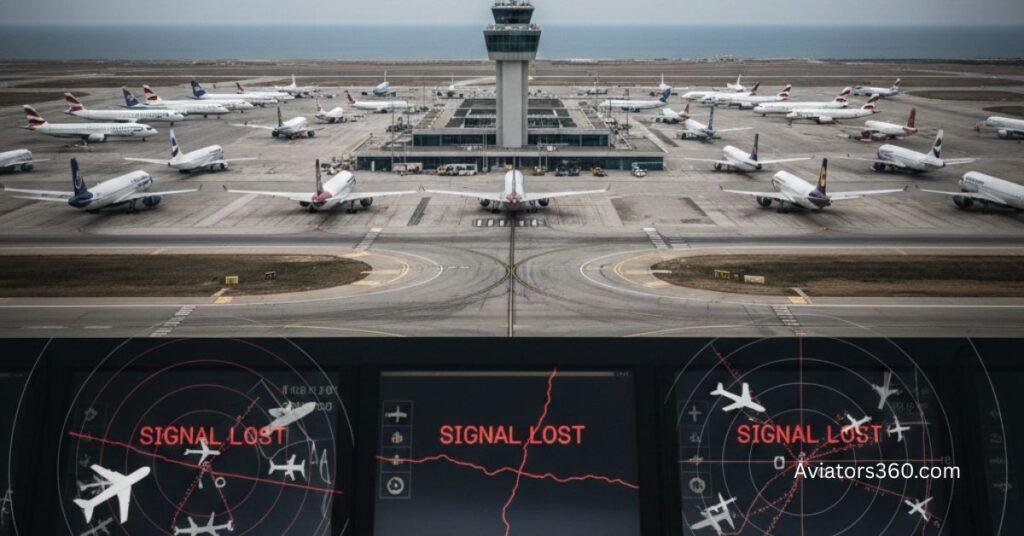
Picture this. You are at Athens airport. Your flight is on the screen. You have your ticket. You are excited. Then, an announcement. “All flights delayed.” Then, “All flights cancelled.” No storm. No strike. Just a “technical problem.” What happened? The radio system that pilots and air traffic controllers use to talk to each other… stopped working. This really happened in Greece. Thousands of people were stuck. This is the story of that day, told simply.
Talking to Pilots: The Sky’s Telephone
To fly safely, pilots need to talk to people on the ground. These people are called Air Traffic Controllers. They sit in towers and big rooms with radars. Their job is to guide planes. Pilots receive directions including “turn left,” “increase altitude,” and “cleared to land.”
They talk using a special radio, like a walkie-talkie but very powerful. This is the Air Traffic Control (ATC) radio. It is the most important tool. Without it, the controller cannot tell the pilot what to do. The pilot cannot ask for help. It would be like driving on a busy highway with no signs, no traffic lights, and you can’t see or talk to anyone.
When this radio stops, it is very dangerous. The rule is simple: No communication, no flying. So, when Greece’s radio system failed, they had to stop all flights. Planes already in the air were guided down carefully using backup methods. But no new planes could take off.
A Day of Chaos: What Travelers Saw
It was a busy summer day. Suddenly, the main system and its backup lost power. The controllers’ microphones went silent.
Here is what happened next, step by step:
- The Stop: The head of Greek air traffic control gave the order. All flights going to Greece were told to stay where they were. All flights leaving Greece were cancelled.
- The Airports: Athens airport became full of confused people. Families sat on the floor. Long, slow lines formed at help desks. People slept on benches. The same happened in other big airports like on the islands of Crete and Mykonos.
- The Ripple Effect: A plane from London to Athens that was cancelled meant that same plane couldn’t make its next trip. A family missing their flight to a Greek island also missed their hotel booking. The problem spread like a wave across Europe.
A pilot explained it this way: “Imagine if every police officer and traffic light in a big city suddenly vanished. You would have to close the roads. That’s what we had to do with the sky.”
More Than Just Bad Luck
The simple reason was a power failure. But experts say bigger problems made it worse:
- Old Systems: The radio equipment in Greece (and in many places in Europe) is old. It is like using a very old computer. It works, but it breaks more easily. Updating it is expensive and slow.
- Not Enough People: There are not enough air traffic controllers in Europe. The ones working are very tired from handling so many flights. A tired system cannot handle big shocks.
- Everything is Connected: Today, a problem in Greece causes trouble in Germany, France, and Italy. One cancelled flight affects ten other flights later that day.
How to Stop It Happening Again: Lessons Learned
This was a bad day, but it taught important lessons:
- Better Backups: They don’t just need one backup system. They need a backup for the backup. Different power sources. More radio towers in different places.
- New Technology: They are trying to use more text messaging between pilots and controllers (called CPDLC). So if the voice radio fails, they can still type messages.
- Clearer Information: Travelers were angry because no one told them what was happening. Airports and airlines now know they must explain clearly: “The radio for all planes has broken. It is not safe to fly. We are sorry. We are fixing it.”
The Bottom Line: Safety First
That day in Greece was scary and frustrating for everyone. But it showed one good thing: safety is the number one rule.
The stoppage was not a mistake. It was the only safe choice. It is better to be stuck on the ground than to be unsafe in the sky.
For us, the travelers, it means we should be a little more patient when these rare “technical problems” happen. They are not just an excuse. They are a sign that the system is putting safety first.
For the people who run our skies, it is a loud alarm bell. They must make the invisible systems we all depend on stronger and newer. So the next time you look up at a plane, you’ll know about the simple, crucial radio conversation keeping it safe—and how important it is that someone always picks up the call.
Also Read : Severe Winter Weather Leads US Airlines to Cancel Over 1,500 Holiday Flights
Also Read : Skies Go Silent Over Venezuela as US Strikes Rock the Nation
Disclaimer:
This blog is for general info only. It is based on news reports about past flight problems in Greece.
Check Official Sources: For exact facts (dates, causes, numbers), check official sources like Greek aviation authorities or major news.
Not Professional Advice: This simplifies things for a general reader. It is not advice for pilots, controllers, or travel planning.
No Guarantee: We are not responsible for any errors in the text or for decisions readers make based on it.
Mentions for Context: Names of companies or experts are used for context, not as an official endorsement.
Rules change. For current travel info, always check with your airline and official authorities.