
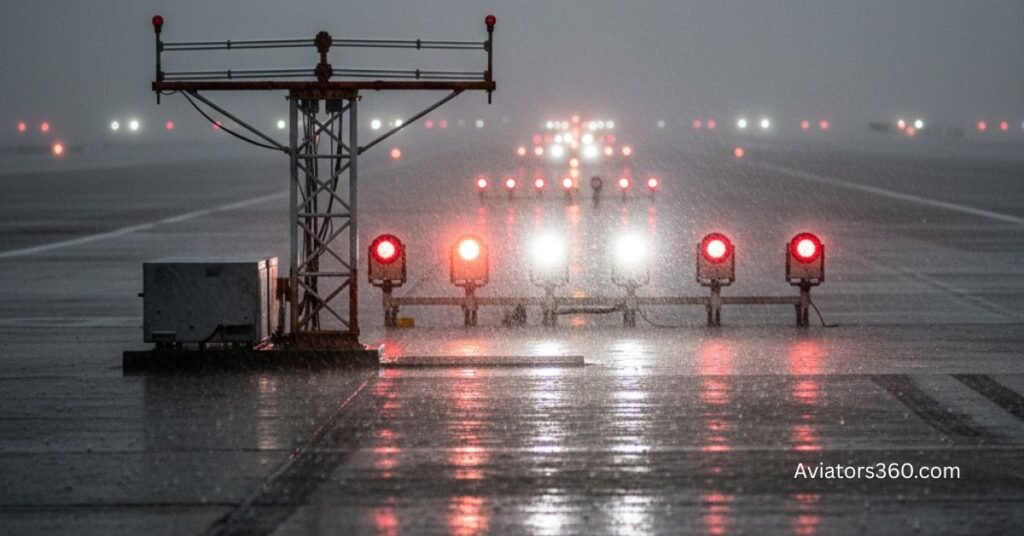
In the early hours of January 1, 2026, air travel to and from San Diego International Airport was thrown into widespread disruption. A reported power outage affected critical runway navigation equipment at the same time a severe New Year’s Day storm battered Southern California. The combination of technical failure and poor weather conditions led to a ground stop, mass diversions, hundreds of delays, and dozens of cancellations during one of the busiest travel periods of the year.
This incident highlights how modern aviation, despite its technological sophistication, remains vulnerable when multiple risk factors align.
Inside the San Diego International Airport Runway Outage
Shortly after the New Year began, airport operations encountered an unexpected power-related issue impacting key runway systems. These systems play a crucial role in guiding aircraft during landing, particularly in low-visibility conditions. With the equipment unavailable, inbound aircraft could not safely land under prevailing weather conditions.
As the situation escalated, authorities implemented a ground stop—an aviation safety measure that temporarily halts all incoming flights to a specific airport. During this period, aircraft already en route were either instructed to hold in the air or divert to alternate airports.
At the peak of the disruption:
- More than 223 flights experienced delays
- Nearly 270 flights were delayed overall across the day
- Over 50 flights were canceled
- Approximately 40 inbound flights were diverted to other airports
Diversions included major hubs such as Los Angeles and Phoenix, where aircraft could land safely despite the challenging weather affecting coastal Southern California.
The Role of the Power Outage
The reported power outage did not shut down the entire airport, but it affected systems essential for aircraft landing guidance. Among the most critical components impacted was the glide slope element of the instrument landing system.
The glide slope provides pilots with precise vertical guidance, allowing aircraft to descend along a safe, controlled path toward the runway. When this system is unavailable, especially during periods of low cloud cover and reduced visibility, safe landings become significantly more difficult.
With weather conditions already deteriorating, the loss of this equipment effectively removed a key safety margin, leaving airport authorities with little choice but to restrict arrivals until conditions improved or systems were restored.
Weather Complications on New Year’s Day
The outage occurred at an especially critical moment. A major New Year’s Day storm brought heavy rain, low cloud ceilings, and reduced visibility across the San Diego region. These conditions are particularly challenging for coastal airports, where weather patterns can shift rapidly.
Under clear skies, pilots can rely on visual references to land aircraft safely. However, during storms with low visibility, instrument-based approaches become essential. When landing systems are partially unavailable, operational flexibility is drastically reduced.
The storm effectively amplified the impact of the power outage. Aircraft that might otherwise have landed using visual approaches were forced to divert because weather conditions no longer supported those procedures.
FAA Ground Stop and Air Traffic Control Response
As safety concerns mounted, the Federal Aviation Administration implemented a ground stop for San Diego-bound flights. This procedure is designed to prevent congestion in the air and on the ground while a critical issue is addressed.
During the ground stop:
- Air traffic controllers coordinated holding patterns for some aircraft
- Airlines assessed fuel limitations and diversion options
- Pilots made real-time decisions balancing safety, fuel, and passenger impact
Several aircraft initially circled the airport, waiting for conditions to improve. However, as weather and equipment limitations persisted, many crews made the decision to divert rather than risk extended holding times.
Impact on Travelers During Peak Holiday Travel
For passengers, the disruption translated into confusion, frustration, and unexpected travel changes. New Year’s Day is traditionally a peak travel date, with aircraft operating at high load factors and limited spare capacity.
Travelers experienced:
- Unexpected landings at alternate airports
- Long waits for rebooking or ground transportation
- Missed connections and overnight delays
- Extended travel times, particularly for international passengers
Some long-haul international flights were among those diverted. In several cases, once conditions stabilized and equipment issues were addressed, these aircraft later returned to San Diego to complete their journeys.
A Chain of Compounding Risks
This incident was not the result of a single failure but rather a convergence of multiple risk factors:
- Infrastructure Vulnerability
Even brief power disruptions can affect sensitive navigation systems that depend on continuous electrical supply. - Weather Dependency
Modern airports rely heavily on instrument landing systems during adverse weather, making outages more consequential. - Peak Traffic Volume
Holiday travel leaves little room for operational flexibility, increasing the ripple effect of disruptions. - Safety-First Decision Making
Aviation prioritizes safety above all else. When uncertainty exists, diversions and ground stops are the preferred option.
Recovery and Future Planning
Following the incident, airport authorities and aviation regulators are expected to conduct a detailed review of what occurred. Such reviews typically focus on both immediate technical causes and broader systemic resilience.
Key areas likely to be addressed include:
- Strengthening power redundancy for runway and navigation systems
- Reviewing emergency response timelines for equipment outages
- Enhancing coordination between airport operations, airlines, and air traffic control
- Assessing storm-readiness protocols for critical infrastructure
Airports increasingly face the challenge of operating in an environment marked by more frequent extreme weather events. As a result, resilience planning—ensuring systems can withstand or quickly recover from disruptions—is becoming as important as capacity expansion.
Lessons for the Aviation Industry
The San Diego disruption serves as a reminder that aviation safety depends on layers of protection. When one layer fails, others must compensate. When multiple layers are compromised simultaneously, operations can grind to a halt.
For passengers, the incident underscores the importance of flexibility during peak travel periods. For the industry, it reinforces the need for continued investment in infrastructure reliability, redundancy, and weather resilience.
Conclusion
The early January 2026 disruptions at San Diego International Airport were the result of a reported power outage affecting critical runway equipment, compounded by a severe New Year’s Day storm. Together, these factors triggered ground stops, diversions, cancellations, and widespread delays that impacted hundreds of flights and thousands of travelers.
While operations eventually stabilized, the incident stands as a case study in how technical reliability, weather, and traffic volume intersect in modern aviation—and why proactive planning is essential to keep the system moving safely in the years ahead.
Also Read: Severe Winter Weather Leads US Airlines to Cancel Over 1,500 Holiday Flights
Also Read: A Very Close Call: When a Plane with 55 People Slid Off the Runway in Nepal
Disclaimer:
This blog is based on publicly available reports, official statements, and user-shared information at the time of publication. Details may evolve as authorities complete their investigations. The content is intended for informational purposes only and should not be interpreted as official aviation, safety, or operational guidance.