
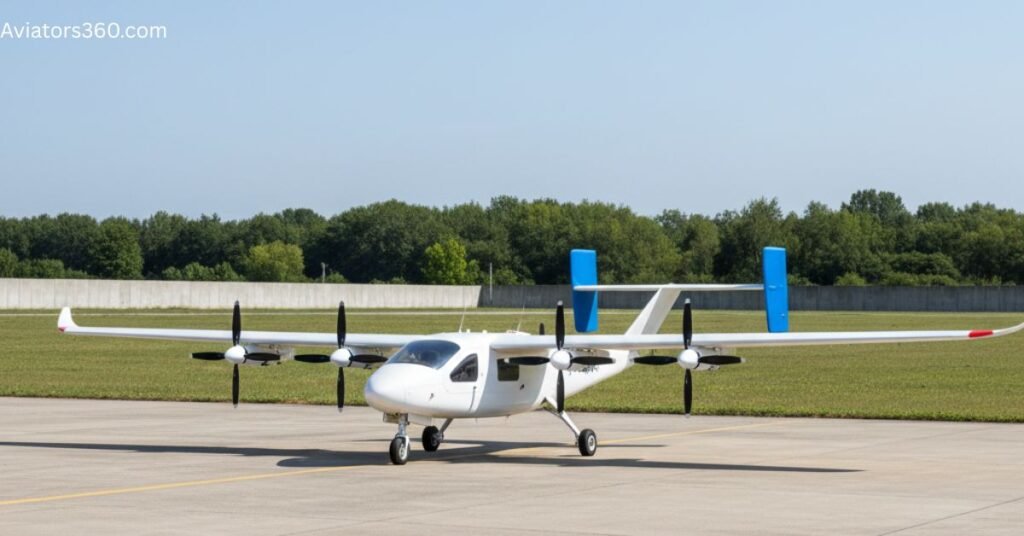
Imagine a plane that can take off from your local park, fly like a regular airplane, and land in your friend’s backyard. Sounds like something from a movie, right?
Well, it’s not science fiction anymore. The brilliant researchers at IIT Madras have just built and tested India’s first runway-free aircraft. This is a huge deal, and it could change how we travel, get packages, and handle emergencies in the future.
Let’s break down what this means in very simple words.
Understanding a “Runway-Free” Plane
First, let’s understand the problem they’re solving.
- Regular Planes need very long, flat runways (like the ones at big airports) to pick up enough speed to get into the air. No runway, no flight.
- Helicopters don’t need runways. They can go straight up and down. But they are noisy, use a lot of fuel, and can’t fly very far very fast.
- The IIT Madras Plane is the best of both worlds. It takes off straight up like a helicopter. Once it’s high enough, it tilts and flies forward like an airplane, which is much more efficient. To land, it slows down, tilts back up, and comes straight down. All it needs is a small clear space.
Think of it like a drone that can transform into a glider. That’s the core idea.
Why This Project Was Developed at IIT Madras
The team didn’t build this just because it’s cool (though it is very cool!). They built it to solve real Indian problems.
- Medicine to Remote Villages: India has many villages in hills, forests, and islands. Building an airport there is impossible. How do you get a vaccine or a blood sample there in an emergency? This plane can land in a small field and deliver it directly.
- Beating Traffic Jams: We all hate being stuck in traffic. The future of city travel might be in the air! Small, electric versions of this technology could work as “flying taxis” or air ambulances, going over crowded roads, not through them.
- No Need for Expensive Airports: Airports take up massive space and cost crores to build. This technology needs much less. In the future, a simple landing pad on a hospital roof or a community ground could be enough.
- “Made in India” for the Future: Usually, such advanced tech comes from other countries. IIT Madras is showing that Indian minds can invent the future too. This is a proud step for Indian science and engineering.
The Working Principle Explained
The IIT team built a small unmanned aircraft (like a big drone). Here’s the simple trick:
- It has multiple propellers (like a drone) attached to its wings.
- For take-off, these propellers spin to lift the plane straight up from the ground.
- Once in the air, the propellers slowly tilt forward. Now, they are pushing the plane ahead, and the wings start to lift it, just like a paper plane glides when you throw it.
- For landing, the process reverses. It slows down, the propellers tilt up again, and it lowers itself gently straight down.
The hardest part is that smooth shift from “helicopter mode” to “airplane mode.” The IIT Madras team has successfully done it!
Shaping the Future: What’s Coming Next
This successful test is just the first chapter. Here’s what they are planning next:
- Bigger and Better: They will build larger versions that can carry more weight—first bigger packages, and maybe one day, people.
- Green and Clean: The goal is to make them fully electric. This means quiet, pollution-free flights, which is perfect for cities.
- Startups for Real Use: IIT Madras is helping its students turn this idea into real companies. One such startup, ePlane, is already working to use this for delivering goods and for tasks like surveying crops.
- New Rules for New Skies: The team will work with the government to create rules for how these new vehicles can safely fly in our skies alongside birds, drones, and regular planes.
In a Nutshell: Why This News Matters to You
You might not fly in one of these next year. But this invention plants a seed for a different future.
- Faster Help in Disasters: When floods or earthquakes hit, these planes could quickly reach cut-off areas with supplies.
- Quick Deliveries: Your online order could someday arrive by a small, silent aircraft landing in a designated spot in your colony.
- A New Way to Commute: The dream of a short “air taxi” ride across a crowded city is now more real than ever.
IIT Madras hasn’t just built a new machine. They have built a new possibility. They’ve shown that for India to rise, it doesn’t always need to build long runways. Sometimes, it just needs to build great ideas that can take off on their own.
Disclaimer:
The information in this blog post is for general knowledge only. It is based on publicly available data about IIT Madras’s runway-free aircraft project and is not professional or technical advice.
Details may change as the technology develops.
Future applications mentioned (like flying taxis) are possibilities, not guarantees.
For the latest and most accurate information, please refer to official IIT Madras sources.
We are not responsible for any errors or for decisions made based on this content.
Pingback: Airline Safety Rules Updated as DGCA Bans In-Flight Charging