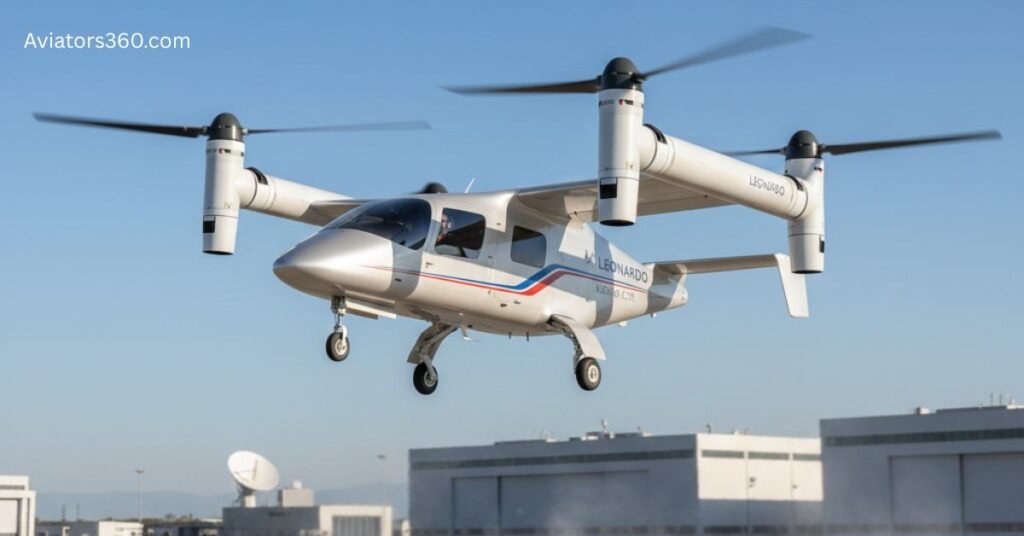
In a defining moment for the future of advanced air mobility, Leonardo has successfully completed the maiden flight of its Next-Generation Civil Tiltrotor (NGCTR) Technology Demonstrator. Conducted at the company’s test facility in Italy, this first flight marks a major milestone in the long-running effort to bring tiltrotor technology into the civilian aviation market.
More than a routine test event, the NGCTR’s first flight represents a tangible step toward reshaping regional air travel. By combining the vertical take-off and landing capability of a helicopter with the speed and range of a fixed-wing aircraft, the NGCTR concept aims to dramatically reduce travel times between cities while retaining operational flexibility. This achievement signals that the civil tiltrotor—once considered niche or experimental—is steadily moving closer to operational reality.
This article examines the significance of the maiden flight, the technology underpinning the NGCTR demonstrator, and what this program means for the future of civil aviation.
The Maiden Flight: Proving the Fundamentals
The first flight of the NGCTR Technology Demonstrator was carried out under the close supervision of Leonardo’s engineers and test pilots. As is typical for early-stage flight testing, detailed performance data such as flight duration, altitude, and envelope limits have not been publicly disclosed. However, the primary objectives of this initial sortie were well defined.
The focus was on validating basic flight mechanics, control laws, propulsion behavior, and overall airworthiness in helicopter mode. For any tiltrotor aircraft, vertical flight is among the most demanding operating regimes, making it the logical starting point for a cautious and methodical test campaign.
Controlled Maneuvers and Stable Hover
During the maiden flight, the aircraft executed a series of fundamental maneuvers, including hover, low-speed translation, and a controlled landing. While these actions may appear modest, they are critical for confirming system integration and stability.
The successful hover demonstrated the effectiveness of the NGCTR’s propulsion system and confirmed that its fly-by-wire flight control architecture can manage the complex aerodynamic interactions unique to tiltrotor aircraft. This digital control system continuously processes sensor data and issues precise control inputs, ensuring stability during vertical lift and preparing the aircraft for the demanding transition between helicopter and airplane modes.
Why This Is a Technology Demonstrator
Leonardo has been clear that the NGCTR is a technology demonstrator rather than a preview of a final production aircraft. Its purpose is not to showcase cabin finishes or commercial configurations, but to validate core technologies in real-world flight conditions.
Visually and structurally, the demonstrator differs significantly from Leonardo’s earlier civil tiltrotor, the AW609. The NGCTR features a larger, more aerodynamically optimized fuselage, a high-mounted wing, and two large tilting rotors driven by advanced turboshaft engines. These design choices reflect a focus on higher cruise speeds, improved efficiency, and scalability for future commercial operations.
The maiden flight confirms years of computational modeling, wind-tunnel testing, and systems integration work. Each successful test reduces technical risk and brings the program closer to a design that can ultimately meet stringent civil certification requirements.
Why the Time Is Right for a Next-Gen Tiltrotor
The NGCTR program is not emerging in isolation. It is the result of converging trends in technology, market demand, and environmental priorities that are reshaping the aviation industry.
Closing the Regional “Speed Gap”
One of the strongest arguments for a civil tiltrotor lies in its ability to bridge the speed gap between helicopters and conventional aircraft. Helicopters excel at point-to-point access but are typically limited to cruise speeds of 150–170 knots. Fixed-wing airliners, while fast, depend on large airports and rigid route structures.
The NGCTR is designed to cruise at speeds exceeding 330 knots (approximately 610 km/h), effectively doubling the speed of traditional helicopters. This capability could transform regional travel between city centers located 100 to 500 nautical miles apart. Journeys that currently require lengthy ground transfers or connecting flights could be completed in a fraction of the time.
Maturing Technology and Proven Experience
Leonardo brings decades of tiltrotor experience to the NGCTR program. Its involvement in the AW609 and the V-22 Osprey—developed with Bell—has generated millions of flight hours and invaluable operational data. Advances in materials, avionics, propulsion, and flight control software have reached a level of maturity that makes a civil-focused tiltrotor both feasible and commercially attractive.
At the same time, demand is growing among operators, corporate users, and public services for aircraft that can bypass congested ground infrastructure while offering higher speed and longer range than helicopters.
Sustainability and Long-Term Vision
Environmental considerations are also shaping the NGCTR’s design philosophy. The demonstrator’s architecture has been conceived with future propulsion solutions in mind, including hybrid-electric and potentially full-electric systems as technology evolves.
Even with conventional engines, a tiltrotor’s efficiency at high cruise speeds can result in lower emissions per passenger-mile compared to helicopters on longer regional routes. This aligns the NGCTR program with the broader aviation industry’s decarbonization objectives and long-term sustainability goals.
The Road Ahead: From Demonstrator to Certified Aircraft
While the maiden flight is a major achievement, it represents only the first step in a long development journey. Turning a technology demonstrator into a certified, passenger-carrying aircraft requires an extensive and carefully phased flight test and certification process.
A Progressive Flight Test Campaign
The NGCTR demonstrator will now enter a multi-phase flight test program designed to gradually expand its operating envelope:
- Phase 1: Continued testing in helicopter mode to refine vertical flight performance and handling qualities.
- Phase 2: The first in-flight conversion, during which the nacelles tilt forward and the aircraft transitions from helicopter to airplane mode—one of the most critical milestones for any tiltrotor.
- Phase 3: Evaluation of high-speed cruise performance, system redundancy, adverse weather operations, and failure-mode management.
Each phase builds upon the previous one, ensuring that risks are identified and mitigated before progressing further.
Targeting Certification in the 2030s
Leonardo ultimately aims to develop a fully certifiable civil tiltrotor based on NGCTR technologies. The anticipated production aircraft could accommodate approximately 9 to 11 passengers and would be certified by authorities such as EASA and the FAA.
Given the complexity of certifying a new aircraft category, entry into service is generally projected for the early to mid-2030s. This timeline reflects the rigorous testing, regulatory scrutiny, and design refinement required to bring a revolutionary aircraft to market safely.
Potential Applications and Market Impact
Once certified, the NGCTR platform could serve a wide range of missions across civil and commercial sectors:
- VIP & Executive Transport: Offering fast, direct travel for business executives, cutting travel time between city centers dramatically.
- Emergency Medical Services and Search & Rescue: Supporting faster response over long distances, particularly in regions with limited infrastructure.
- Regional Air Mobility: Operating as high-speed air shuttles between regional vertiports, complementing existing transport networks.
- Offshore Energy and Utility Missions: Accelerating crew rotation and logistics support for remote and long-distance offshore platforms.
These applications highlight the versatility of the tiltrotor concept and its potential to unlock entirely new operational models.
Conclusion: A Meaningful Step Toward the Future of Flight
The successful first flight of Leonardo’s Next-Generation Civil Tiltrotor Demonstrator is far more than a technical milestone—it is a clear signal that civil tiltrotor aviation is entering a new phase of maturity. By combining helicopter flexibility with airplane speed, the NGCTR concept has the potential to redefine regional mobility, reduce pressure on ground infrastructure, and reshape how people perceive distance.
Significant challenges remain, particularly in certification and large-scale commercialization. However, this maiden flight confirms the fundamental soundness of the design and the credibility of Leonardo’s long-term vision. As the demonstrator progresses toward its first in-flight conversion, the global aviation community will be watching closely.
The future of fast, vertical flight is no longer confined to simulations and test rigs. With the NGCTR now airborne, it has firmly entered the real world.
Disclaimer:
This blog is for informational and educational purposes only. All technical details, performance figures, timelines, and projections related to Leonardo’s Next-Generation Civil Tiltrotor are based on publicly available information and industry expectations at the time of writing. Actual specifications, certification schedules, and operational capabilities may change as development and regulatory processes continue. This content does not constitute investment, engineering, or aviation operational advice.