
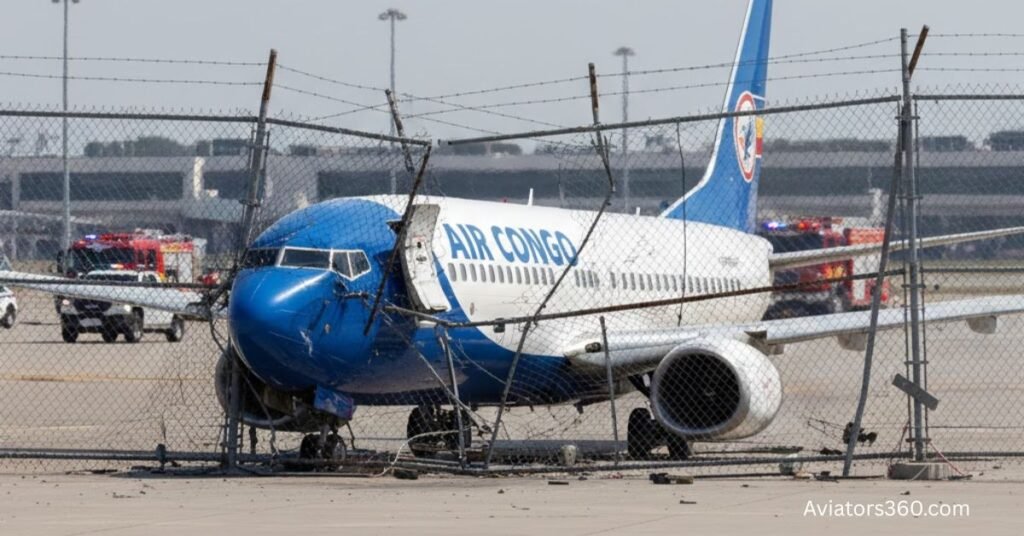
A Shocking Failure of Aviation’s Final Safety Layer
What should have been a routine arrival turned into a stark and shocking reminder of how fragile aviation safety becomes when ground systems fail. At Kindu Airport in the Democratic Republic of Congo, passengers aboard an Air Congo Boeing 737 experienced a terrifying conclusion to their journey, exposing a dangerous breakdown in fundamental airport protocols. This incident, captured on video and shared globally, transcends a mere travel inconvenience—it represents a critical failure of multiple safety layers designed to protect passengers from the moment an aircraft touches down until they are safely on the ground.
The Incident: From Routine Arrival to Dangerous Disembarkation
Passengers on the Air Congo flight arrived at Kindu Airport expecting the normal flow of deplaning. Instead, they were met with an alarming situation. The aircraft sat on the apron for hours, sealed with no ground support in sight. No air stairs arrived, no jet bridge connected, and no clear communication was offered to those trapped inside the metal tube.
The Critical Moment: A Door Opens to Danger
The situation escalated from concerning to critically unsafe when the aircraft door was finally opened. Rather than revealing a secure passage to the terminal, it opened to nothing but open air and bare tarmac, several feet below. Faced with no alternative and likely after hours of waiting, the disembarkation process began. One by one, passengers were forced to jump directly from the aircraft door onto the hard ground. This was not an emergency evacuation triggered by fire or imminent danger; it was an improvised, dangerous solution to a profound logistical failure.
The visuals are disturbing: individuals, including those who may have had hidden health conditions or reduced mobility, assessing the drop, hesitating, and then taking a leap of faith. What is designed as the final, controlled step of a commercial flight had been transformed into an uncontrolled and hazardous activity.
Why This Isn’t Just an “Inconvenience”—It’s a Major Safety Breach
To dismiss this as a simple travel mishap is to misunderstand the fundamentals of aviation safety. A Boeing 737’s cabin door is positioned well above a safe stepping height. It is engineered explicitly to be used in conjunction with certified equipment: passenger stairs, jet bridges, or, in emergencies, inflatable slides.
The Real Risks of an Unassisted Jump
Allowing passengers to jump exposes them to significant risks of serious injury. The force of impact from that height can easily lead to:
- Fractures: Ankles, legs, and hips are particularly vulnerable.
- Spinal Compression Injuries: The jarring landing can damage vertebrae.
- Head Trauma: A loss of balance upon landing could result in a dangerous fall.
The fact that no injuries have been widely reported from the Kindu incident appears to be a matter of sheer luck, not a reflection of safe procedure. This action violated a cardinal rule in aviation: never compromise a controlled environment for an uncontrolled one without absolute necessity.
A Systemic Collapse in Airport Safety Procedures
Aviation safety is a complex ecosystem, a “Swiss Cheese Model” where multiple layers of defense—aircraft design, crew training, airport infrastructure, and ground handling coordination—must align to prevent an accident. At Kindu, several of these layers seem to have developed gaping holes simultaneously.
The Chain of Breakdowns
- Failure in Ground Handling Coordination: The most immediate failure. Why was the aircraft cleared to park without confirmed availability of boarding stairs or equivalent equipment? This suggests a severe breakdown in communication between the airline’s operations, the flight crew, and the airport’s ground handlers.
- Failure in Contingency Planning: Keeping passengers onboard for hours indicates a lack of a viable Plan B. Standard procedures should have triggered an alternative, such as arranging equipment from another provider, using a different parking stand, or, as a last resort in a non-emergency, arranging safe transportation like a truck with a platform to ferry passengers.
- Failure in Crew and Ground Decision-Making: The decision to open the door and allow jumping is the most perplexing. While the pressure to resolve the situation was immense, this action directly contravened basic safety principles. It replaced a known, controlled hazard (passengers waiting) with an active, uncontrolled one (passengers jumping).
- Potential Infrastructure and Resourcing Issues: Kindu Airport, like many in regions with limited funding, may suffer from inadequate equipment, poor maintenance, or understaffing. While this explains the lack of stairs, it does not excuse the operational decisions that followed.
The Silence and the Stakes: Air Congo’s Response and Regulatory Implications
As of now, Air Congo has not issued a comprehensive public statement explaining the event. This silence is deafening and problematic. Key questions remain unanswered:
- Why was the flight dispatched or routed to Kindu without confirmed ground support?
- What were the communications between the cockpit and ground control during the hours of waiting?
- Who authorized the dangerous disembarkation method, and under what justification?
The Democratic Republic of Congo’s civil aviation authority (AAC) now faces a critical test. This incident must trigger a rigorous investigation. The probe should not only look at this specific event but also audit the operational readiness and safety compliance of ground handlers at Kindu and similar airports across the country.
Lessons for the Future: Preventing the Next “Leap of Faith”
This incident at Kindu Airport is a cautionary tale for the global aviation industry, especially in regions where infrastructure challenges exist. Moving forward requires concrete actions.
Immediate and Long-Term corrective Actions
- Operational Audits: Airlines must verify ground service availability before dispatching flights to airports with known resource challenges. “Dispatch and hope” is not a safe strategy.
- Enhanced Contingency Training: Crew and ground staff need training for “non-normal” disembarkation scenarios that do not escalate into unsafe practices. This includes better communication protocols and predefined alternative solutions.
- Infrastructure Investment: While long-term, there must be a push, potentially through international aviation bodies like ICAO, to support basic, reliable ground equipment at all airports servicing commercial jets.
- Cultivating a “Just Culture”: The investigation must focus on systemic fixes, not just blaming individuals. Employees must feel safe reporting equipment failures or operational pressures without fear of retribution, so problems can be solved before they lead to crisis.
Conclusion: Safety Ends at the Terminal Door
The Kindu incident delivers a sobering, unambiguous message: A safe flight does not end at touchdown. The safety chain extends seamlessly from the manufacturing plant to the airport gate. When the final link—competent ground handling—fails, the entire system is compromised.
The image of passengers jumping from a commercial airliner is more than a viral curiosity; it is a flashing red warning light. It warns of what happens when preparedness is assumed rather than verified, when coordination breaks down, and when operational pressure overrides fundamental safety doctrine. The global aviation community must look at Kindu not with detached shock, but with a determined commitment to ensure that such a dangerous and preventable scene is never repeated. The alternative—relying on luck instead of protocol—is a risk the flying public should never be asked to take.
Disclaimer:
This blog is based on public reports and analysis. We are not direct witnesses or affiliated with the involved parties. The official investigation by authorities will determine the final facts and accountability. For verified information, please refer to statements from Air Congo and the relevant aviation authority.
Pingback: A Very Close Call: When a Plane with 55 People Slid Off the Runway in Nepal - aviators360.com