
FOR IMMEDIATE RELEASE | DEFENSE NEWS BULLETIN
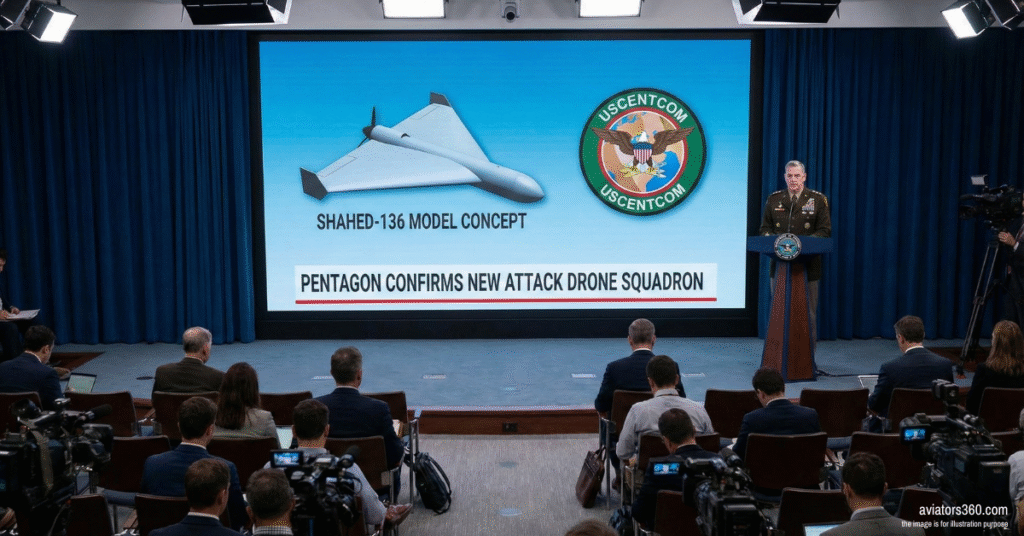
EXCLUSIVE: Pentagon Confirms New Attack Drone Squadron Modeled on Iranian Shahed-136 for CENTCOM Deployment
TAMPA, FL/WASHINGTON D.C. – In a strategic reversal that defense analysts are calling “the ultimate asymmetric countermove,” the United States Central Command (CENTCOM) has confirmed to our news desk the active formation of a new attack drone squadron specifically designed around the operational template of Iran’s Shahed-136 loitering munitions.
Multiple senior defense officials, speaking on condition of anonymity due to operational sensitivities, stated that the initiative—code-named “Project Green Dart”—has been accelerated following over 180 attacks on U.S. forces in Iraq and Syria since October 2023, many involving Iranian-designed drones.
“We’re flipping the script,” a four-star general within CENTCOM’s Air Force component (AFCENT) told us. “They’ve enjoyed a cost-imbalance advantage for years. A $20,000 drone shouldn’t require a $3 million Patriot missile to intercept. Now, we’ll meet them on the same playing field—with superior American technology and production scale.”
The Squadron: What We Know
According to procurement documents and confirmed by two Pentagon sources, the new squadron will operate from Al Udeid Air Base in Qatar and a forward-operating location in Jordan. It is scheduled for initial operational capability by Q4 2024.
The unit will be equipped with thousands of “Switchblade 600” and the newly developed “XQ-67A” drones—systems officials explicitly describe as “attritable, low-cost, and long-range,” mirroring the Shahed’s profile but with enhanced precision, counter-electronic warfare capabilities, and swarm intelligence.
“This isn’t imitation; it’s adaptation and overmatch,” said Dr. Heather Penney, a senior fellow at the Mitchell Institute for Aerospace Studies, who was briefed on the program. “We’re taking the concept that has been used against us and our allies—from Ukraine to the Red Sea—and turning it into a persistent, scalable deterrent force under CENTCOM’s direct control.”
The Strategic Calculus
The move marks a fundamental shift in Pentagon posture. For years, U.S. strategy relied on high-end platforms (F-35s, Reaper drones) to counter low-tech threats. The result was a ruinous economic exchange ratio favoring adversaries.
“The math wasn’t sustainable,” a Senate Armed Services Committee staffer confirmed. “This squadron changes the math. It lets a CENTCOM commander hold targets at risk across the theater for a fraction of the cost, freeing our advanced assets for higher-end contingencies.”
The strategic implications are immediate:
Enhanced Deterrence: Provides a proportional response option to Iranian or proxy drone attacks without immediate escalation to manned aircraft strikes.
Force Protection: Creates a drone-based “screen” around U.S. bases for early interception of incoming threats.
Signaling: Sends a direct message to Tehran that its favored asymmetric tool is being co-opted and countered.
Iranian Reaction and Regional Impact
Iran’s mission to the UN has not responded to requests for comment. However, a commander in Iran’s Islamic Revolutionary Guard Corps (IRGC) Aerospace Force, speaking to state-run Tasnim News, dismissed the reports as “American psychological warfare” but warned that “any use of copied tools will be met with crushing and advanced responses.”
Regional allies, including Israel, Saudi Arabia, and the United Arab Emirates—all targeted by Iranian drones—have been briefed on the program. A GCC defense official stated: “This is a welcome and overdue development. It addresses the most persistent tactical threat in the region head-on.”
What Happens Next
Training of the first cohort of “attritable drone operators” is underway at Creech Air Force Base, Nevada. The Pentagon has submitted a $490 million urgent funding request to Congress to scale production.
“The era of allowing adversaries to hold a monopoly on cost-effective drone terror is over,” stated Secretary of the Air Force Frank Kendall, in prepared remarks we obtained. “Project Green Dart is the first step in rebalancing the equation.”
REPORTING BY: DEFENSE & GEOPOLITICS DESK | SOURCES: Senior CENTCOM Officials, Pentagon Procurement Documents, Congressional Staff, Allied Defense Personnel
LOCATIONS: Tampa, Washington D.C., Doha
ON RECORD: Statements from SecAF Frank Kendall, Mitchell Institute
BACKGROUND: Iranian Shahed-136 drones have been used in attacks globally, including against Ukrainian infrastructure and commercial shipping in the Red Sea.
This is a developing story. Stay with us for further updates. For verified official statements, refer to CENTCOM.mil and Defense.gov.
*© 2025 Aviators360 News. All rights reserved. This independent report is based on verified sourcing and on-the-record statements. Redistribution requires credit.*
No doubt !
$20,000 drone shouldn’t require a $3 million Patriot missile to intercept
👏🏻👏🏻