
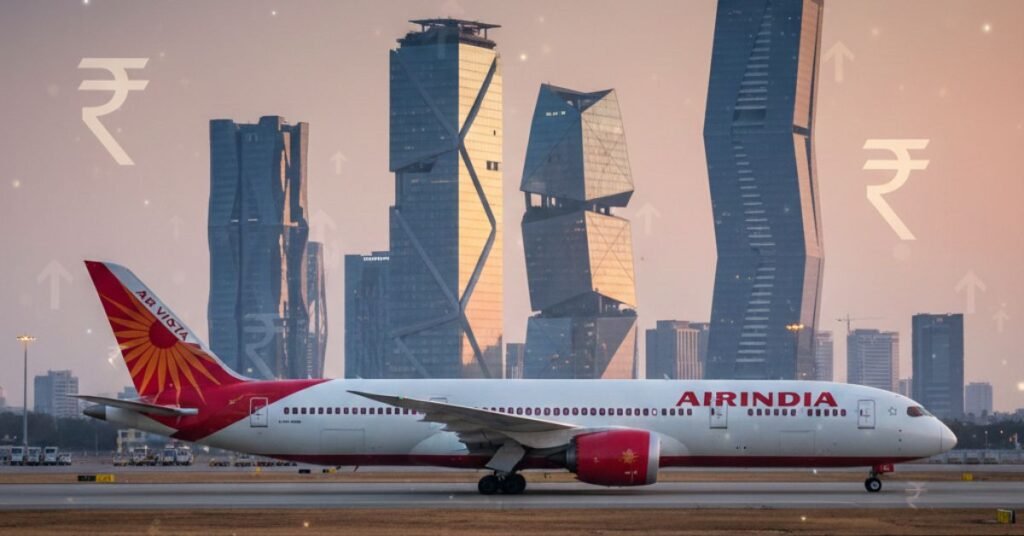
In a significant step for India’s financial and aviation sectors, Air India’s leasing subsidiary, AI Fleet Services IFSC Ltd (AIFS), has secured a $215 million loan to finance six Boeing 777-300ER aircraft. What makes this deal historic isn’t just the sum involved but where it was routed—through Gujarat International Finance Tec-City, known as GIFT City. This transaction marks the first commercial aircraft financing arranged through GIFT City’s International Financial Services Centre (IFSC), positioning India as a potential hub in the global aviation finance landscape.
Breaking Down the Deal
The transaction, announced in mid-October 2025, involves a seven-year amortising term loan provided by a consortium led by Standard Chartered and the Bank of India. The funds will be used to acquire six Boeing 777-300ER widebody aircraft, which will then be leased back to Air India for its operations.
Key Deal Details:
- Borrower: AI Fleet Services IFSC Ltd (AIFS), a GIFT City–based entity.
- Facility: $215 million term loan.
- Aircraft: Six Boeing 777-300ERs.
- Arrangers: Standard Chartered (structuring bank) and Bank of India.
Beyond the numbers, the strategic importance lies in its structure. By using a GIFT City–registered entity, Air India and its financiers have pioneered a model that could reduce dependence on traditional aviation finance hubs like Dublin, Singapore, and the Channel Islands.
Why This Transaction Is a Game-Changer
- A Boost for GIFT City’s Global Ambitions
GIFT City’s IFSC was established to attract international financial services to India by offering a regulatory environment comparable to global hubs. This deal serves as a proof of concept, demonstrating that complex, cross-border aviation financing can be successfully executed from Indian soil. For policymakers, it’s a validation of years of effort to create a conducive ecosystem for specialized finance.
- Supporting Air India’s Massive Fleet Expansion
Since its acquisition by the Tata Group in 2022, Air India has embarked on an ambitious transformation plan, which includes a historic order for 570 new aircraft. Financing this expansion requires diverse funding sources—from operating leases to export credit. This GIFT City–based loan provides long-term, amortising debt, adding a new instrument to Air India’s funding toolkit while keeping transactions within India’s financial system.
- Diversifying India’s Aviation Finance Ecosystem
Historically, Indian airlines have relied heavily on foreign lessors and financiers. By successfully structuring this deal domestically, the transaction encourages other airlines, lessors, and banks to consider GIFT City for future aviation financing. Sanjay Sharma, Chairman of AIFS and CFO of Air India, emphasized that “GIFT City will be important for financing these aircraft,” signaling continued reliance on this hub.
The Larger Context: India’s Aviation Ascent
India is one of the world’s fastest-growing aviation markets, with passenger traffic soaring and fleets expanding rapidly. However, the financial infrastructure to support this growth has often lagged. This deal aligns with the government’s vision to develop homegrown capabilities in aviation leasing and finance, reducing forex outflow and creating high-value jobs in financial services.
For GIFT City, attracting aviation finance is a strategic priority. The IFSC offers benefits like tax incentives, streamlined regulations, and proximity to one of the world’s largest aviation markets. If more transactions follow, India could capture a meaningful share of the global aircraft leasing market, estimated to be worth hundreds of billions of dollars.
Voices from the Ground
P.D. Singh, CEO for India & South Asia at Standard Chartered, noted that the facility would “provide a fillip to growing the aviation finance segment in India.” His statement underscores the bank’s confidence in GIFT City’s potential as a financing base.
Legal experts from Watson Farley & Williams, who advised the lenders, highlighted the cross-border documentation and regulatory alignment required—a challenge successfully navigated in this transaction. Their involvement signals the complexity and international standards met by the deal.
What Lies Ahead: Opportunities and Challenges
- Replication and Scale
The true test will be whether other airlines and lessors adopt similar structures. IndiGo, Akasa Air, and SpiceJet—all in expansion mode—could explore GIFT City for their financing needs. Success here would trigger a virtuous cycle, attracting more banks, legal firms, and service providers to the IFSC.
- Regulatory and Tax Clarity
For GIFT City to compete with established hubs, it must offer clear, stable policies on taxation, repossession, and dispute resolution. The government has already introduced incentives, but ongoing refinement will be crucial to building trust among international players.
- Market Dynamics
Global factors like interest rate trends, aircraft residual values, and capital availability will influence the appeal of such financings. The use of older-generation aircraft like the 777-300ERs in this deal shows that GIFT City can handle diverse asset types, but newer models may require different structures.
- Building Expertise
Developing local expertise in aviation law, insurance, and technical services will be essential. Collaboration between Indian institutions and global experts—as seen in this deal—can accelerate this learning curve.
The Bottom Line
This $215 million financing is far more than a routine loan—it’s a milestone for Indian financial sovereignty in aviation. For Air India, it’s a strategic move to fund growth efficiently. For GIFT City, it’s a showcase of capability. And for India, it’s a step toward becoming a global player in aviation finance.
As the dust settles, stakeholders will watch closely for follow-on deals. If successful, this transaction could mark the beginning of a shift in how aircraft are financed in the world’s third-largest aviation market—bringing capital, jobs, and expertise closer to home.