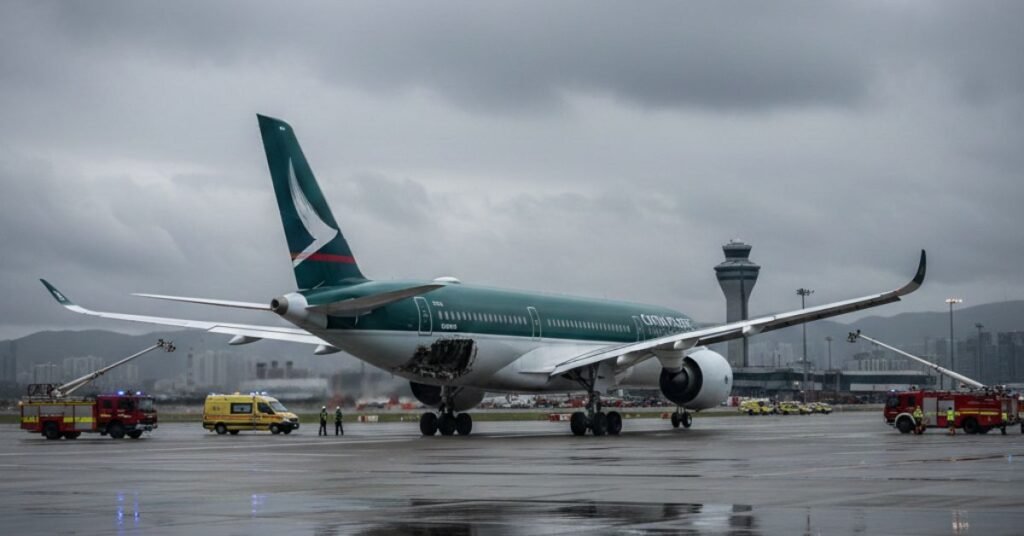
A Cathay Pacific Airbus A350-1000 operating a flight from Ho Chi Minh City to Hong Kong encountered a serious incident on November 26 when it experienced a tail strike during a go-around at Hong Kong International Airport (HKG). Although the aircraft later landed safely, the event has raised important questions about approach stability, aircraft handling, and the challenges involved in executing a go-around close to the runway.
This blog dives deep into what exactly happened, why the tail strike occurred, and what comes next for both the aircraft and the airline.
A Routine Landing That Suddenly Changed Course
The A350-1000 was on its final approach to Runway 07C at Hong Kong when the crew noticed the aircraft veering slightly left of the centerline. In commercial aviation, precision is everything during landing, and even slight instability can become a risk.
To avoid an unsafe touchdown, the crew initiated a go-around — a normal and recommended procedure when the approach is unstable.
But this go-around didn’t go as smoothly as expected.
As the aircraft transitioned from the landing flare into full thrust, its lower aft fuselage made contact with the runway, causing a tail strike.
Tail strikes usually happen when an aircraft reaches an abnormally high pitch angle close to the ground. For the long-bodied A350-1000, the clearance margin is even smaller, making it more vulnerable during aggressive pitch changes.
How the Aircraft Recovered After the Tail Strike
Despite the impact, the aircraft continued climbing safely. There was no loss of control, no onboard emergency, and no immediate systems failure.
After stabilizing at 6,000 feet, the pilots held the aircraft in the airspace while coordinating with air traffic control and the airline’s operations team. Roughly 34 minutes later, the aircraft lined up again for Runway 07C and executed a safe and smooth landing.
The A350 then taxied to the gate under its own power, but the situation was far from over.
Aircraft Grounded for Comprehensive Inspections
Because the Airbus A350 is built with advanced composite materials, tail strikes require extremely detailed inspection procedures.
Cathay Pacific removed the aircraft from service immediately and began:
- Visual Examination
Technicians inspected the tail cone, tail bumper, and lower fuselage skin for visible scuffs, abrasion marks, dents, or punctures.
- Borescope Assessment
Internal structures such as frames and stringers were examined for cracks or delamination.
- Non-Destructive Testing (NDT)
Composite aircraft require detailed scanning using:
- Ultrasound
- Infrared thermography
- Tap tests
These methods detect internal damage not visible from outside.
- Flight Data Analysis
The flight data recorder was reviewed to determine:
- Exact pitch angle during the strike
- Thrust settings
- Flight control inputs
- Aircraft attitude during flare and go-around
As of now, the aircraft has not returned to service, indicating that inspections and possible repairs are ongoing.
Why Tail Strikes Happen: The Technical Factors
Tail strikes during go-arounds are not common — but the aerodynamic and mechanical forces involved make these moments extremely sensitive. Several factors can contribute:
- Strong Pitch-Up Forces During TOGA
When pilots select Takeoff/Go-Around (TOGA) thrust:
- Engines deliver maximum power
- Aircraft naturally pitches up
- The nose rises quickly
If pilots add extra back-pressure or don’t counteract this pitch tendency, the tail may strike the runway.
On the A350-1000, tail strike risk increases above 13.5–14 degrees of pitch.
- Fly-By-Wire Transition
The A350’s fly-by-wire system provides envelope protection, but very low-altitude, rapid maneuvers can momentarily challenge these limits — especially during:
- Transition from flare to climb
- High workload situations
- Unstable approaches
- A350-1000’s Length
At nearly 74 meters long, the A350-1000:
- Has a long rear fuselage
- Has reduced tail clearance
- Requires precise control inputs
This makes the variant more susceptible to tail strikes than the shorter A350-900.
What Happens Next for the Aircraft and Crew
- Engineering Actions
Depending on inspection results, the aircraft may require:
- Composite skin repairs
- Replacement of fuselage panels
- Reinforcement patches
- Tail skid assembly changes
All repairs must meet Airbus structural integrity standards before the aircraft can re-enter service.
- Crew Review and Safety Analysis
Incidents like these trigger:
- Internal safety board analysis
- Flight crew debriefing
- Simulator recreations
- Review of approach stability protocols
This helps identify whether the cause was:
- Environmental
- Mechanical
- Procedural
- A combination of multiple factors
- Regulatory Reporting
Cathay Pacific will submit incident details to:
- Hong Kong Civil Aviation Department
- Airbus technical teams
- Internal safety management systems
Future Implications for the Airline and Industry
Events like this often lead to broader safety enhancements. Possible future measures include:
- Updated Go-Around Training
Airlines may emphasize:
- Low-level go-around technique
- Pitch control during TOGA
- Avoiding over-rotation
- Transition handling from flare to climb
- Software or System Refinements
Airbus may refine:
- Tail strike protection logic
- Fly-by-wire pitch envelope parameters
- Approach stability warning systems
- Enhanced Monitoring Tools
More real-time monitoring of:
- Pitch angles
- Flight control surface positions
- Aircraft attitude during approach
- Review of Approach Stabilization Policies
Airlines may tighten criteria for:
- Go-around initiation
- Acceptable crosswind deviation
- Approach technique in adverse conditions
Conclusion
The Cathay Pacific A350-1000 tail strike at Hong Kong highlights how even routine flights can encounter unexpected challenges. While passengers were safe and the aircraft landed successfully, the incident reinforces the importance of precision, pilot training, and robust aircraft design.
As inspections continue, the aviation industry will closely follow the findings — not only to repair one aircraft, but to improve safety guidelines for every future flight.
I get pleasure from, cause I found just what I was looking for.
You’ve endxed my 4 day long hunt! God Bless you man. Have a nice day.
Bye http://boyarka-inform.com/