
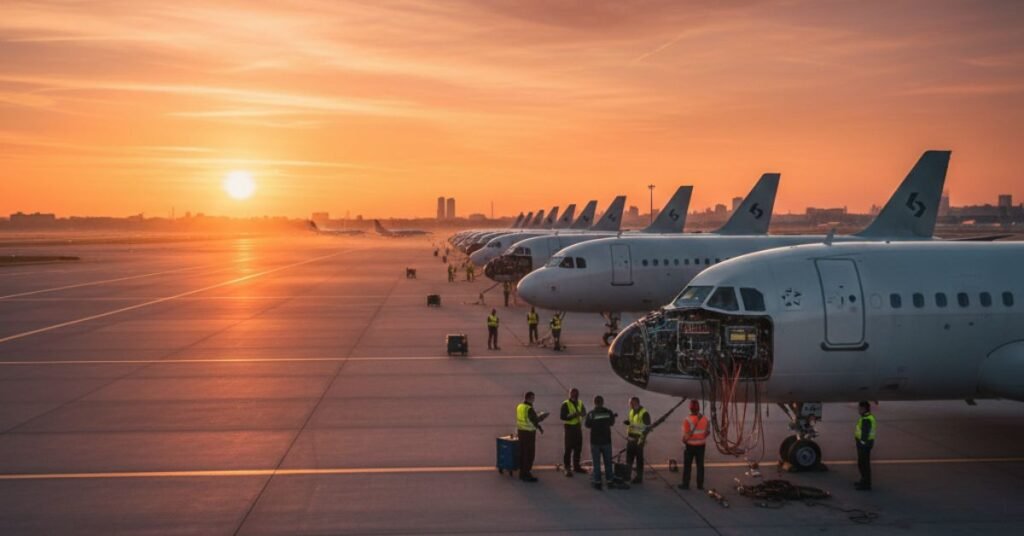
A quiet weekend turned into a global aviation crisis when Airbus alerted airlines about a critical software issue affecting numerous A320-family aircraft. What followed was a massive wave of delays, cancellations, operational confusion, and thousands of stranded passengers across continents.
From IndiGo and Air India to Lufthansa, Air France, Air India Express, American Airlines and others, carriers scrambled to inspect and update aircraft systems. The situation highlighted a simple truth: in an age where airplanes rely heavily on digital systems, even a few lines of faulty code can disrupt the world.
What Triggered the Chaos?
The issue began when an A320-series jet experienced an unusual altitude fluctuation during flight. Although the aircraft landed safely, it raised concerns. Engineers traced this to a software vulnerability in the flight-control system introduced during a recent update.
Under rare environmental conditions — especially during strong solar activity — the updated software could receive corrupted sensor inputs. This combination created a scenario where the aircraft’s computers might respond unpredictably.
To avoid any possible risk, Airbus urgently instructed operators to roll back the update or install a corrective patch.
Because the A320 family is the most widely used aircraft in the world, the problem spread across global networks instantly.
Why a Software Glitch Turned Into a Worldwide Problem
Modern aircraft are built around complex code. Autopilot, stabilization, flight laws, and even safety logic depend on digital systems.
In this case, a software update intended to improve efficiency created an unexpected vulnerability.
It wasn’t mechanical failure.
It wasn’t crew error.
It was pure digital unpredictability triggered by rare atmospheric conditions.
Since the issue touched flight-control logic — the heart of aircraft safety — airlines had zero flexibility. Every affected aircraft had to be grounded until engineers confirmed it was safe.
Airlines and Aircraft Affected
The impact was global because the Airbus A320 family includes:
- A320
- A321
- A319
- A320neo families
Airlines operating hundreds of these aircraft — like IndiGo, Air India, Lufthansa, Air France, American Airlines, and more — faced immediate disruptions. Some airlines had dozens of aircraft waiting for software checks simultaneously.
Even though each update or rollback takes only a few hours, doing this for entire fleets caused a domino effect:
- delayed departures
- cancelled flights
- missed international connections
- confused passengers across airports
Passenger Impact: A Global Ripple Effect
The disruption extended far beyond technical work:
Massive delays
Airlines withheld aircraft from service until cleared by engineers.
Cancellations
Some carriers didn’t have backup aircraft, especially low-cost airlines with tight turnaround schedules.
Stranded travellers
People missed connecting flights, hotel bookings, business meetings, or family events.
Operational chaos
Airlines had to reorganize rosters, gates, hangar time, and crew schedules in real time.
Airport congestion
Customer service desks were overwhelmed across multiple countries.
Even after fixes were applied, it took days for flight schedules to stabilize.
Why Airlines Couldn’t Ignore the Problem
Aviation is based on the principle: If there is even 0.1% doubt, take 100% precaution.
The risk was extremely rare, but because it affected flight-control inputs, Airbus instructed:
“Do not fly until the aircraft is updated or rolled back.”
No airline could take a chance, especially when passenger safety is involved.
How Airlines Responded Internally
Behind the scenes, airlines worked around the clock:
Emergency maintenance teams activated
Engineers worked overnight to run updates.
Priority aircraft first
Planes scheduled for early flights were updated immediately.
Pilot and crew realignment
With shifts disrupted, crew duty hours had to be re-planned.
Backup aircraft deployment
Where possible, airlines used reserve planes to minimize cancellations.
Passenger communication
Apps, emails, and display boards were used, though many passengers still complained about delayed notifications.
Despite the chaos, technicians worldwide managed to resolve the issue faster than expected.
Future Outlook: How This Incident Will Shape Global Aviation
The Airbus A320 software glitch wasn’t just a crisis — it was a warning. The aviation industry is becoming increasingly digital, and with that comes new responsibilities.
Here’s how the future may change after this event:
- Stricter Software Certification
Airbus and aviation regulators may enforce stronger validation for software updates, especially those affecting flight-control logic.
Expected changes:
- testing in extreme radiation, heat, weather simulations
- multi-layer redundancy in code
- extended real-world trials before rollout
- Real-Time Software Monitoring
Airlines may invest in systems that continuously monitor the health of onboard software, similar to how aircraft already monitor engines.
This would allow:
- instant detection of corrupted data inputs
- automatic correction before the next flight
- Increased Solar Activity Awareness
With rising solar storms in the upcoming solar cycle, aviation authorities will likely integrate space-weather forecasts into flight planning and software design.
- More Flexible Fleet Management
Airlines may keep more spare aircraft ready so that unexpected technical grounding doesn’t create massive delays.
- Introduction of “Digital Safety Audits”
Maintenance hangars may adopt audits specifically focused on:
- software versions
- update logs
- digital error reports
This will become as routine as physical safety checks.
- Faster Global Coordination Framework
Manufacturers, regulators, and airlines may establish faster communication channels for technical alerts, preventing sudden worldwide disruptions.
Final Thoughts
The Airbus A320 software glitch created a global crisis that grounded flights, disrupted airlines, and stranded thousands. Yet it also proved how seriously aviation takes safety. Within days, airlines updated fleets, implemented fixes, and restored normal operations.
This incident will be remembered not just for the chaos it caused, but for the lessons it delivered:
In today’s world, aviation safety isn’t only about engines — it’s equally about code.