

In a remarkable milestone for Indian astronomy, scientists from the Physical Research Laboratory (PRL) have successfully observed the interstellar comet 3I/ATLAS using the 1.2m telescope at Mount Abu, Rajasthan. The observations, conducted between November 12–15, 2025, offer rare insight into a cosmic traveler that did not originate from our Solar System.
As 3I/ATLAS moves away after its perihelion passage, these detailed imaging and spectroscopic studies provide crucial data that deepen our understanding of interstellar objects—an area of space science that has only recently begun to unfold.
What Is 3I/ATLAS? An Interstellar Visitor Explained
3I/ATLAS is only the third confirmed interstellar object ever observed, following 1I/‘Oumuamua and 2I/Borisov. Unlike regular comets from the Kuiper Belt or Oort Cloud, interstellar comets originate outside our Solar System and follow hyperbolic orbits, indicating they are just passing through before leaving forever.
Studying them is invaluable—they carry material formed around other stars and planetary systems, offering a glimpse into the chemistry and evolution of distant cosmic environments.
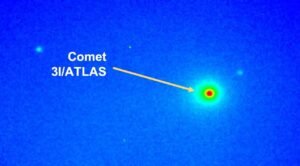
Imaging Observations: A Near-Circular Coma
Using PRL’s 1.2m wide-area imaging telescope, scientists captured high-resolution images of the comet in false-color representation. The images revealed a near-circular coma, the glowing cloud of gas and dust surrounding the comet’s nucleus.
What is a Coma?
A comet’s coma forms when:
Solar heat strikes the icy nucleus
Frozen molecules vaporize (sublimate)
Released gas and dust expand outward
A diffuse, glowing atmosphere appears
From Earth’s perspective during this observing period:
The dust tail would be pointing away from the Sun, behind the comet
Deep, wide-field images may reveal an ion tail, which glows due to solar radiation interacting with ionized gases
Two faint background stars observed in the image confirm the clarity and precision of the telescope’s capabilities.
Spectroscopic Study: Identifying the Comet’s Chemical Signature
Before the morning sky brightened, PRL scientists also captured the spectrum of 3I/ATLAS using the LISA spectrograph. Spectroscopy allows astronomers to break down light into constituent wavelengths to identify chemicals present in the coma.
Key Emission Bands Detected
The spectrum revealed:
CN (cyanogen)
C₂ (diatomic carbon)
C₃ (triatomic carbon)
These are hallmark features of typical Solar System comets, showing that despite its interstellar origin, 3I/ATLAS displays familiar chemical signatures.
This discovery suggests that the chemical building blocks found around other stars may not be very different from those in our own Solar System.
Comet Activity: Production Rate Analysis
Scientists measured the comet’s gas production rates, which indicate how actively the nucleus is releasing material into the coma.
For 3I/ATLAS:
Production rates for major molecules were estimated at about 10²⁵ molecules per second
These values place the comet in the category of “typical comets” when compared to native Solar System comets
This is a fascinating result because interstellar objects could differ significantly—but 3I/ATLAS appears chemically familiar.
Why Is This Discovery Important?
1. Understanding Interstellar Chemistry
Observing CN, C₂, and C₃ bands confirms that key volatile compounds exist around stars other than the Sun.
2. Rare Opportunity for Ground-Based Research
Interstellar objects pass through the Solar System only once in human timescales. Capturing them requires rapid coordination and precise instrumentation.
3. Boost to India’s Astronomical Research
The PRL Mount Abu Telescope continues to establish itself as a powerful facility for:
Exoplanet studies
High-energy astrophysics
Solar system observations
This successful observation further strengthens India’s presence in global astronomical research.
About the PRL 1.2m Mount Abu Telescope
Located at 1680 meters altitude near Gurushikhar, this telescope is:
Equipped with wide-field imagers
Supported by advanced spectroscopic instruments
Designed for cutting-edge astronomical studies
Its location and atmospheric clarity make it ideal for observing faint cosmic objects—such as distant comets and interstellar bodies.
What’s Next?
The PRL team plans to continue observing 3I/ATLAS as it moves into the darker regions of the night sky. Further imaging and spectroscopic data will help refine:
Gas release rates
Chemical composition
Dust properties
Cometary evolution as it exits the Solar System
The ongoing research will enhance our scientific understanding of how interstellar comets compare with those native to our system.
Conclusion
The successful observation of Interstellar Comet 3I/ATLAS using the PRL 1.2m Mount Abu Telescope marks a significant achievement for Indian astronomy. With detailed imaging, precise spectral measurements, and computed production rates, scientists have uncovered valuable information about this rare celestial visitor.
As 3I/ATLAS continues its journey back into interstellar space, the data collected will remain a scientific treasure—offering new clues about the origins, chemistry, and behavior of bodies formed around other stars.
Such a wonderful platform to enhance knowledge and interest in astrology and solar system.
These amazing facts are hard to find everywhere.
Really liked it…👍👍👍