
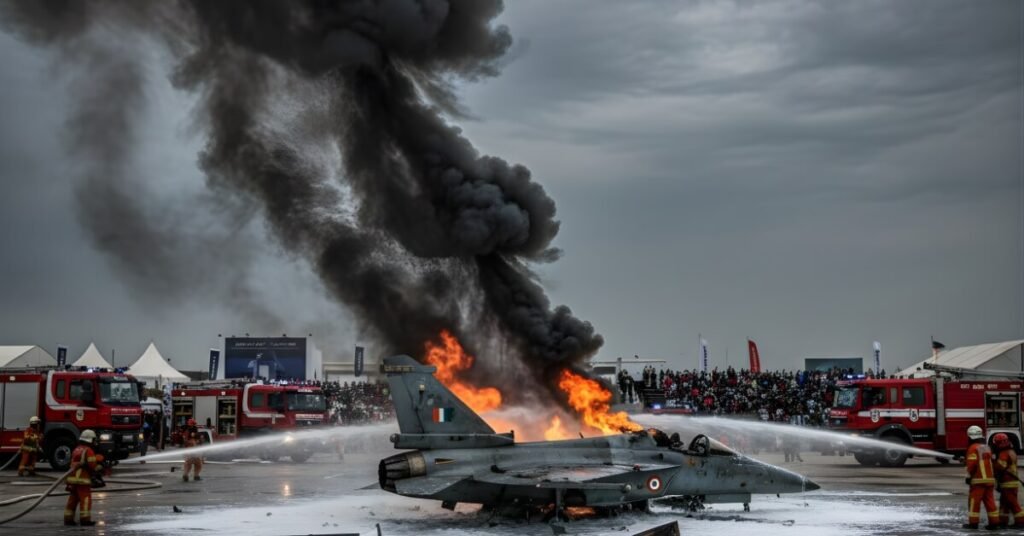
The global aviation community was left stunned when an Indian HAL Tejas fighter jet crashed during a live aerobatic display at the Dubai Air Show on November 21, 2025. The aircraft went down in a ball of fire, and tragically, the pilot lost his life, marking one of the most devastating moments in the event’s history.
What Happened at the Air Show
The crash took place around 2:10 PM local time at Al Maktoum International Airport, where thousands of spectators had gathered.
Witnesses captured chilling visuals of the Tejas suddenly losing altitude mid-maneuver, spiraling downward, and exploding upon impact. Thick black smoke quickly engulfed the crash site, causing panic among attendees.
The Indian Air Force (IAF) later confirmed that the pilot sustained fatal injuries. A Court of Inquiry has been ordered to determine the exact cause of the accident.
Understanding the Tejas Fighter Jet
The Tejas jet involved in the crash holds immense importance for India’s defense modernization efforts.
Key highlights:
- Tejas is India’s indigenous Light Combat Aircraft (LCA) developed by HAL and the Aeronautical Development Agency (ADA).
- It is a single-engine, multi-role fighter capable of air defense, ground attack, and precision strikes.
- Its delta-wing design, advanced avionics, and lightweight composite structure make it a technologically advanced platform.
- The IAF currently uses the Tejas Mk-1, while the Mk-1A variant—equipped with AESA radar, improved electronic warfare systems, and enhanced survivability—is under production.
- While primarily indigenous, Tejas uses a foreign-manufactured engine, adding layers of operational complexity.
What Might Have Gone Wrong?
While investigation results are awaited, several possibilities are being explored:
- Aerobatic Maneuver Risk
High-intensity maneuvers at low altitude leave little room for error. A sudden aerodynamic stall or loss of control could have triggered the crash.
- Negative-G Turn Miscalculation
Eyewitnesses reported a failed recovery from a negative-G maneuver, which can put extreme stress on the aircraft’s control systems.
- Lack of Ejection Evidence
Video footage does not show any clear sign of the pilot ejecting before impact, raising concerns about a possible system malfunction or limited reaction time.
- Technical or Mechanical Failure
As with any high-performance jet, technical issues such as engine failure, flight control malfunction, or structural stress cannot be ruled out.
Implications for India and the Tejas Program
This tragic event carries significant repercussions:
- Impact on Global Perception: The crash may affect Tejas’s export potential, especially as several countries are evaluating it for procurement.
- Safety & Reliability Concerns: The IAF may conduct internal reviews to re-evaluate safety protocols for the aircraft.
- Scrutiny on HAL & ADA: India’s aerospace manufacturing processes may come under deeper assessment.
- Procurement Impact: Pending domestic and international orders may be impacted until the inquiry findings are released.
What Happens Next?
The next steps are crucial for the future of the Tejas program:
- A detailed Court of Inquiry will reconstruct the event and analyze flight data.
- Engineering evaluations will inspect engine systems, avionics, airframe integrity, and flight control algorithms.
- Demonstration flights at international shows may be temporarily paused.
- The IAF and HAL are expected to provide a transparent public report to maintain global confidence.
- Export discussions with several nations may be put on hold until the investigation concludes.
Conclusion
The Tejas crash at the Dubai Air Show is a heartbreaking incident that underscores the extreme risks associated with high-performance flying. While the loss of a brave pilot is irreparable, the investigation ahead will be vital for ensuring safety, strengthening the Tejas program, and preserving India’s growing stature in global aviation.