
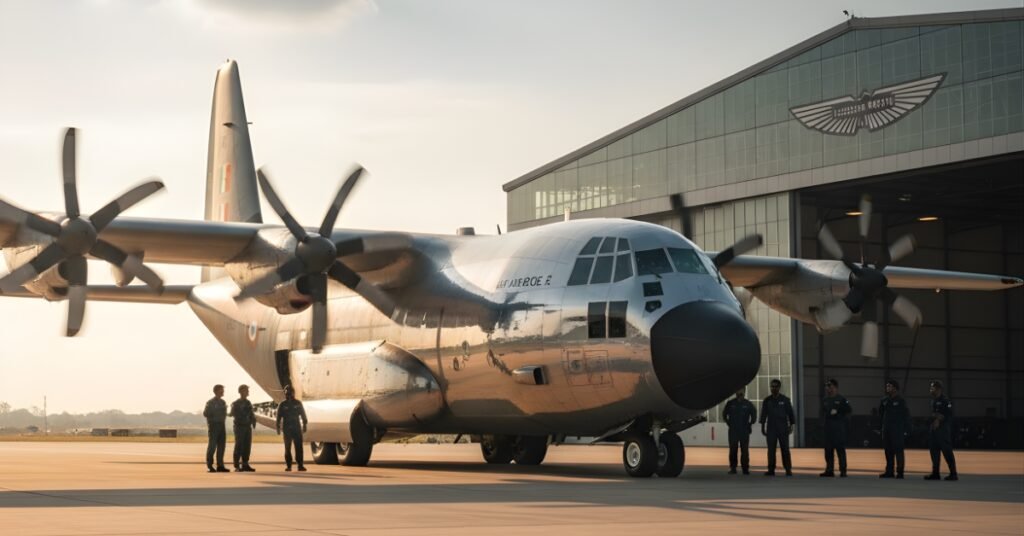
In a significant move that could redefine India’s transport aviation capabilities, Lockheed Martin is preparing to position its globally acclaimed C-130J Super Hercules as the leading contender in the Indian Air Force’s upcoming Medium Transport Aircraft (MTA) tender. With the IAF planning to procure up to 80 aircraft, this deal is expected to be one of the largest defence aviation contracts in India’s history.
As India seeks to modernize its fleet and replace ageing platforms like the An-32, Lockheed Martin’s C-130J stands out due to its proven performance, operational reliability, and strong industrial partnerships in India.
Why India is Launching the MTA Program
The IAF’s MTA initiative aims to acquire aircraft in the 18–30-ton payload class, capable of operating across diverse terrains — from high-altitude Himalayan bases to remote island airfields.
Key reasons driving this tender include:
- Replacement of ageing aircraft with limited efficiency and increasing maintenance costs.
- Strengthening India’s airlift and logistics capabilities for both defence and humanitarian missions.
- Enhancing domestic defence manufacturing under the ‘Make in India’ initiative.
- Expanding strategic autonomy through technology transfer and local production.
With the proposal gaining momentum, the Ministry of Defence is expected to issue an official Request for Proposal (RFP) soon, marking a pivotal step in India’s military modernization journey.
Why the C-130J Stands Out
Lockheed Martin’s C-130J Super Hercules brings a blend of proven design, adaptability, and cost efficiency that perfectly aligns with India’s requirements. Here’s what sets it apart:
- Operational Track Record – The C-130J has logged millions of flight hours worldwide across 20+ nations, earning a reputation for unmatched reliability in tactical and strategic airlift missions.
- Existing Footprint in India – The IAF already operates a fleet of C-130J-30 aircraft, which simplifies logistics, training, and maintenance. This existing familiarity offers a major advantage in operational readiness.
- Local Industrial Collaboration – Lockheed Martin’s partnership with Tata Advanced Systems Limited (TASL) provides a strong foundation for manufacturing, maintenance, and assembly in India, supporting domestic aerospace growth.
- Rugged and Versatile – The C-130J can take off and land from short, unpaved runways, carry heavy loads, and operate efficiently in extreme weather and altitude conditions — ideal for India’s diverse geography.
- Cost-Effective Lifecycle – Thanks to its maturity, established logistics chain, and global support network, the C-130J offers lower lifecycle and operational costs compared to newer aircraft.
The Competitive Landscape
While the C-130J is a strong contender, it faces stiff competition from aircraft like the Embraer KC-390 and Airbus A400M. Each offers unique capabilities in terms of payload and range, but the final decision will depend on a combination of factors such as:
- Cost and Value Proposition – Balancing acquisition cost with lifecycle efficiency.
- Make-in-India Commitment – Extent of local production, technology transfer, and job creation.
- Payload and Range Balance – Matching operational needs with affordability.
- Production Readiness – Ability to deliver aircraft quickly and ensure sustained maintenance support.
- Strategic Partnerships – Long-term geopolitical and industrial relationships with India.
Lockheed’s long-standing collaboration with Indian industry and government agencies gives it a distinct strategic and logistical advantage.
What This Means for the IAF and Indian Industry
Winning the MTA tender could significantly boost India’s defence aviation ecosystem. The C-130J’s inclusion would:
- Modernize India’s medium-lift fleet with advanced technology.
- Strengthen India’s rapid response and air mobility capabilities.
- Generate skilled employment and boost local aerospace manufacturing.
- Foster long-term self-reliance through technology integration and supply chain development.
For the IAF, it would mean a more reliable, efficient, and capable transport backbone to support missions ranging from troop deployment to humanitarian relief.
The Road Ahead
The coming months will be crucial as India moves toward issuing formal tenders, evaluating technical proposals, and negotiating production terms. The process will focus heavily on cost, capability, and domestic participation.
If Lockheed Martin secures the contract, the C-130J Super Hercules could soon become the centerpiece of India’s medium transport fleet — potentially assembled or serviced within India itself.
This would mark not only a milestone for Lockheed Martin but also a major leap for India’s defence aviation sector, signaling progress toward strategic autonomy and indigenous aerospace growth.
Final Take
Lockheed Martin’s C-130J has all the elements of a frontrunner — proven performance, existing infrastructure, and strong Make-in-India credentials. However, the final decision will hinge on competitive pricing, industrial benefits, and India’s long-term strategic calculus.
Whichever platform is chosen, the MTA tender represents a defining moment for the Indian Air Force — shaping its transport fleet for decades and reinforcing India’s vision of becoming a global aerospace hub.