
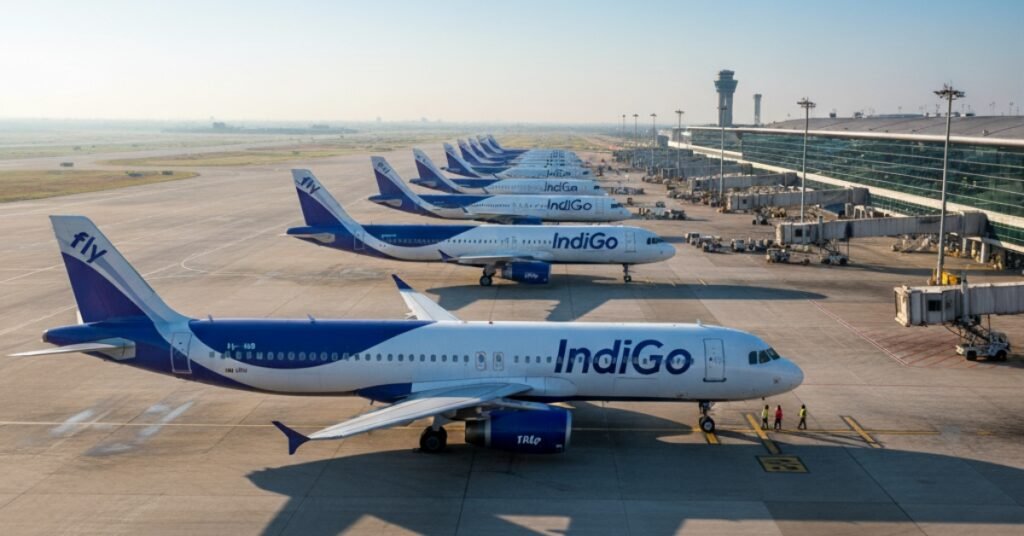
India’s domestic aviation sector is set for another expansion phase this winter, reflecting continued demand resilience and strong operational momentum. The Directorate General of Civil Aviation (DGCA) has approved a 6% year-on-year increase in total weekly domestic flights for the Winter Schedule (WS) 2025, running from October 26, 2025, to March 28, 2026.
According to the regulator, Indian airlines will collectively operate 26,495 weekly flights from 126 airports, compared with 25,007 flights last winter and 25,610 during the Summer Schedule 2025 — a clear indicator of robust market recovery and rising air travel appetite.
DGCA Data: Continued Growth in Flight Operations
The DGCA’s winter report underlines a strong rebound in domestic connectivity. The 3% sequential rise from the summer schedule suggests that airlines are confident about sustaining demand through the busy travel season.
Newly added airports such as Amravati, Hissar, Purnia, and Rupsi highlight the regulator’s focus on regional connectivity through the UDAN scheme, while operations from some smaller airports have been temporarily suspended due to operational feasibility.
IndiGo: The Undisputed Market Leader
The biggest gainer in the new schedule is IndiGo, India’s largest carrier by fleet and passenger volume. The airline will operate 15,014 weekly domestic flights, marking a 10% increase year-on-year and a 6% rise from the summer schedule.
According to Jefferies India’s latest equity research, IndiGo’s sustained fleet expansion, efficient route planning, and disciplined cost structure make it the best-positioned airline to benefit from India’s structural air travel growth.
“InterGlobe Aviation continues to demonstrate strong execution amid industry-wide supply chain disruptions,” Jefferies noted, reaffirming a Buy rating with a target price of ₹6,925, valuing the stock at 11x June 2027 EV/EBITDA.
IndiGo’s market share in total weekly departures has now climbed to 57%, up from 55% a year ago, reinforcing its near-monopoly presence in the domestic segment. Passenger load factors have remained healthy at 84–86%, underscoring sustained demand despite growing capacity.
Air India Group: Capacity Challenges Persist
While IndiGo’s dominance continues, the Air India Group remains constrained by operational and supply-side limitations. The group’s combined domestic departures have fallen to 7,448 weekly flights, down 2% year-on-year and 3% versus the summer schedule.
The Air India–Vistara network will operate 4,277 weekly flights, a steep 11% decline from the previous year. Analysts attribute this to the ongoing merger integration, aircraft lease transitions, and maintenance cycles, which have limited the airline’s ability to deploy capacity effectively.
Meanwhile, Air India Express has shown positive movement with a 12% rise in departures to 3,171 flights, reflecting the induction of new Boeing 737 MAX aircraft. However, on a consolidated basis, the Tata Group’s domestic market share slipped to 28%, compared with 30% last winter.
Jefferies cautioned that recovery for Air India will remain gradual until new aircraft from its 2023 mega order begin arriving. “The flat schedule mirrors continued supply pressures at Air India,” the report observed.
Smaller Players: SpiceJet and Akasa Show Diverging Paths
Among the smaller carriers, the winter schedule shows a diverging growth pattern.
- SpiceJet recorded a 21% year-on-year increase in weekly departures to 1,568, its first positive growth in six schedules. This rise reflects the airline’s efforts to restore grounded aircraft and rebuild capacity.
- Akasa Air, on the other hand, will operate 1,027 weekly flights, up 4% YoY but 6% below summer levels, signaling a strategic shift from rapid expansion to yield optimization.
Jefferies noted that the widening gap between the two marks the first reversal of the trend since Akasa’s market entry, hinting at a reshaping competitive landscape among smaller airlines.
Strong Demand Momentum and Market Outlook
Analysts at Jefferies emphasize that India’s domestic demand remains robust, fueled by rising disposable incomes, a revival in business travel, and surging leisure tourism. The brokerage expects IndiGo’s operational momentum to continue into FY26 and FY27, supported by its expanding fleet and efficient turnaround times.
Even as aviation turbine fuel (ATF) prices and rupee depreciation pose cost risks, IndiGo’s strong balance sheet and liquidity position give it a significant edge. Jefferies projects EBITDA margins near 25% and consistent profit growth through FY27.
New Airports and Regional Connectivity Push
The inclusion of new airports in the Winter 2025 schedule reflects DGCA’s ongoing push toward regional inclusivity. Under the UDAN scheme, more Tier-II and Tier-III cities are getting connected to the national grid, offering new opportunities for both business and tourism sectors.
While operations have been temporarily suspended at airports like Bhavnagar, Ludhiana, and Pakyong, the net addition of airports shows India’s air network is expanding steadily toward greater accessibility.
Two-Speed Recovery in Indian Aviation
The DGCA’s data paints a clear picture of a two-speed recovery in India’s domestic aviation ecosystem. On one hand, IndiGo continues to accelerate with consistent growth, operational reliability, and profitability. On the other, Air India’s consolidation phase and supply constraints have slowed its expansion temporarily.
Industry analysts expect this divergence to persist into 2026, with IndiGo tightening its grip on the domestic market, while Air India focuses on reclaiming strength in the international long-haul segment.
“The market is effectively bifurcating,” an analyst noted. “IndiGo dominates domestic skies, while Air India’s next phase will be defined by its global play.”
Conclusion
The India aviation winter schedule 2025 highlights a sector in transition — one that’s expanding in scale, yet stratified in growth momentum. As IndiGo widens its lead with unmatched execution and market presence, the Tata-led Air India Group is focusing on long-term structural integration.
Despite headwinds from fuel costs and currency pressures, India’s aviation story remains one of resilience and opportunity — a reflection of a nation on the move, with its skies busier than ever before.